Bill would require immediate reporting of serious incidents at private detention centers
January 19, 2026 | Legislative Sessions, Washington
This article was created by AI summarizing key points discussed. AI makes mistakes, so for full details and context, please refer to the video of the full meeting. Please report any errors so we can fix them. Report an error »
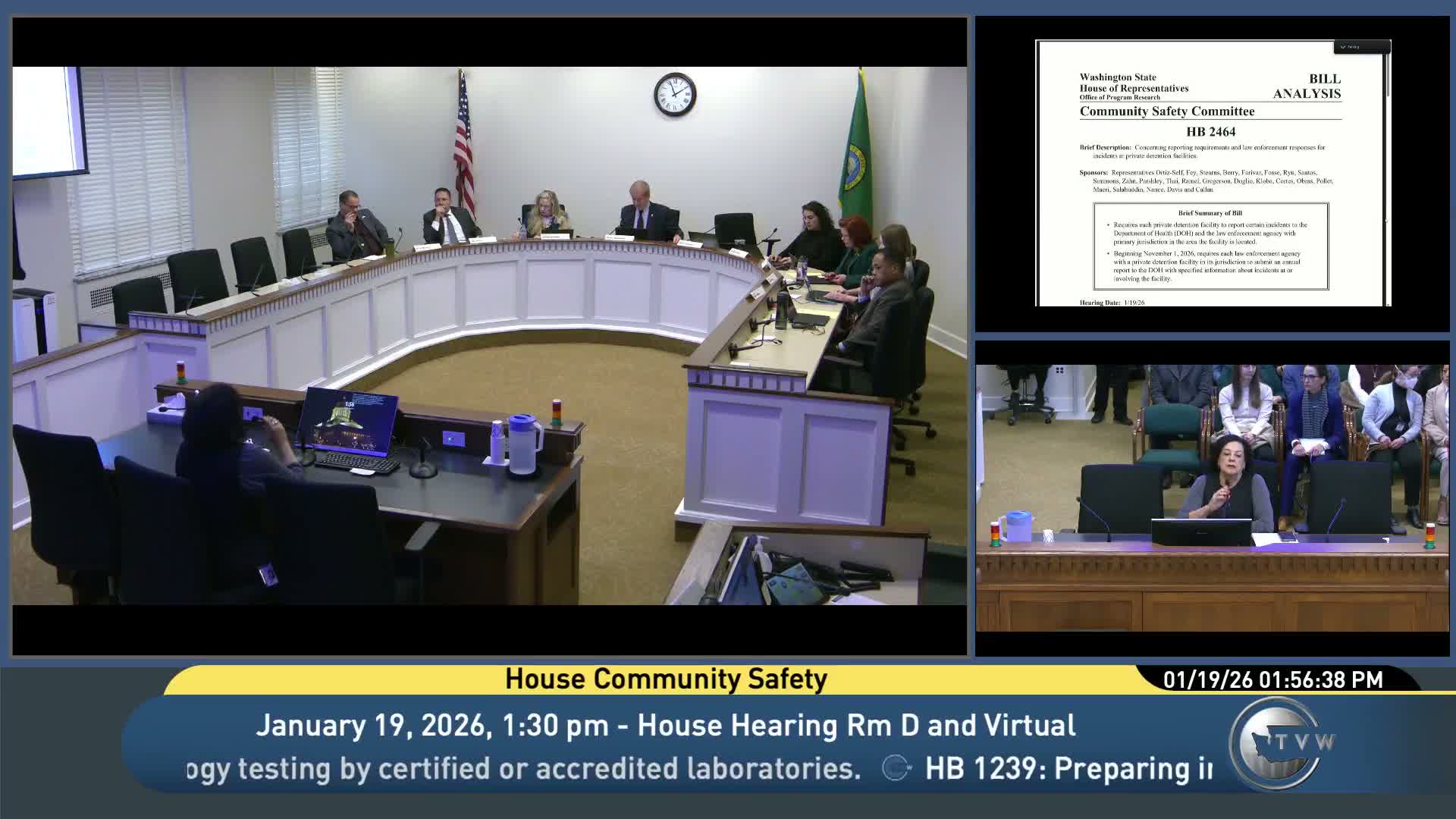
OLYMPIA, Wash. — Lawmakers heard testimony Jan. 19 on House Bill 24-64, which would require private detention facilities with contracts effective on or after Jan. 1, 2023 (or modified after that date) to report serious incidents — including allegations of abuse, suicide, inpatient-level injuries, deaths and major service disruptions — to the state Department of Health and the local law enforcement agency within one business day.
Supporters framed the measure as a transparency fix for two facilities that fall under the bill’s definition. Representative Lillian Ortiz Self, the bill sponsor, told the House Committee on Community Safety that advocacy groups, researchers and family members have reported abuse, hunger strikes and suicides at the Northwest ICE Processing Center in Tacoma and another facility in Eastern Washington and that public reporting of incidents would provide clarity about conditions and responses.
“This isn’t anything new,” Ortiz Self said. “We ask that, just because you’re a private company, you do not hide information if people are being hurt.”
Advocates and researchers described specific concerns in testimony. Rufina Reyes of La Resistencia said the GEO Group-run facility in Tacoma had two deaths in 2024, repeated ambulance calls and hunger strikes; Angelina Godoy of the University of Washington Center for Human Rights said federal records are kept internally but are not publicly accessible and that litigation has been necessary to obtain some reports. A written statement read for a detained person, Kevin Munoz, said staff-to-detainee assaults were not promptly reported and asked the committee to require law enforcement be notified within 24 hours.
Columbia Legal Services and the League of Women Voters supported the bill, arguing that Department of Health inspections and law-enforcement reports are needed to ensure accurate public oversight. Roland Thompson, representing multiple media associations, said reporters have been stonewalled when attempting to obtain records and that consolidated reporting would help the public understand conditions inside privately operated detention facilities.
Law enforcement associations offered qualified support but urged engagement on implementation. James McMahon, policy director for the Association of Sheriffs and Police Chiefs, said the bill affects just two Washington law enforcement agencies and urged the committee to consult those agencies on whether the proposed reporting procedures are reasonable. McMahon also cautioned that the legislature has added many reporting requirements in recent years and asked lawmakers to consider the cumulative burden.
Committee members pressed staff and advocates on scope and jurisdiction. Staff told the committee the bill requires law enforcement to include the number of calls related to incidents at or involving a facility in its annual report to DOH beginning Nov. 1, 2026, but does not itself mandate law enforcement to take a particular enforcement action in response to a call. Sponsors said incidents occurring during transportation while a person is in custody could fall under the reporting requirement if they involve the facility.
Several members asked whether records already exist at the federal level; researchers and advocates answered that records are often maintained internally by federal agencies but are not readily accessible to the public and in some cases are years old. The sponsor and witnesses said state reporting would improve public visibility and oversight.
The committee closed public testimony on the bill with no vote taken. The hearing record includes requests from members and law enforcement groups for the committee staff to work through implementation details, including whether annual reports and one‑day reporting timelines are operationally feasible for the affected jurisdictions.
What happens next: The committee held the hearing open for further consideration and possible amendment; no formal action was recorded during the Jan. 19 session.
Supporters framed the measure as a transparency fix for two facilities that fall under the bill’s definition. Representative Lillian Ortiz Self, the bill sponsor, told the House Committee on Community Safety that advocacy groups, researchers and family members have reported abuse, hunger strikes and suicides at the Northwest ICE Processing Center in Tacoma and another facility in Eastern Washington and that public reporting of incidents would provide clarity about conditions and responses.
“This isn’t anything new,” Ortiz Self said. “We ask that, just because you’re a private company, you do not hide information if people are being hurt.”
Advocates and researchers described specific concerns in testimony. Rufina Reyes of La Resistencia said the GEO Group-run facility in Tacoma had two deaths in 2024, repeated ambulance calls and hunger strikes; Angelina Godoy of the University of Washington Center for Human Rights said federal records are kept internally but are not publicly accessible and that litigation has been necessary to obtain some reports. A written statement read for a detained person, Kevin Munoz, said staff-to-detainee assaults were not promptly reported and asked the committee to require law enforcement be notified within 24 hours.
Columbia Legal Services and the League of Women Voters supported the bill, arguing that Department of Health inspections and law-enforcement reports are needed to ensure accurate public oversight. Roland Thompson, representing multiple media associations, said reporters have been stonewalled when attempting to obtain records and that consolidated reporting would help the public understand conditions inside privately operated detention facilities.
Law enforcement associations offered qualified support but urged engagement on implementation. James McMahon, policy director for the Association of Sheriffs and Police Chiefs, said the bill affects just two Washington law enforcement agencies and urged the committee to consult those agencies on whether the proposed reporting procedures are reasonable. McMahon also cautioned that the legislature has added many reporting requirements in recent years and asked lawmakers to consider the cumulative burden.
Committee members pressed staff and advocates on scope and jurisdiction. Staff told the committee the bill requires law enforcement to include the number of calls related to incidents at or involving a facility in its annual report to DOH beginning Nov. 1, 2026, but does not itself mandate law enforcement to take a particular enforcement action in response to a call. Sponsors said incidents occurring during transportation while a person is in custody could fall under the reporting requirement if they involve the facility.
Several members asked whether records already exist at the federal level; researchers and advocates answered that records are often maintained internally by federal agencies but are not readily accessible to the public and in some cases are years old. The sponsor and witnesses said state reporting would improve public visibility and oversight.
The committee closed public testimony on the bill with no vote taken. The hearing record includes requests from members and law enforcement groups for the committee staff to work through implementation details, including whether annual reports and one‑day reporting timelines are operationally feasible for the affected jurisdictions.
What happens next: The committee held the hearing open for further consideration and possible amendment; no formal action was recorded during the Jan. 19 session.
Don't Miss a Word: See the Full Meeting!
Go beyond summaries. Unlock every video, transcript, and key insight with a Founder Membership.
✓
Get instant access to full meeting videos
✓
Search and clip any phrase from complete transcripts
✓
Receive AI-powered summaries & custom alerts
✓
Enjoy lifetime, unrestricted access to government data
30-day money-back guarantee
