Bill would let accredited private labs supplement state toxicology testing to reduce backlog
January 19, 2026 | Legislative Sessions, Washington
This article was created by AI summarizing key points discussed. AI makes mistakes, so for full details and context, please refer to the video of the full meeting. Please report any errors so we can fix them. Report an error »
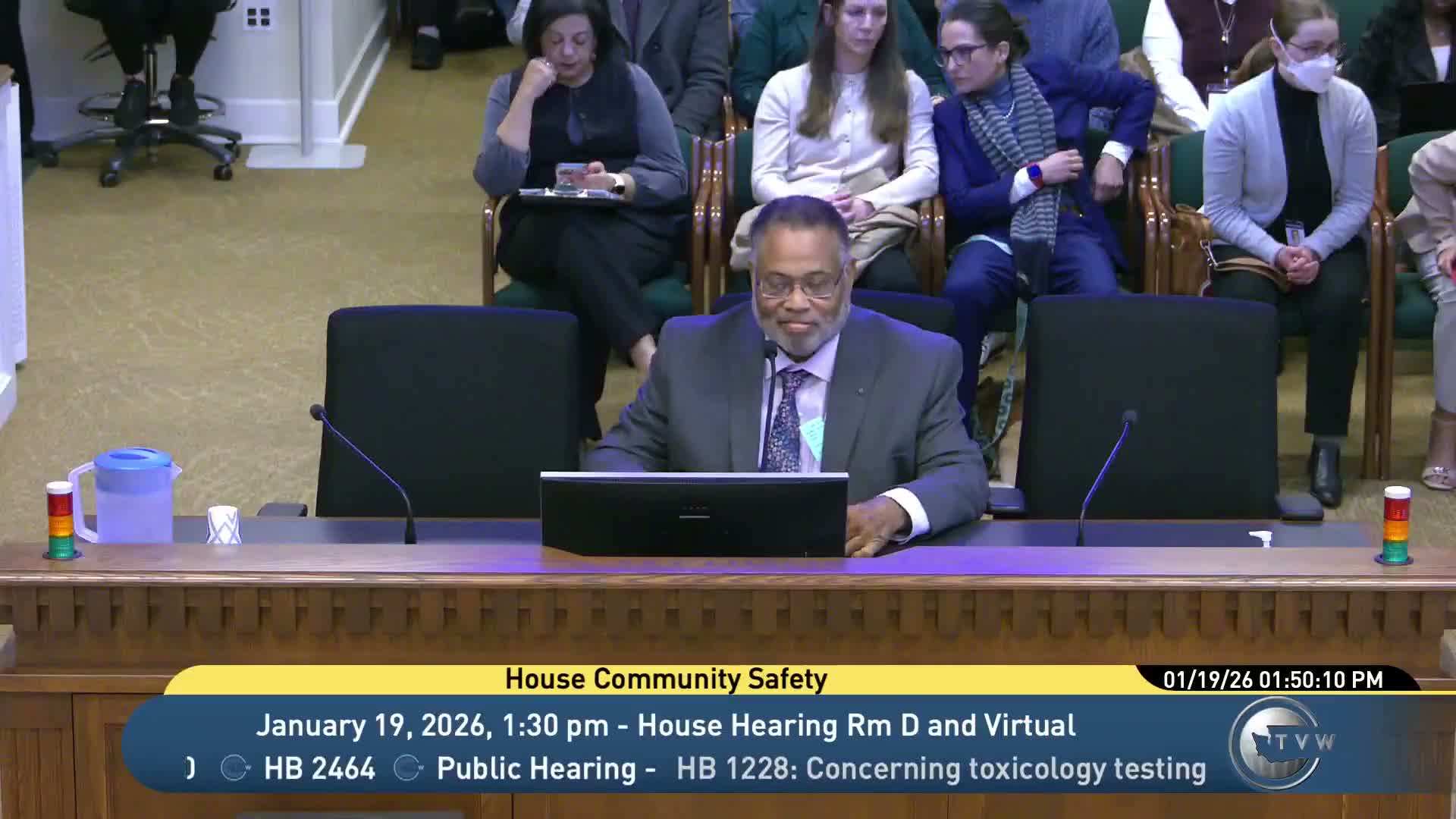
OLYMPIA, Wash. — House Bill 12-28 would establish an alternative means of validating blood and breath analyses for driving-under-the-influence and related prosecutions by recognizing testing from laboratories accredited to the ISO/IEC 17025 standard alongside the state toxicologist’s methods.
Committee staff and multiple testifiers described the problem the bill aims to address: Washington’s toxicology backlog. Representative David Hackney, the sponsor, said the state processed about 19,000 nonlethal toxicology requests last year with an average turnaround of over 300 days, compared with shorter turnaround times in other states. Seattle City Attorney Erica Evans said some cases in her office cannot be filed for nearly two years because of delayed results, allowing alleged offenders to drive without court-ordered conditions in the interim.
The bill would permit local jurisdictions to use accredited private laboratories as an option; it would not mandate private testing or require jurisdictions to pay for it. Proponents said private accreditation to ISO/IEC 17025 would ensure the same scientific standards while reducing turnaround times and speeding prosecution and accountability.
Stakeholders raised operational and equity concerns. Defense attorneys asked for contractual language to preserve defendants’ due-process discovery rights in cases where labs are part of multistate organizations and may not reliably appear for deposition or production without complex interstate subpoenas. County officials and the Association of Counties cautioned that outsourcing testing could shift costs to counties that lack budget capacity and create a two‑tier system of justice where wealthier jurisdictions obtain faster results.
Law‑enforcement and prosecutorial witnesses said reducing backlog is urgent and urged either the in-state private-lab option or increased funding for the state toxicology lab; technical witnesses described grant models and bulk-sample approaches used in other states to address backlogs.
The committee heard the variety of views and closed public testimony; members signaled they would continue to weigh options including clarifying discovery language and looking at funding paths for the state lab.
Committee staff and multiple testifiers described the problem the bill aims to address: Washington’s toxicology backlog. Representative David Hackney, the sponsor, said the state processed about 19,000 nonlethal toxicology requests last year with an average turnaround of over 300 days, compared with shorter turnaround times in other states. Seattle City Attorney Erica Evans said some cases in her office cannot be filed for nearly two years because of delayed results, allowing alleged offenders to drive without court-ordered conditions in the interim.
The bill would permit local jurisdictions to use accredited private laboratories as an option; it would not mandate private testing or require jurisdictions to pay for it. Proponents said private accreditation to ISO/IEC 17025 would ensure the same scientific standards while reducing turnaround times and speeding prosecution and accountability.
Stakeholders raised operational and equity concerns. Defense attorneys asked for contractual language to preserve defendants’ due-process discovery rights in cases where labs are part of multistate organizations and may not reliably appear for deposition or production without complex interstate subpoenas. County officials and the Association of Counties cautioned that outsourcing testing could shift costs to counties that lack budget capacity and create a two‑tier system of justice where wealthier jurisdictions obtain faster results.
Law‑enforcement and prosecutorial witnesses said reducing backlog is urgent and urged either the in-state private-lab option or increased funding for the state toxicology lab; technical witnesses described grant models and bulk-sample approaches used in other states to address backlogs.
The committee heard the variety of views and closed public testimony; members signaled they would continue to weigh options including clarifying discovery language and looking at funding paths for the state lab.
View the Full Meeting & All Its Details
This article offers just a summary. Unlock complete video, transcripts, and insights as a Founder Member.
✓
Watch full, unedited meeting videos
✓
Search every word spoken in unlimited transcripts
✓
AI summaries & real-time alerts (all government levels)
✓
Permanent access to expanding government content
30-day money-back guarantee
