Substitute reentry bill would standardize earned release and fund pilot peer‑support program
January 19, 2026 | Legislative Sessions, Washington
This article was created by AI summarizing key points discussed. AI makes mistakes, so for full details and context, please refer to the video of the full meeting. Please report any errors so we can fix them. Report an error »
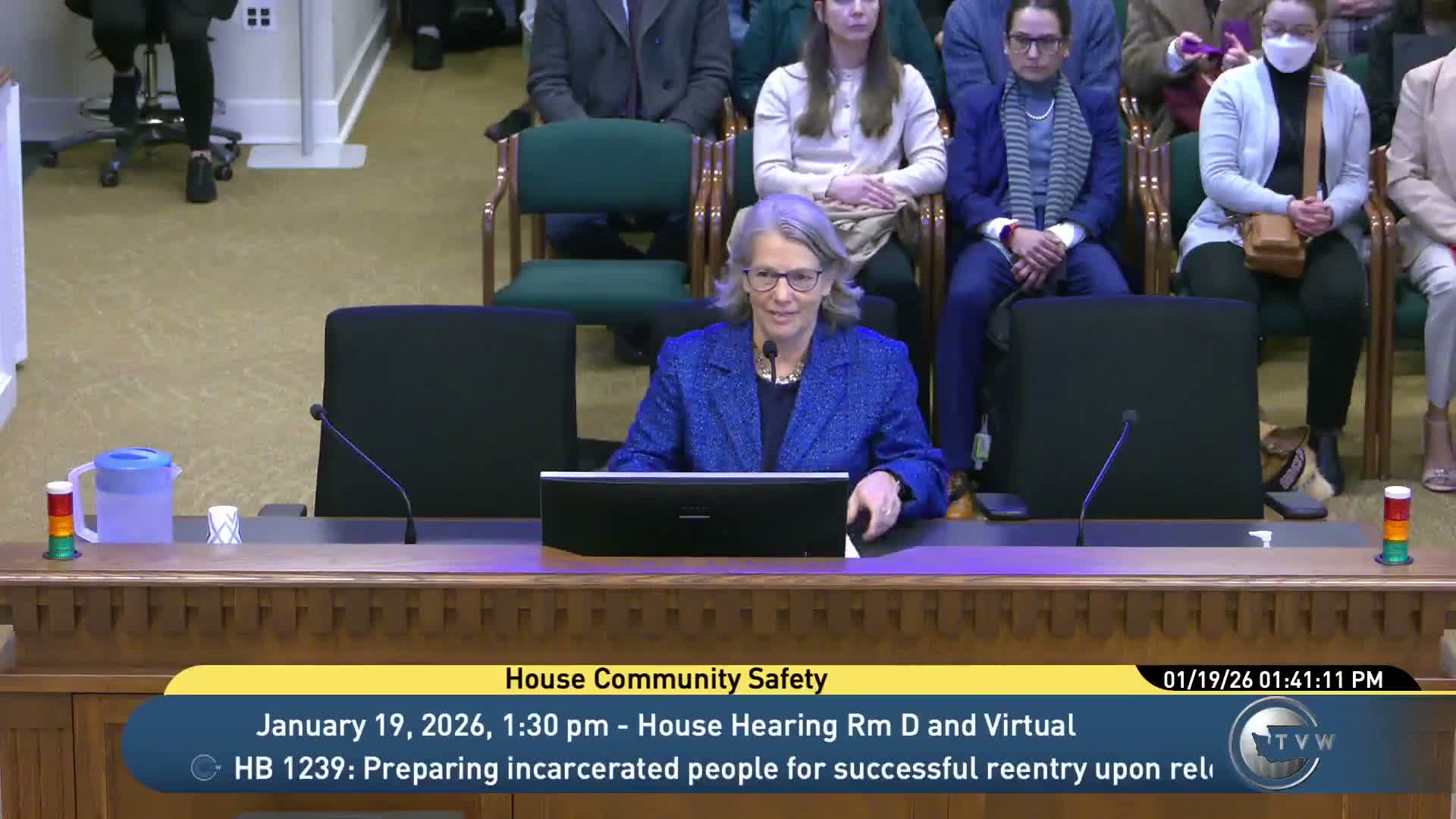
OLYMPIA, Wash. — A proposed substitute to House Bill 12-39 would make several changes to earned release and reentry supports for people in state custody, committee staff and witnesses told the House Committee on Community Safety on Jan. 19.
Under the substitute described by committee counsel, the earned release time rate for sentences and portions of sentences imposed for offenses committed on or after July 1, 2026, would be up to 33.33% of the total sentence. The bill would not remove already-accrued earned release time for people who qualify for higher rates before that date; staff said anyone who had qualified for up to 50% prior to July 1, 2026, would not lose credits previously accrued.
The bill would also direct the Department of Corrections to establish a two‑year pilot delivered by peer-support specialists at the Washington Corrections Center for Women to support incarcerated survivors of gender-based and intimate-partner violence. The Washington Statewide Reentry Council would be required to submit preliminary and final reports on the pilot. Finally, the Office of Crime Victims Advocacy would be tasked with informing victims and survivors of how sentencing and release dates could change under statutory updates.
Supporters — including the Washington Statewide Reentry Council, formerly incarcerated advocates and evidence‑based organizations — said restoring or standardizing earned-time opportunities would incentivize participation in programming, improve reentry outcomes and reduce recidivism. Candace Baumann, a member of the Reentry Council and formerly incarcerated, said the measure focuses on “preparation, not shortcuts.” Esther Matthews and other researchers cited studies that link programming and education to reduced reoffending.
Opponents, including the Washington Association of Prosecuting Attorneys, the Association of Sheriffs and Police Chiefs and some victim-advocate witnesses, raised concerns that a one-third reduction in sentence time could dilute accountability for serious crimes and that the fiscal note might understate future costs tied to supervision and services. Defense and reentry proponents emphasized that earned release is not automatic and that credits are forfeited for misconduct.
The committee concluded a long hearing with mixed testimony and no vote recorded; members requested clarifying language on victim notification, retroactivity and program capacity.
Under the substitute described by committee counsel, the earned release time rate for sentences and portions of sentences imposed for offenses committed on or after July 1, 2026, would be up to 33.33% of the total sentence. The bill would not remove already-accrued earned release time for people who qualify for higher rates before that date; staff said anyone who had qualified for up to 50% prior to July 1, 2026, would not lose credits previously accrued.
The bill would also direct the Department of Corrections to establish a two‑year pilot delivered by peer-support specialists at the Washington Corrections Center for Women to support incarcerated survivors of gender-based and intimate-partner violence. The Washington Statewide Reentry Council would be required to submit preliminary and final reports on the pilot. Finally, the Office of Crime Victims Advocacy would be tasked with informing victims and survivors of how sentencing and release dates could change under statutory updates.
Supporters — including the Washington Statewide Reentry Council, formerly incarcerated advocates and evidence‑based organizations — said restoring or standardizing earned-time opportunities would incentivize participation in programming, improve reentry outcomes and reduce recidivism. Candace Baumann, a member of the Reentry Council and formerly incarcerated, said the measure focuses on “preparation, not shortcuts.” Esther Matthews and other researchers cited studies that link programming and education to reduced reoffending.
Opponents, including the Washington Association of Prosecuting Attorneys, the Association of Sheriffs and Police Chiefs and some victim-advocate witnesses, raised concerns that a one-third reduction in sentence time could dilute accountability for serious crimes and that the fiscal note might understate future costs tied to supervision and services. Defense and reentry proponents emphasized that earned release is not automatic and that credits are forfeited for misconduct.
The committee concluded a long hearing with mixed testimony and no vote recorded; members requested clarifying language on victim notification, retroactivity and program capacity.
View the Full Meeting & All Its Details
This article offers just a summary. Unlock complete video, transcripts, and insights as a Founder Member.
✓
Watch full, unedited meeting videos
✓
Search every word spoken in unlimited transcripts
✓
AI summaries & real-time alerts (all government levels)
✓
Permanent access to expanding government content
30-day money-back guarantee
