Committee hears bill to allow stock albuterol in schools under statewide standing order
January 19, 2026 | Legislative Sessions, Washington
This article was created by AI summarizing key points discussed. AI makes mistakes, so for full details and context, please refer to the video of the full meeting. Please report any errors so we can fix them. Report an error »
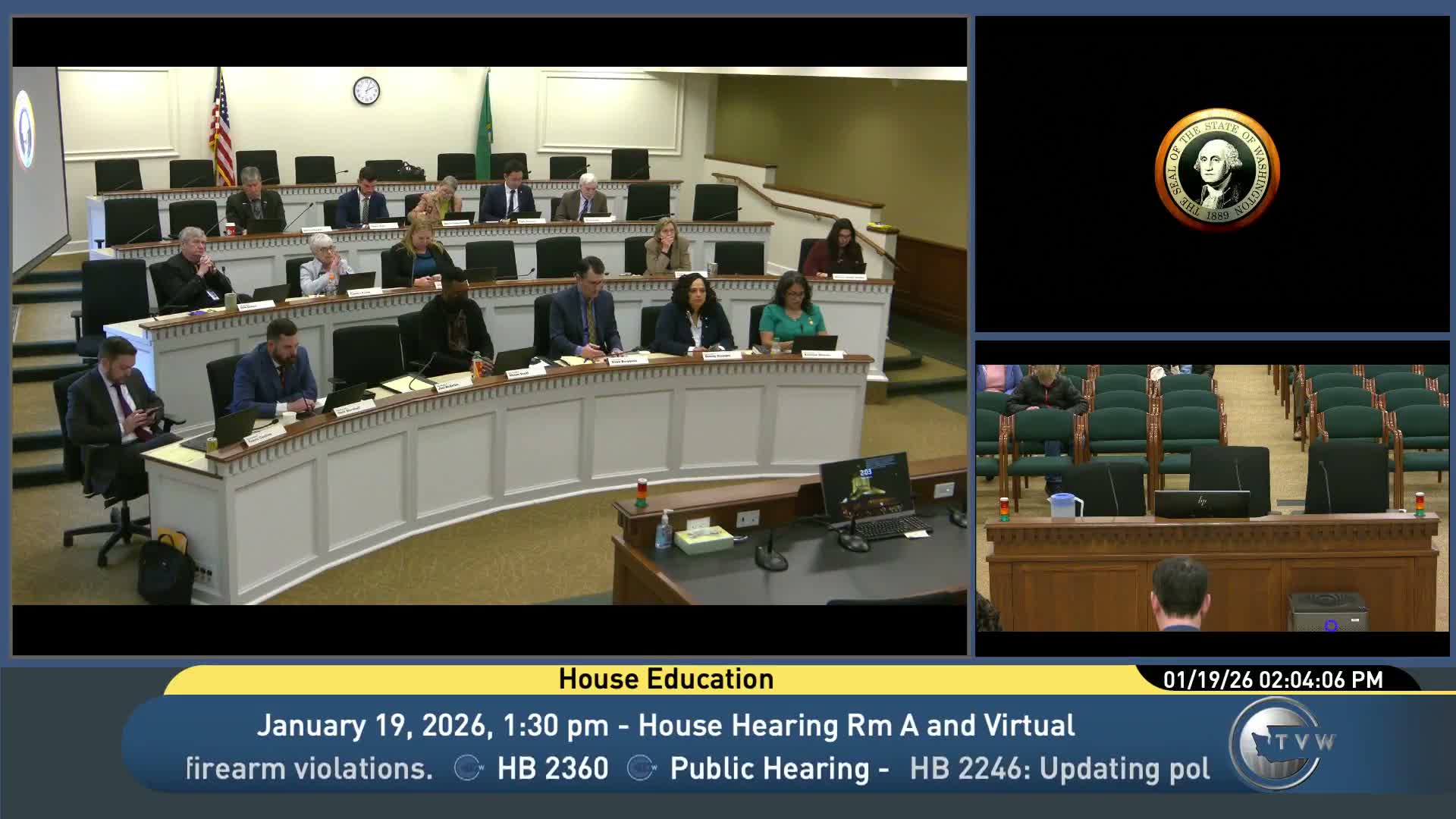
The House Education Committee opened a public hearing on House Bill 2360, which would permit public and private schools to maintain a supply of albuterol (in inhaler or nebulizer form) under a statewide standing order issued by the Department of Health. Committee counsel Megan Wargahay briefed the bill: it would allow school-supplied albuterol to be stored in a designated location on school property, transported on sanctioned excursions, and administered by a school nurse or designated trained personnel (with limitations when the student lacks an existing prescription). The bill sets a deadline (by Jan. 1, 2027) for OSPI and the Department of Health to include uniform procedures governing staff training and access.
Representative Brandy Donaghy, the prime sponsor, said the measure is analogous to prior laws authorizing stock epinephrine and argued stock albuterol can be life‑saving, especially in rural areas with longer EMS response times. ‘‘This is the same idea,’’ she said, describing the proposal as an emergency provision to preserve breathing until emergency care arrives.
Medical and nursing testimony was mixed but largely supportive of the underlying goal. Dr. Robin Ortenberg, a pediatric pulmonologist, cited national data on asthma prevalence and studies showing stock albuterol reduces emergency calls and ambulance transports; she said stock programs are common in other states and urged passage. The School Nurse Organization of Washington, represented by Erica Hallock, Wendy Jones and Lynette (on deck), urged legislative prioritization and described how nurses would assess students, use spacers, administer two puffs, and reassess for 15 minutes while contacting parents and recommending follow-up with primary care.
Several school nurses and frontline practitioners voiced reservations about moving ahead without clearer statewide protocols, definitions of ‘‘school nurse,’’ dedicated training requirements, or a fiscal note. Dr. Danielle Harvey, a school nurse with long clinical experience, said the bill ‘‘puts the cart before the horse’’ if staffing, training, and protocols are not addressed first and noted heavy caseloads (she said she covers about 3,000 students), limited full-time nurse coverage in many districts, and the absence of requirements such as pediatric advanced life support training for school nurses.
OSPI testified in support and emphasized the bill is permissive and intended to be district-adopted rather than a statewide mandate. OSPI offered to continue working with the sponsor and Department of Health to align implementation details. The committee record contains no committee action on HB 2360 during this session; sign-in tallies were read before the hearing closed.
The committee will consider submitted materials and potential amendments from agencies and stakeholders as the bill proceeds.
Representative Brandy Donaghy, the prime sponsor, said the measure is analogous to prior laws authorizing stock epinephrine and argued stock albuterol can be life‑saving, especially in rural areas with longer EMS response times. ‘‘This is the same idea,’’ she said, describing the proposal as an emergency provision to preserve breathing until emergency care arrives.
Medical and nursing testimony was mixed but largely supportive of the underlying goal. Dr. Robin Ortenberg, a pediatric pulmonologist, cited national data on asthma prevalence and studies showing stock albuterol reduces emergency calls and ambulance transports; she said stock programs are common in other states and urged passage. The School Nurse Organization of Washington, represented by Erica Hallock, Wendy Jones and Lynette (on deck), urged legislative prioritization and described how nurses would assess students, use spacers, administer two puffs, and reassess for 15 minutes while contacting parents and recommending follow-up with primary care.
Several school nurses and frontline practitioners voiced reservations about moving ahead without clearer statewide protocols, definitions of ‘‘school nurse,’’ dedicated training requirements, or a fiscal note. Dr. Danielle Harvey, a school nurse with long clinical experience, said the bill ‘‘puts the cart before the horse’’ if staffing, training, and protocols are not addressed first and noted heavy caseloads (she said she covers about 3,000 students), limited full-time nurse coverage in many districts, and the absence of requirements such as pediatric advanced life support training for school nurses.
OSPI testified in support and emphasized the bill is permissive and intended to be district-adopted rather than a statewide mandate. OSPI offered to continue working with the sponsor and Department of Health to align implementation details. The committee record contains no committee action on HB 2360 during this session; sign-in tallies were read before the hearing closed.
The committee will consider submitted materials and potential amendments from agencies and stakeholders as the bill proceeds.
Don't Miss a Word: See the Full Meeting!
Go beyond summaries. Unlock every video, transcript, and key insight with a Founder Membership.
✓
Get instant access to full meeting videos
✓
Search and clip any phrase from complete transcripts
✓
Receive AI-powered summaries & custom alerts
✓
Enjoy lifetime, unrestricted access to government data
30-day money-back guarantee
