Committee hears bill to let young adults with disabilities access HCLA employment supports at 20
January 19, 2026 | Legislative Sessions, Washington
This article was created by AI summarizing key points discussed. AI makes mistakes, so for full details and context, please refer to the video of the full meeting. Please report any errors so we can fix them. Report an error »
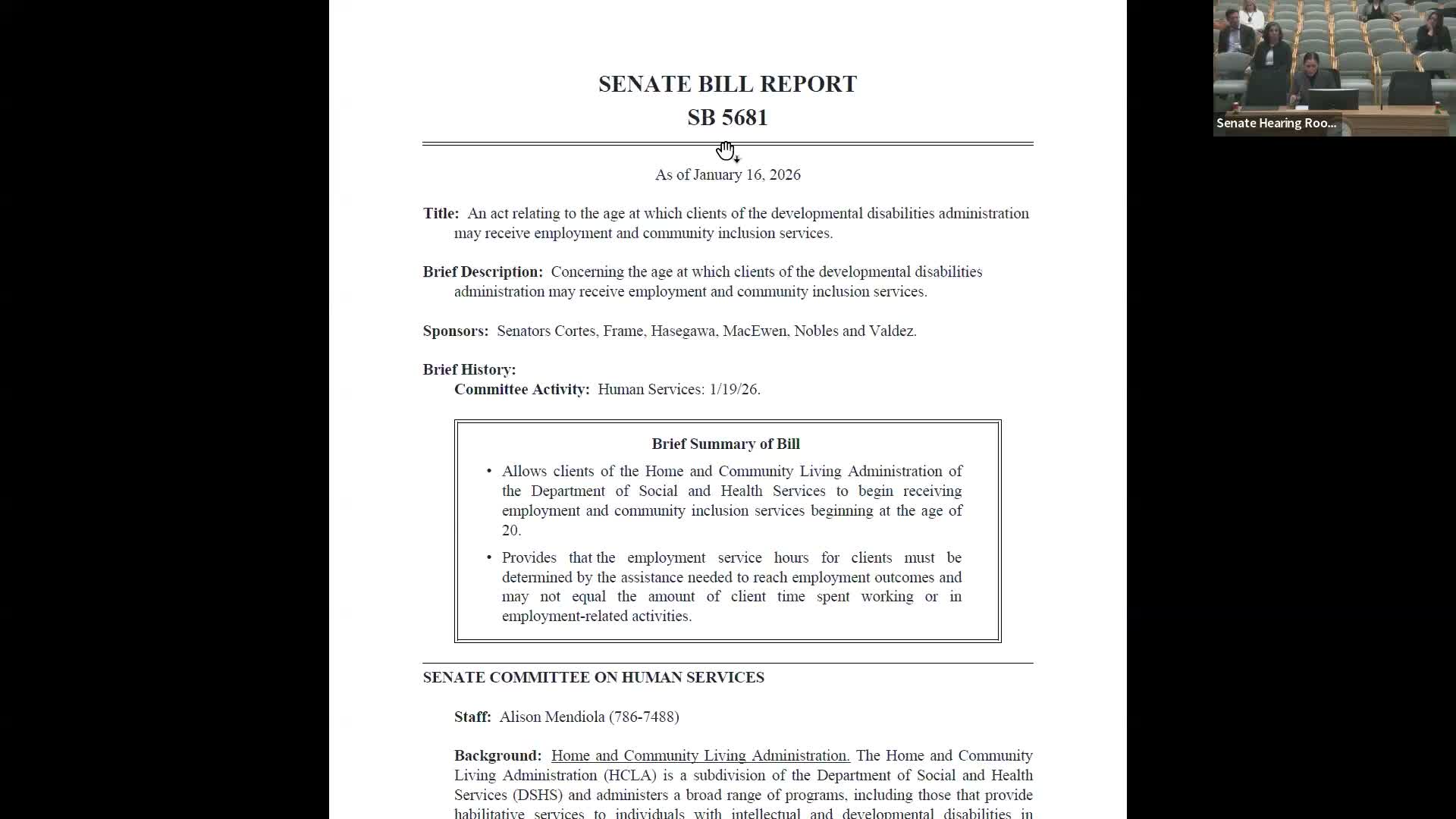
Senate Human Services Committee members heard testimony Jan. 19 on a proposed substitute to Senate Bill 5,681 that would allow clients of the Home and Community Living Administration (HCLA) to begin receiving employment and community inclusion services at age 20 instead of 21.
Allison Mendiola, committee staff, told the panel the substitute moves the eligibility threshold from 21 to 20, renames community access services to community inclusion, and clarifies that employment-service hours will be based on assistance needed to reach employment outcomes rather than time on the job. Mendiola said a fiscal note had been requested and was not yet available.
Senator Adrienne Cortez (18th Legislative District), sponsor of the underlying bill, said the change creates earlier workforce training opportunities for young adults with intellectual and developmental disabilities and helps foster independence and confidence. "This small change really expands the opportunities for young adults with disabilities," Cortez said.
Supporters from the Community Employment Alliance, school transition programs and service providers said the bill would reduce the risk that young people lose employment supports as they leave school. Darcy Huffman described a young man who lost his job when funding for a job coach ended; she said that because he was 20 and not eligible for adult services he had to leave his job. "When I had to leave my job at We Care, it was hard because I didn't know what was next," the witness quoted the young man as saying.
John Lemus of AtWork said advocates originally asked for age 19 but adjusted the proposal to 20 because of budget constraints. "This bill would allow young adults with IDD to receive access to supportive services at an age that is closer to their peers," he said, adding advocates expect longer-term fiscal benefits from increased workforce participation.
Tanya May of the Office of Superintendent of Public Instruction told the committee overlapping transition services from schools and adult providers can be coordinated to avoid duplicative supports and the post-school 'cliff' that many families report.
Committee members asked why the substitute sets eligibility at 20 rather than 18 or 19; Cortez replied many 18- and 19-year-olds remain in high school transition programming, and the 20-year threshold aligns services with common transition timing.
The hearing closed with supporters urging the committee to move the bill forward; staff noted the requested fiscal note was not yet available and would be needed for budget deliberations.
Allison Mendiola, committee staff, told the panel the substitute moves the eligibility threshold from 21 to 20, renames community access services to community inclusion, and clarifies that employment-service hours will be based on assistance needed to reach employment outcomes rather than time on the job. Mendiola said a fiscal note had been requested and was not yet available.
Senator Adrienne Cortez (18th Legislative District), sponsor of the underlying bill, said the change creates earlier workforce training opportunities for young adults with intellectual and developmental disabilities and helps foster independence and confidence. "This small change really expands the opportunities for young adults with disabilities," Cortez said.
Supporters from the Community Employment Alliance, school transition programs and service providers said the bill would reduce the risk that young people lose employment supports as they leave school. Darcy Huffman described a young man who lost his job when funding for a job coach ended; she said that because he was 20 and not eligible for adult services he had to leave his job. "When I had to leave my job at We Care, it was hard because I didn't know what was next," the witness quoted the young man as saying.
John Lemus of AtWork said advocates originally asked for age 19 but adjusted the proposal to 20 because of budget constraints. "This bill would allow young adults with IDD to receive access to supportive services at an age that is closer to their peers," he said, adding advocates expect longer-term fiscal benefits from increased workforce participation.
Tanya May of the Office of Superintendent of Public Instruction told the committee overlapping transition services from schools and adult providers can be coordinated to avoid duplicative supports and the post-school 'cliff' that many families report.
Committee members asked why the substitute sets eligibility at 20 rather than 18 or 19; Cortez replied many 18- and 19-year-olds remain in high school transition programming, and the 20-year threshold aligns services with common transition timing.
The hearing closed with supporters urging the committee to move the bill forward; staff noted the requested fiscal note was not yet available and would be needed for budget deliberations.
Don't Miss a Word: See the Full Meeting!
Go beyond summaries. Unlock every video, transcript, and key insight with a Founder Membership.
✓
Get instant access to full meeting videos
✓
Search and clip any phrase from complete transcripts
✓
Receive AI-powered summaries & custom alerts
✓
Enjoy lifetime, unrestricted access to government data
30-day money-back guarantee
