Committee Hears Bill to Restructure Climate Commitment Act Accounts, Preserve Community Targets
January 19, 2026 | Legislative Sessions, Washington
This article was created by AI summarizing key points discussed. AI makes mistakes, so for full details and context, please refer to the video of the full meeting. Please report any errors so we can fix them. Report an error »
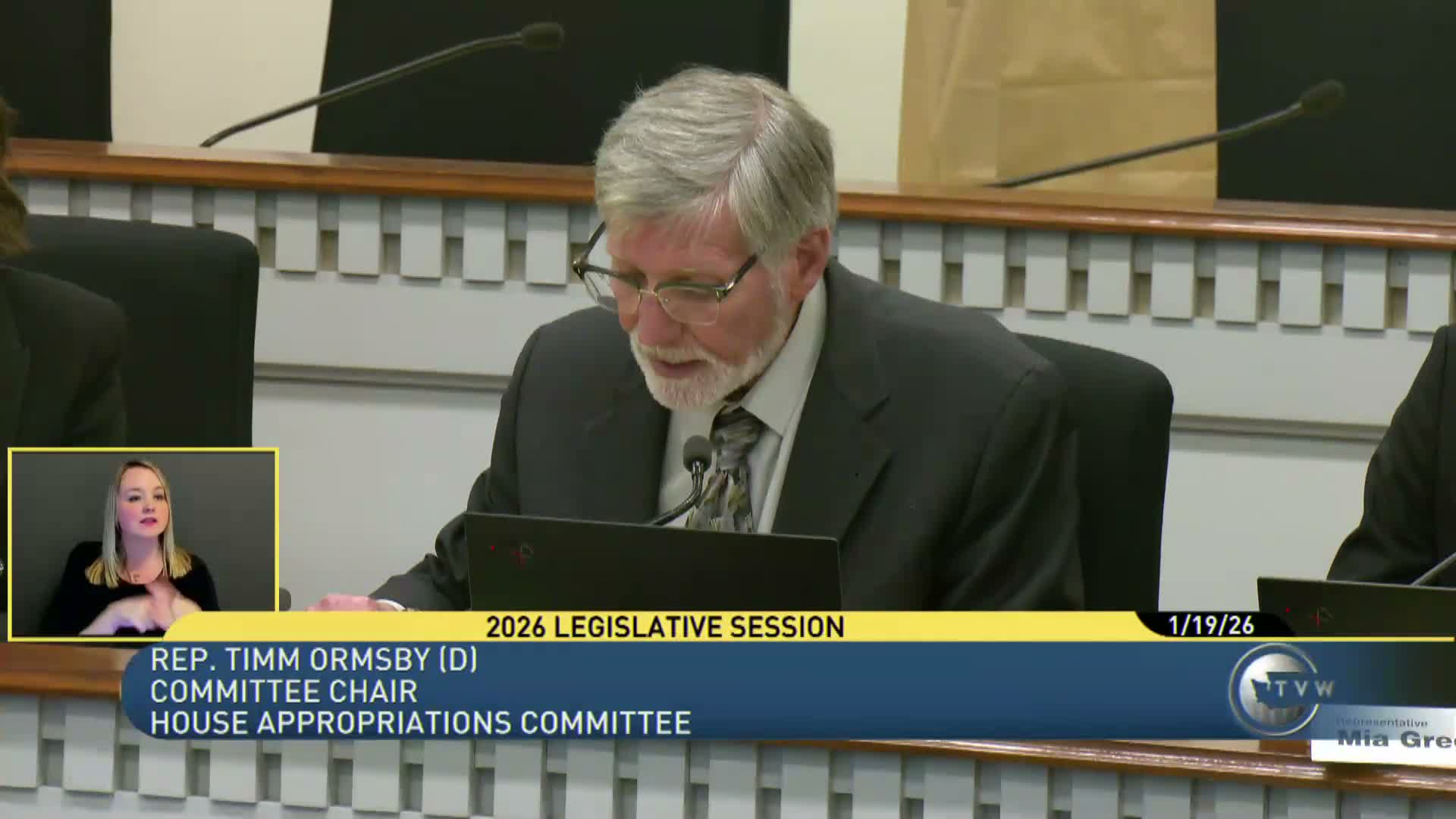
House Appropriations Committee members heard a staff briefing and public testimony on HB 22-51 on Jan. 30, a bill that would replace several Climate Commitment Act (CCA) accounts with two new accounts—CCA operating and CCA capital—and adjust how auction revenue is distributed and reported.
Dan Jones, staff to the committee for natural resource issues, told the panel that under current law Carbon Emissions Reduction Account (CIRA) receives about $359,000,000 “off the top” for transportation uses and that remaining auction revenue flows through accounts typically called the Climate Investment Account (CIA), the Natural Climate Solutions Account (NCSA) and the Climate Commitment account. HB 22-51 would repeal CIA, NCSA and the Climate Commitment account and allocate residual balances 80% to the new capital account and 20% to CIRA. Jones also summarized the bill’s two-tier distribution formulas tied to Ecology’s revenue projection thresholds: when projected revenue exceeds $513,000,000 one allocation applies; when revenue is below that threshold, a different split is used.
The bill retains two CCA spending goals set in current law: a minimum 35% (goal 40%) of spending to benefit overburdened communities and 10% for activities formally supported by a tribe. HB 22-51 would broaden the definition of what counts toward the 10% tribal-supported goal (allowing letters of support or funding provided to tribes to qualify), add electric vehicles and commute-reducing housing to allowable uses in both accounts, remove payments to agricultural fuel purchasers as an allowed use, and cap Ecology’s administrative cost reimbursement at $25,000,000 per year adjusted by the fiscal growth factor.
Stakeholders were split but largely supportive of the restructuring concept. Isaac Castam of Clean and Prosperous Washington said the current account structure made a publicly available Climate Commitments Map difficult to administer and welcomed simplification to improve public understanding. Environmental groups including Washington Conservation Action and The Nature Conservancy supported the bill’s aim to clarify and preserve equity-focused targets; Darcy Nonnamaker said the proposal preserves up to 40% for overburdened communities and strengthens tribal access to funding. The Nature Conservancy’s Justin Allegro added that the bill prepares the program for forecasted revenue declines.
Conversely, critics urged caution on oversight and reporting. John Extel, a citizen, urged that spending results be released promptly and opposed changing reporting from annual to every two years. Todd Myers of the Washington Policy Center said the Department of Ecology’s recent report on CCA spending was ‘‘badly inaccurate’’ and cited an agency admission that roughly 86% of reported CO2 reductions in that report were incorrect; he warned HB 22-51 would reduce spending guidelines and eliminate evaluation requirements, making accountability weaker.
The committee took no vote during the hearing. The staff fiscal note remains in progress, and proponents and critics both emphasized the importance of resolving detailed language on allowable uses, reporting frequency and protections for transportation investments before final action. The public hearing concluded with no formal action taken.
Dan Jones, staff to the committee for natural resource issues, told the panel that under current law Carbon Emissions Reduction Account (CIRA) receives about $359,000,000 “off the top” for transportation uses and that remaining auction revenue flows through accounts typically called the Climate Investment Account (CIA), the Natural Climate Solutions Account (NCSA) and the Climate Commitment account. HB 22-51 would repeal CIA, NCSA and the Climate Commitment account and allocate residual balances 80% to the new capital account and 20% to CIRA. Jones also summarized the bill’s two-tier distribution formulas tied to Ecology’s revenue projection thresholds: when projected revenue exceeds $513,000,000 one allocation applies; when revenue is below that threshold, a different split is used.
The bill retains two CCA spending goals set in current law: a minimum 35% (goal 40%) of spending to benefit overburdened communities and 10% for activities formally supported by a tribe. HB 22-51 would broaden the definition of what counts toward the 10% tribal-supported goal (allowing letters of support or funding provided to tribes to qualify), add electric vehicles and commute-reducing housing to allowable uses in both accounts, remove payments to agricultural fuel purchasers as an allowed use, and cap Ecology’s administrative cost reimbursement at $25,000,000 per year adjusted by the fiscal growth factor.
Stakeholders were split but largely supportive of the restructuring concept. Isaac Castam of Clean and Prosperous Washington said the current account structure made a publicly available Climate Commitments Map difficult to administer and welcomed simplification to improve public understanding. Environmental groups including Washington Conservation Action and The Nature Conservancy supported the bill’s aim to clarify and preserve equity-focused targets; Darcy Nonnamaker said the proposal preserves up to 40% for overburdened communities and strengthens tribal access to funding. The Nature Conservancy’s Justin Allegro added that the bill prepares the program for forecasted revenue declines.
Conversely, critics urged caution on oversight and reporting. John Extel, a citizen, urged that spending results be released promptly and opposed changing reporting from annual to every two years. Todd Myers of the Washington Policy Center said the Department of Ecology’s recent report on CCA spending was ‘‘badly inaccurate’’ and cited an agency admission that roughly 86% of reported CO2 reductions in that report were incorrect; he warned HB 22-51 would reduce spending guidelines and eliminate evaluation requirements, making accountability weaker.
The committee took no vote during the hearing. The staff fiscal note remains in progress, and proponents and critics both emphasized the importance of resolving detailed language on allowable uses, reporting frequency and protections for transportation investments before final action. The public hearing concluded with no formal action taken.
View the Full Meeting & All Its Details
This article offers just a summary. Unlock complete video, transcripts, and insights as a Founder Member.
✓
Watch full, unedited meeting videos
✓
Search every word spoken in unlimited transcripts
✓
AI summaries & real-time alerts (all government levels)
✓
Permanent access to expanding government content
30-day money-back guarantee
