Senate committee hears bill to require WSDOT to notify utilities before fish‑barrier work, seek federal funds for relocations
January 19, 2026 | Legislative Sessions, Washington
This article was created by AI summarizing key points discussed. AI makes mistakes, so for full details and context, please refer to the video of the full meeting. Please report any errors so we can fix them. Report an error »
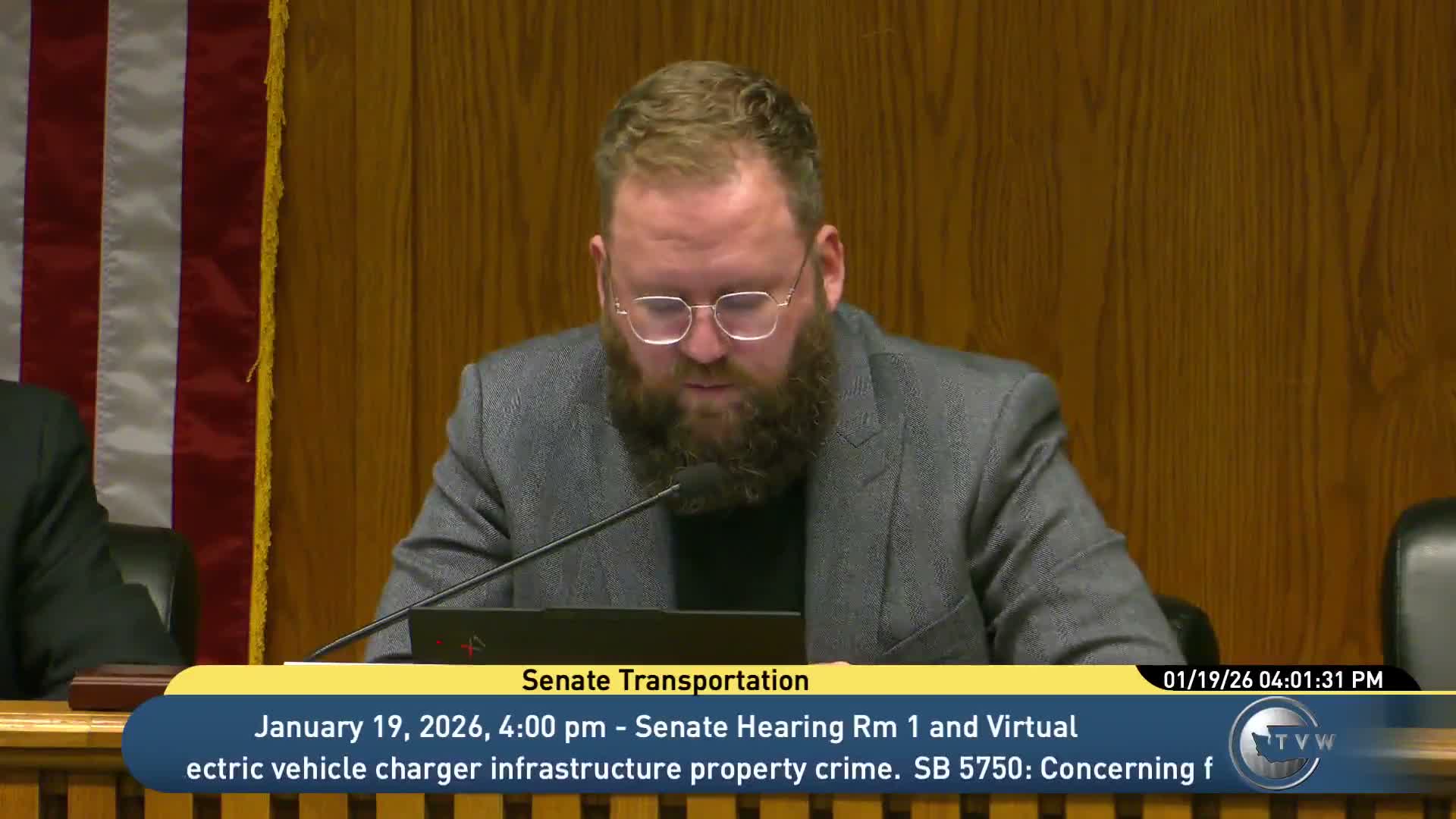
A Senate Transportation Committee public hearing on substitute Senate Bill 5690 focused on planning and funding for utility relocations tied to state fish‑barrier removal projects.
Danny Masterson, committee staff, told the committee the bill would require the Washington State Department of Transportation to notify affected utility providers of planned fish‑barrier removal projects at least one year in advance when feasible, extend the 2021 "dig once" broadband coordination to other utility types, encourage WSDOT to request any eligible federal funding to cover utility relocation costs, and report to the Legislature by Dec. 15, 2026, on federal requests and any recommended changes to state law. Masterson also summarized a fiscal note estimating ongoing costs of about $2,000,000 per biennium and one‑time reporting costs of $470,000.
Why it matters: Several testifiers told the committee that relocation costs can be substantial—sometimes running into millions of dollars for small public utilities—and that advance notice and any available federal assistance would help local providers plan and protect ratepayers.
Scott Hazelgrove, representing the Washington Association of Sewer and Water Districts, said small sewer and water districts lack taxing authority and must cover relocation costs through rates. "The bill before you takes an important first step by providing a notice provision to help districts, especially small districts, be able to plan for these costs," he said.
Greg Gajowski, state utilities manager at WSDOT, said the department supports the bill’s collaborative aims but warned the statutory changes would not by themselves create a funding source for relocations. He told senators that recent federal guidance makes relocation funding "no longer available for the foreseeable future" for many fish‑passage grants and that eligibility can depend on underlying property rights rather than departmental franchises.
Bill Clark of the Washington PUD Association said some relocation projects can exceed a small PUD’s entire annual capital budget and urged the committee to narrow language and pursue state or federal funding assistance. Ian Cope of Grays Harbor PUD testified remotely that one‑year advance notice would allow utilities to fit projects into capital budgets and help meet franchise obligations.
Committee discussion asked whether existing franchise agreements already provide notification; WSDOT staff replied that standard operating protocols exist but that expanding the bill’s reach to invite utilities that do not presently occupy right‑of‑way explains part of the projected fiscal impact.
The public hearing closed after the committee recorded 46 pro sign‑ins and 0 con sign‑ins. No formal vote was taken at the hearing.
Danny Masterson, committee staff, told the committee the bill would require the Washington State Department of Transportation to notify affected utility providers of planned fish‑barrier removal projects at least one year in advance when feasible, extend the 2021 "dig once" broadband coordination to other utility types, encourage WSDOT to request any eligible federal funding to cover utility relocation costs, and report to the Legislature by Dec. 15, 2026, on federal requests and any recommended changes to state law. Masterson also summarized a fiscal note estimating ongoing costs of about $2,000,000 per biennium and one‑time reporting costs of $470,000.
Why it matters: Several testifiers told the committee that relocation costs can be substantial—sometimes running into millions of dollars for small public utilities—and that advance notice and any available federal assistance would help local providers plan and protect ratepayers.
Scott Hazelgrove, representing the Washington Association of Sewer and Water Districts, said small sewer and water districts lack taxing authority and must cover relocation costs through rates. "The bill before you takes an important first step by providing a notice provision to help districts, especially small districts, be able to plan for these costs," he said.
Greg Gajowski, state utilities manager at WSDOT, said the department supports the bill’s collaborative aims but warned the statutory changes would not by themselves create a funding source for relocations. He told senators that recent federal guidance makes relocation funding "no longer available for the foreseeable future" for many fish‑passage grants and that eligibility can depend on underlying property rights rather than departmental franchises.
Bill Clark of the Washington PUD Association said some relocation projects can exceed a small PUD’s entire annual capital budget and urged the committee to narrow language and pursue state or federal funding assistance. Ian Cope of Grays Harbor PUD testified remotely that one‑year advance notice would allow utilities to fit projects into capital budgets and help meet franchise obligations.
Committee discussion asked whether existing franchise agreements already provide notification; WSDOT staff replied that standard operating protocols exist but that expanding the bill’s reach to invite utilities that do not presently occupy right‑of‑way explains part of the projected fiscal impact.
The public hearing closed after the committee recorded 46 pro sign‑ins and 0 con sign‑ins. No formal vote was taken at the hearing.
Don't Miss a Word: See the Full Meeting!
Go beyond summaries. Unlock every video, transcript, and key insight with a Founder Membership.
✓
Get instant access to full meeting videos
✓
Search and clip any phrase from complete transcripts
✓
Receive AI-powered summaries & custom alerts
✓
Enjoy lifetime, unrestricted access to government data
30-day money-back guarantee
