Analysts say MEMSOF is solvent through forecast horizon; MSPAC funding flexibility in BRFAA raises solvency questions
This article was created by AI summarizing key points discussed. AI makes mistakes, so for full details and context, please refer to the video of the full meeting. Please report any errors so we can fix them. Report an error »
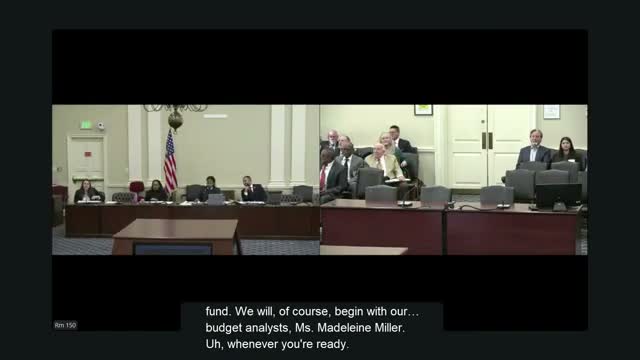
Department of Legislative Services analysts told the Appropriations subcommittee that structural fixes enacted in 2024 made Maryland’s Emergency Medical System Operations Fund (MEMSOF) solvent through the DLS forecast horizon, but legislative choices could materially affect long‑term balances.
Madeline Miller reviewed revenue sources — primarily a surcharge on motor vehicle registrations — and the FY27 allowance which allocates $112.9 million across MEMSOF recipients including the Maryland State Police Aviation Command (MSPAC), the Maryland Institute for Emergency Medical Services (MEMS), the Amos Fund (AMOS), and the Maryland Fire and Rescue Institute (MFRI). DLS showed that $5.5 million of MSPAC planned FY27 spending is contingent on BRFAA language that would permit the fund to support MSPAC’s general operations for an extended period.
Miller explained that DBM and DLS forecasts differ in assumptions but both project solvency through 2032 under current policies; if the BRFAA provision allowing MSPAC expanded access to MEMSOF dollars were rejected, DLS estimates a 2032 closing balance of about $33.7 million instead of $15.0 million under the provision. The BRFAA provision would provide roughly $16.5 million in general fund relief between FY27 and FY29 if enacted.
MSPAC described its medevac and lifesaving work and said its 2025 operations were calculated to be over 95% medically oriented; Major Michael Tagliaferi and other partners argued that allowing up to $5.5 million in MEMSOF to offset general fund expenses would reflect MSPAC’s mission and provide immediate relief to the general fund.
Partners including MFRI, MEMS, Shock Trauma, and the State Firefighters Association described how MEMSOF funds support training, trauma care, and equipment for volunteer companies. Witnesses stressed the practical effect of the fund on response capacity and sought continued support.
What’s next: DLS asked the EMS Board and MSPAC to verify mission profiles and expense categorization before any long‑term change in the MEMSOF funding split; committee members pressed witnesses on feasibility and long‑term solvency implications.
Madeline Miller reviewed revenue sources — primarily a surcharge on motor vehicle registrations — and the FY27 allowance which allocates $112.9 million across MEMSOF recipients including the Maryland State Police Aviation Command (MSPAC), the Maryland Institute for Emergency Medical Services (MEMS), the Amos Fund (AMOS), and the Maryland Fire and Rescue Institute (MFRI). DLS showed that $5.5 million of MSPAC planned FY27 spending is contingent on BRFAA language that would permit the fund to support MSPAC’s general operations for an extended period.
Miller explained that DBM and DLS forecasts differ in assumptions but both project solvency through 2032 under current policies; if the BRFAA provision allowing MSPAC expanded access to MEMSOF dollars were rejected, DLS estimates a 2032 closing balance of about $33.7 million instead of $15.0 million under the provision. The BRFAA provision would provide roughly $16.5 million in general fund relief between FY27 and FY29 if enacted.
MSPAC described its medevac and lifesaving work and said its 2025 operations were calculated to be over 95% medically oriented; Major Michael Tagliaferi and other partners argued that allowing up to $5.5 million in MEMSOF to offset general fund expenses would reflect MSPAC’s mission and provide immediate relief to the general fund.
Partners including MFRI, MEMS, Shock Trauma, and the State Firefighters Association described how MEMSOF funds support training, trauma care, and equipment for volunteer companies. Witnesses stressed the practical effect of the fund on response capacity and sought continued support.
What’s next: DLS asked the EMS Board and MSPAC to verify mission profiles and expense categorization before any long‑term change in the MEMSOF funding split; committee members pressed witnesses on feasibility and long‑term solvency implications.
Don't Miss a Word: See the Full Meeting!
Go beyond summaries. Unlock every video, transcript, and key insight with a Founder Membership.
✓
Get instant access to full meeting videos
✓
Search and clip any phrase from complete transcripts
✓
Receive AI-powered summaries & custom alerts
✓
Enjoy lifetime, unrestricted access to government data
30-day money-back guarantee
