Commerce reports on Clean Buildings implementation: 28,000 covered buildings and nascent compliance costs
January 22, 2026 | Legislative Sessions, Washington
This article was created by AI summarizing key points discussed. AI makes mistakes, so for full details and context, please refer to the video of the full meeting. Please report any errors so we can fix them. Report an error »
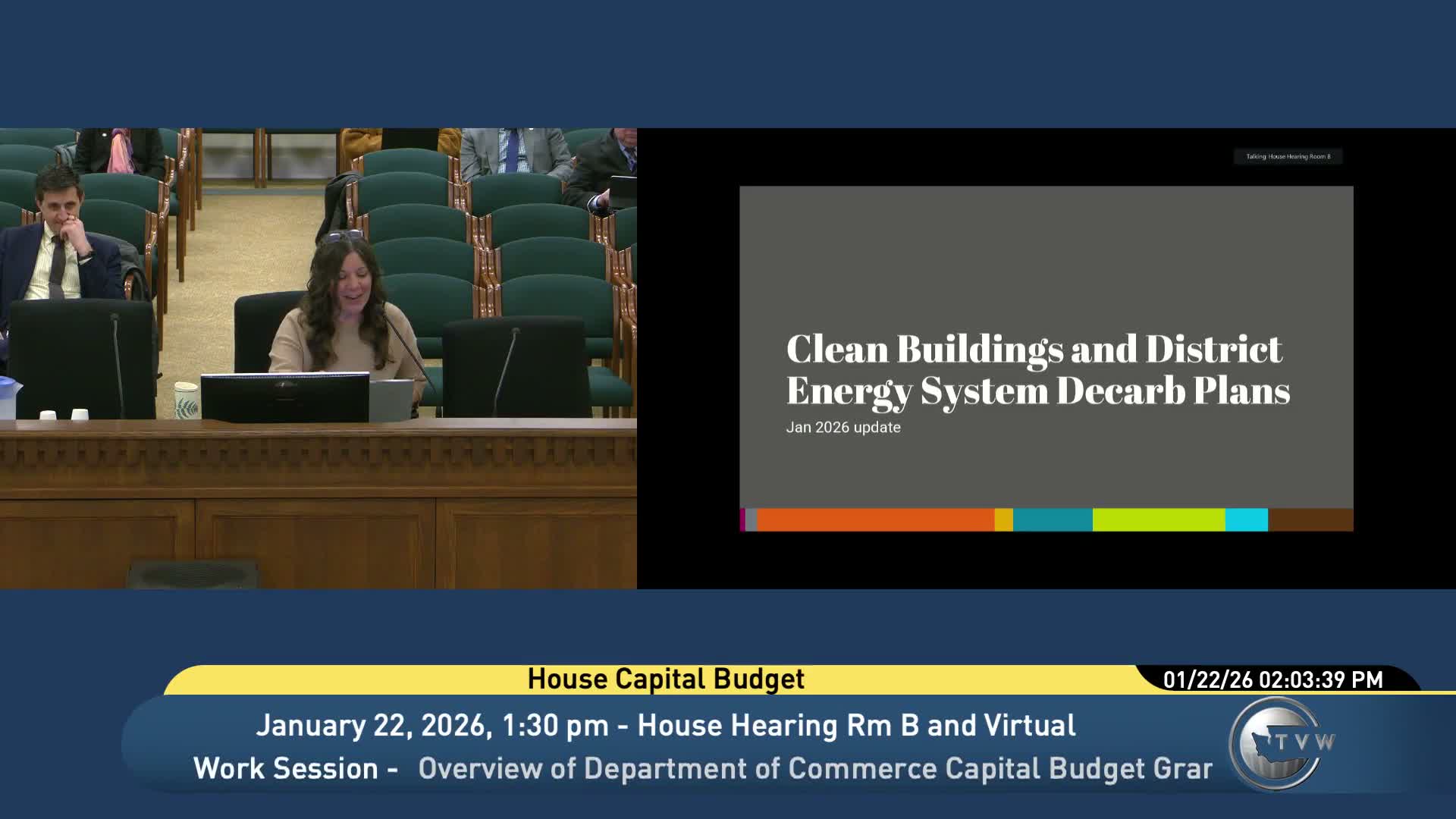
Emily Salzberg, managing director for Clean Buildings at the Department of Commerce, briefed the committee on the state's Clean Buildings implementation and progress under recent legislative changes.
Salzberg said Commerce stands up outreach, education and technical assistance for building owners preparing for mandatory compliance dates. "We responded to nearly 5,000 inquiries just in 2025 alone," she said, and added that Commerce has placed 10 fellows who have served over 250 buildings in 16 counties to assist under-resourced owners with compliance documentation.
Commerce identified approximately 28,000 buildings covered by the law (about 10,000 tier 1 buildings required to meet energy-performance targets and 18,000 tier 2 buildings required to benchmark and complete operations-and-maintenance plans). Salzberg said many tier 1 buildings already meet targets and that operations-and-maintenance actions can yield 10% to 15% annual utility savings on average.
On incentives and costs, Salzberg described early-adopter incentive programs funded by utility tax credits (and legislative changes in 2024 that increased available per-square-foot incentives). She said Commerce has reserved funds for both tier 1 and tier 2 incentives and noted a recent payment from Avista to Whitworth University under the tier 1 incentive program.
Salzberg also reviewed campus-level district energy decarbonization plans submitted under HB 1390. Commerce received 27 of 34 expected plans and found a range of common approaches (electrification, heat-pump technology, geothermal, thermal energy storage and phased/nodal implementation) along with data-reporting inconsistencies and challenges aggregating cost estimates across submissions. She emphasized that more consistent cost and greenhouse-gas reduction reporting would improve prioritization and budgeting.
Lawmakers asked whether additional statutory changes are needed; Salzberg pointed to recent rulemaking after HB 1543 and invited continued legislative conversation as the agency collects more implementation experience.
Salzberg said Commerce stands up outreach, education and technical assistance for building owners preparing for mandatory compliance dates. "We responded to nearly 5,000 inquiries just in 2025 alone," she said, and added that Commerce has placed 10 fellows who have served over 250 buildings in 16 counties to assist under-resourced owners with compliance documentation.
Commerce identified approximately 28,000 buildings covered by the law (about 10,000 tier 1 buildings required to meet energy-performance targets and 18,000 tier 2 buildings required to benchmark and complete operations-and-maintenance plans). Salzberg said many tier 1 buildings already meet targets and that operations-and-maintenance actions can yield 10% to 15% annual utility savings on average.
On incentives and costs, Salzberg described early-adopter incentive programs funded by utility tax credits (and legislative changes in 2024 that increased available per-square-foot incentives). She said Commerce has reserved funds for both tier 1 and tier 2 incentives and noted a recent payment from Avista to Whitworth University under the tier 1 incentive program.
Salzberg also reviewed campus-level district energy decarbonization plans submitted under HB 1390. Commerce received 27 of 34 expected plans and found a range of common approaches (electrification, heat-pump technology, geothermal, thermal energy storage and phased/nodal implementation) along with data-reporting inconsistencies and challenges aggregating cost estimates across submissions. She emphasized that more consistent cost and greenhouse-gas reduction reporting would improve prioritization and budgeting.
Lawmakers asked whether additional statutory changes are needed; Salzberg pointed to recent rulemaking after HB 1543 and invited continued legislative conversation as the agency collects more implementation experience.
View the Full Meeting & All Its Details
This article offers just a summary. Unlock complete video, transcripts, and insights as a Founder Member.
✓
Watch full, unedited meeting videos
✓
Search every word spoken in unlimited transcripts
✓
AI summaries & real-time alerts (all government levels)
✓
Permanent access to expanding government content
30-day money-back guarantee
