Staff compare Washington to Arizona, Colorado, Nevada, Utah; highlight debt service, ferries and fish-passage costs
January 22, 2026 | Legislative Sessions, Washington
This article was created by AI summarizing key points discussed. AI makes mistakes, so for full details and context, please refer to the video of the full meeting. Please report any errors so we can fix them. Report an error »
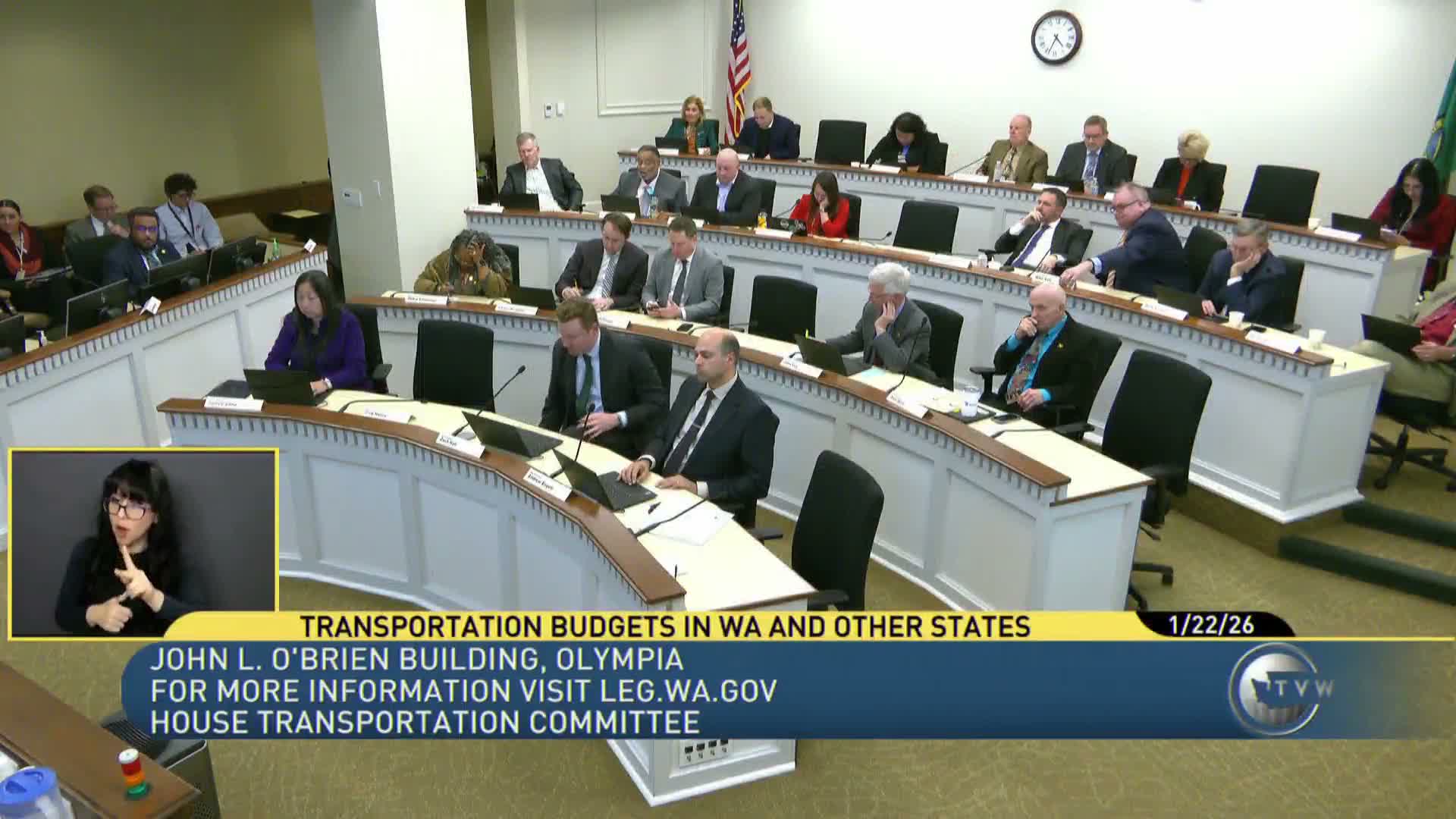
Mark Mattson and Amy Skay briefed the committee on a cross‑state comparison of transportation metrics for Washington, Arizona, Colorado, Nevada and Utah. They compared area and population, lane miles, pavement condition (International Roughness Index), fuel-tax rates and DOT budgets.
Mattson emphasized Washington’s distinct budget pressures: the ferry system (about $1.3 billion in the 2325 biennium), significant obligations for fish‑passage culvert remediation (just over $1 billion), and unusually large debt-service commitments (about $1.8 billion per biennium). On inflation-adjusted preservation spending, Washington’s real spending on preservation fell between 2008 and 2023, while the other comparison states generally kept up with inflation.
The presentation reviewed megaproject starts since 2010 (the team defined a megaproject as a highway project with nominal cost of $500 million or more) and found Washington initiated roughly twice as many such projects as its next-closest peer, Utah. Staff noted that challenging geography, climate and geotechnical issues contribute to higher costs in Washington.
Committee members asked for follow-up details on the composition of debt service (principal versus interest), the timing of megaproject starts, cost-per-mile comparisons and the effect of the Climate Commitment Act on pump prices; staff offered to provide additional data and ranges where a single number is uncertain.
The briefing concluded with policy takeaways: short-term steps (indexing or restructuring fuel taxes, reallocating resources) and longer-term options (expanded tolling or RUCs) to address stagnating fuel-tax revenues and construction inflation.
Mattson emphasized Washington’s distinct budget pressures: the ferry system (about $1.3 billion in the 2325 biennium), significant obligations for fish‑passage culvert remediation (just over $1 billion), and unusually large debt-service commitments (about $1.8 billion per biennium). On inflation-adjusted preservation spending, Washington’s real spending on preservation fell between 2008 and 2023, while the other comparison states generally kept up with inflation.
The presentation reviewed megaproject starts since 2010 (the team defined a megaproject as a highway project with nominal cost of $500 million or more) and found Washington initiated roughly twice as many such projects as its next-closest peer, Utah. Staff noted that challenging geography, climate and geotechnical issues contribute to higher costs in Washington.
Committee members asked for follow-up details on the composition of debt service (principal versus interest), the timing of megaproject starts, cost-per-mile comparisons and the effect of the Climate Commitment Act on pump prices; staff offered to provide additional data and ranges where a single number is uncertain.
The briefing concluded with policy takeaways: short-term steps (indexing or restructuring fuel taxes, reallocating resources) and longer-term options (expanded tolling or RUCs) to address stagnating fuel-tax revenues and construction inflation.
Don't Miss a Word: See the Full Meeting!
Go beyond summaries. Unlock every video, transcript, and key insight with a Founder Membership.
✓
Get instant access to full meeting videos
✓
Search and clip any phrase from complete transcripts
✓
Receive AI-powered summaries & custom alerts
✓
Enjoy lifetime, unrestricted access to government data
30-day money-back guarantee
