Committee advances bill to validate child-risk assessment tool after heated debate
January 23, 2026 | Legislative Sessions, Washington
This article was created by AI summarizing key points discussed. AI makes mistakes, so for full details and context, please refer to the video of the full meeting. Please report any errors so we can fix them. Report an error »
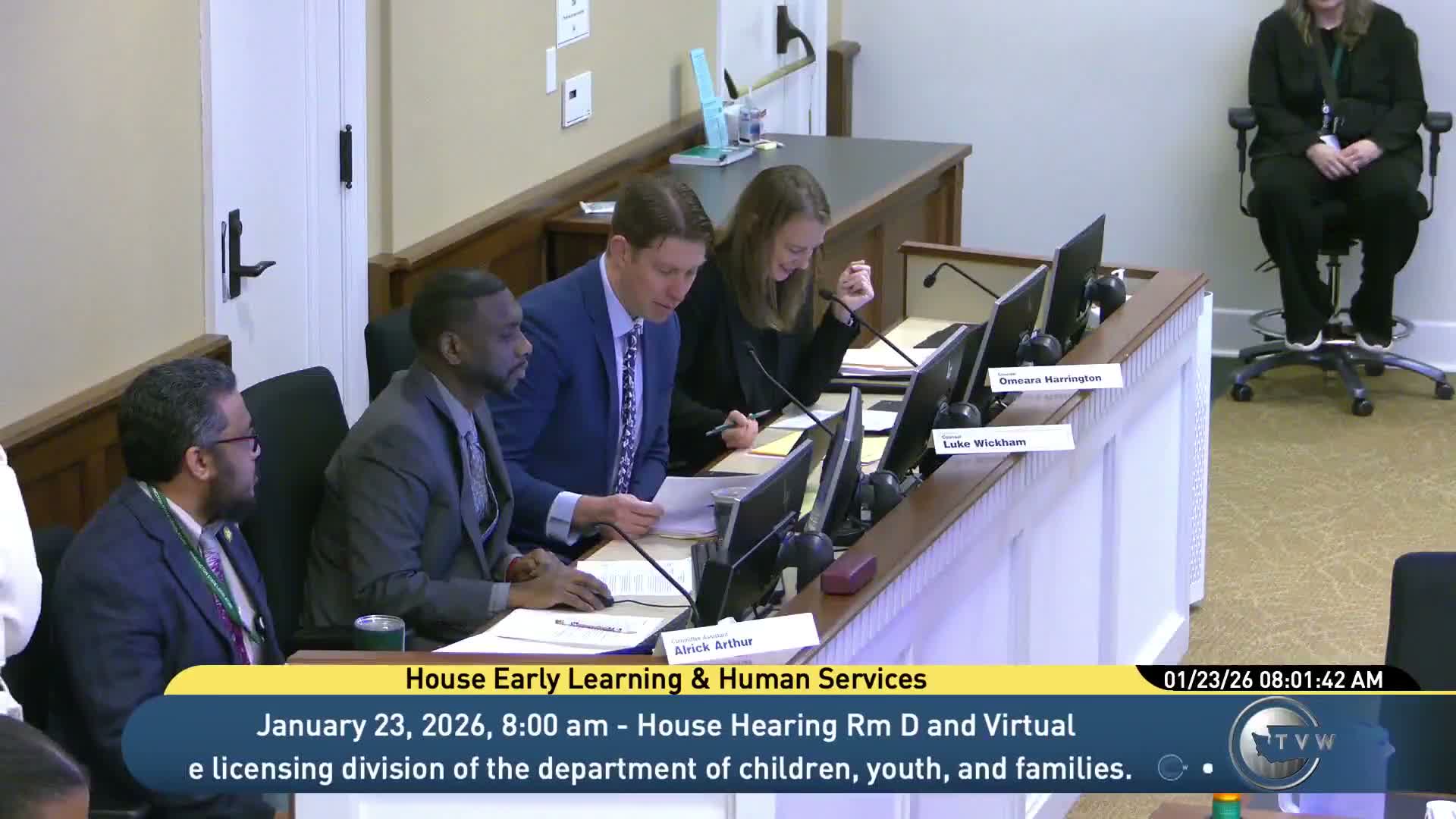
The Early Learning & Human Services Committee on Jan. 30 advanced a second substitute to House Bill 15-44 directing the Department of Children, Youth, and Families (DCYF) to study and improve its child risk, strengths and needs assessment tool, require periodic validation against current academic standards and add cultural, tribal and Department of Health guidance.
The bill — which the committee moved out with a due-pass recommendation after an executive-session debate — would expand the study to include cultural strengths and culturally appropriate service needs, incorporate Office of Tribal Relations feedback and extend the bill’s reporting deadline by one year from the date set in the original bill.
Much of the hearing focused on four amendments offered by Representative Penner that sought to (1) require the study to identify domestic violence as a risk factor; (2) define and evaluate the department’s use of the term “safe,” including whether a child living in a tent, vehicle or temporary structure in an area with a dense open-air drug market should be considered safe; (3) order an audit of DCYF’s data capacity to identify near-fatalities from 2020 through 2025 and whether safety plans failed; and (4) prohibit using an unvalidated risk-assessment process to screen out child abuse and neglect referrals until a validated process is implemented.
Representative Penner, urging adoption of the consumer-protection-style amendment, argued that the agency must be able to identify failures before it can validate any predictive tool. “If the bill were to pass without the amendment, I fear that we'd be asking the agencies solve an equation while missing half the numbers,” Penner said, and later asserted that “50 children have either died or been seriously injured” despite being classified as safe under the current tool.
Representative Ortiz Self said she would vote no on one amendment not because she questioned the severity of domestic violence but because she feared singling out specific abuse types would skew the study away from examining all forms of abuse. “The study for the risk assessment is supposed to study anything that falls under the category of abuse,” Ortiz Self said.
Supporters said the substitute improves a tool many legislators described as currently inadequate. Representative Hill told colleagues he appreciated the sponsor’s work and favored broadening the tool’s scope to include culturally relevant factors and all forms of abuse.
The committee voted to report the second substitute out with a due-pass recommendation. The roll call recorded nine members voting aye and two voting nay (those two recorded as voting ‘nay without recommendation’ in committee comments). The chair said members would continue to work on remaining implementation details in follow-up bills and committee hearings.
Next steps: the bill, as reported, moves to the floor (or the next procedural stage). The committee chair closed the session and adjourned.
The bill — which the committee moved out with a due-pass recommendation after an executive-session debate — would expand the study to include cultural strengths and culturally appropriate service needs, incorporate Office of Tribal Relations feedback and extend the bill’s reporting deadline by one year from the date set in the original bill.
Much of the hearing focused on four amendments offered by Representative Penner that sought to (1) require the study to identify domestic violence as a risk factor; (2) define and evaluate the department’s use of the term “safe,” including whether a child living in a tent, vehicle or temporary structure in an area with a dense open-air drug market should be considered safe; (3) order an audit of DCYF’s data capacity to identify near-fatalities from 2020 through 2025 and whether safety plans failed; and (4) prohibit using an unvalidated risk-assessment process to screen out child abuse and neglect referrals until a validated process is implemented.
Representative Penner, urging adoption of the consumer-protection-style amendment, argued that the agency must be able to identify failures before it can validate any predictive tool. “If the bill were to pass without the amendment, I fear that we'd be asking the agencies solve an equation while missing half the numbers,” Penner said, and later asserted that “50 children have either died or been seriously injured” despite being classified as safe under the current tool.
Representative Ortiz Self said she would vote no on one amendment not because she questioned the severity of domestic violence but because she feared singling out specific abuse types would skew the study away from examining all forms of abuse. “The study for the risk assessment is supposed to study anything that falls under the category of abuse,” Ortiz Self said.
Supporters said the substitute improves a tool many legislators described as currently inadequate. Representative Hill told colleagues he appreciated the sponsor’s work and favored broadening the tool’s scope to include culturally relevant factors and all forms of abuse.
The committee voted to report the second substitute out with a due-pass recommendation. The roll call recorded nine members voting aye and two voting nay (those two recorded as voting ‘nay without recommendation’ in committee comments). The chair said members would continue to work on remaining implementation details in follow-up bills and committee hearings.
Next steps: the bill, as reported, moves to the floor (or the next procedural stage). The committee chair closed the session and adjourned.
View the Full Meeting & All Its Details
This article offers just a summary. Unlock complete video, transcripts, and insights as a Founder Member.
✓
Watch full, unedited meeting videos
✓
Search every word spoken in unlimited transcripts
✓
AI summaries & real-time alerts (all government levels)
✓
Permanent access to expanding government content
30-day money-back guarantee
