Senate committee hears competing views on bill to license animal chiropractors
January 23, 2026 | Legislative Sessions, Washington
This article was created by AI summarizing key points discussed. AI makes mistakes, so for full details and context, please refer to the video of the full meeting. Please report any errors so we can fix them. Report an error »
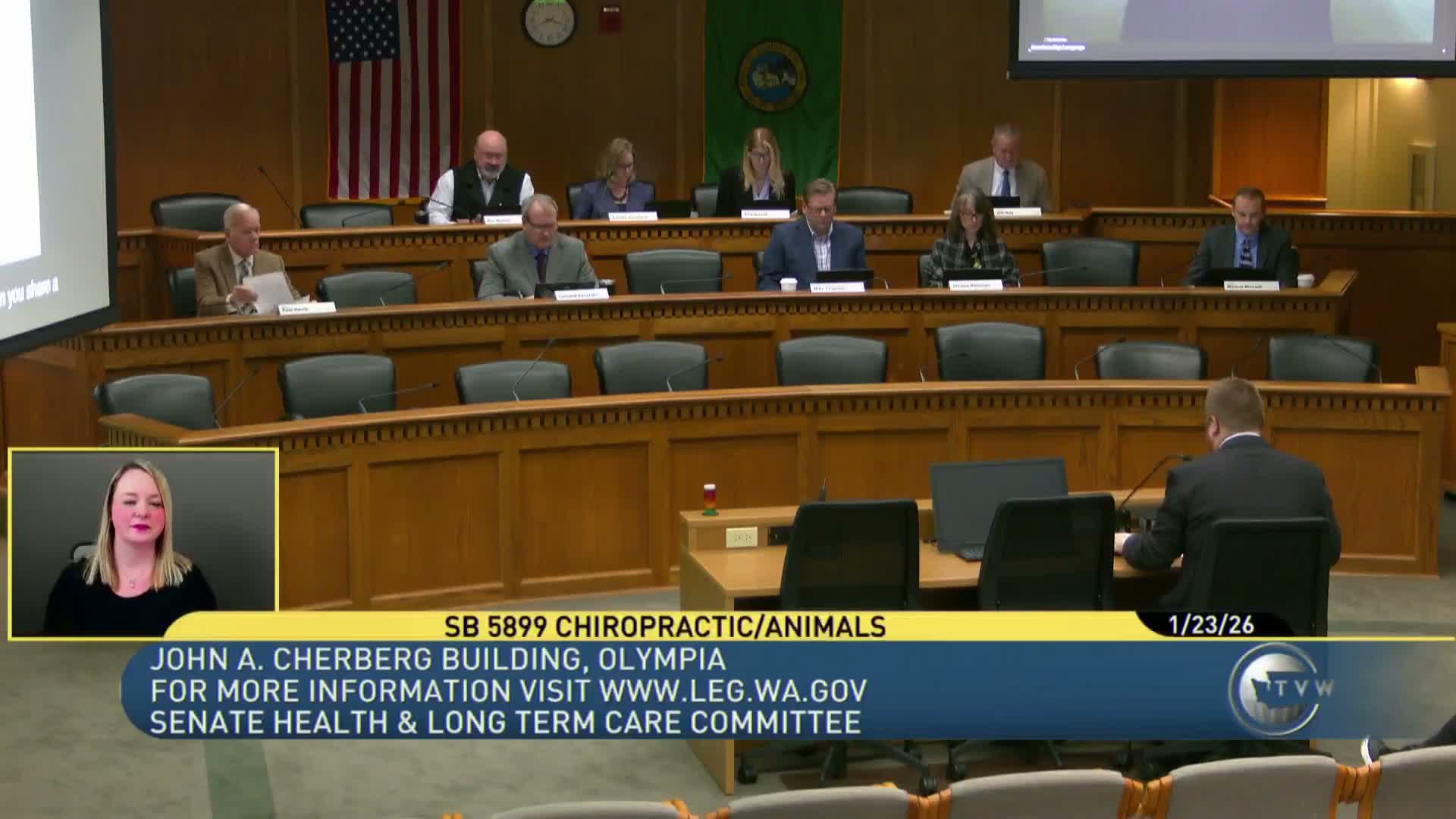
Senate Health and Long Term Care Committee members on Jan. 23 heard testimony for and against Senate Bill 5,899, which would create a three‑year animal chiropractic endorsement allowing licensed chiropractors who complete approved animal chiropractic training to perform chiropractic diagnosis and adjustments on non‑human animals.
Jacob Ewing, committee staff, said the bill would let a licensed chiropractor obtain an animal chiropractor endorsement after demonstrating approved animal‑specific education or current animal chiropractic certification, allow limited diagnostic imaging review, require signage and sanitary standards where clinics treat both people and animals, and set a 30‑hour continuing‑education renewal every three years.
Prime sponsor Sen. Shelley Short, R‑7th Legislative District, described the change as "a tool" to increase rural access to non‑surgical, drug‑free care and said the endorsement was intended to complement, not replace, veterinary medicine. "This does not replace veterinary medicine at all," Short said, noting stakeholder work and anticipated amendatory language.
Supporters from the chiropractic community and training programs told the committee they already offer multi‑hundred‑hour animal chiropractic curricula and national certification. Susan Jensen, a public member of the Chiropractic Quality Assurance Commission, said the commission studied models from other states and is prepared to regulate animal chiropractic in Washington.
Veterinarians and the Washington State Veterinary Medical Association urged changes before the bill advances. Eddie Hague, a mixed‑animal veterinarian, said the current draft does not require veterinary referral and could put animals and people at risk because signs of systemic or reportable disease (he cited rabies as an example) can present as lameness. "Conditions that potentially can be treated by a chiropractor could come from an underlying disease that could be transferred to humans," Hague said. Greg Hannon of the WSVMA told the committee many states require veterinary supervision or referral and that the bill lacks explicit animal disease‑reporting duties.
Committee members heard technical descriptions of accredited animal chiropractic programs and continuing‑education frameworks from presenters who said training includes anatomy, radiology and hands‑on lab hours. Opponents countered that recognizing zoonotic or reportable conditions and establishing a durable veterinary‑client‑patient relationship require veterinary involvement.
The committee suspended the SB 5,899 hearing earlier to hold a dental workforce work session and later resumed public testimony; the chair set time limits for each testifier. The committee did not vote on the bill during the hearing.
Next steps: testimony on SB 5,899 concluded with pro and con panels; any amendments and committee action will determine whether additional veterinary protections or reporting requirements are added.
Jacob Ewing, committee staff, said the bill would let a licensed chiropractor obtain an animal chiropractor endorsement after demonstrating approved animal‑specific education or current animal chiropractic certification, allow limited diagnostic imaging review, require signage and sanitary standards where clinics treat both people and animals, and set a 30‑hour continuing‑education renewal every three years.
Prime sponsor Sen. Shelley Short, R‑7th Legislative District, described the change as "a tool" to increase rural access to non‑surgical, drug‑free care and said the endorsement was intended to complement, not replace, veterinary medicine. "This does not replace veterinary medicine at all," Short said, noting stakeholder work and anticipated amendatory language.
Supporters from the chiropractic community and training programs told the committee they already offer multi‑hundred‑hour animal chiropractic curricula and national certification. Susan Jensen, a public member of the Chiropractic Quality Assurance Commission, said the commission studied models from other states and is prepared to regulate animal chiropractic in Washington.
Veterinarians and the Washington State Veterinary Medical Association urged changes before the bill advances. Eddie Hague, a mixed‑animal veterinarian, said the current draft does not require veterinary referral and could put animals and people at risk because signs of systemic or reportable disease (he cited rabies as an example) can present as lameness. "Conditions that potentially can be treated by a chiropractor could come from an underlying disease that could be transferred to humans," Hague said. Greg Hannon of the WSVMA told the committee many states require veterinary supervision or referral and that the bill lacks explicit animal disease‑reporting duties.
Committee members heard technical descriptions of accredited animal chiropractic programs and continuing‑education frameworks from presenters who said training includes anatomy, radiology and hands‑on lab hours. Opponents countered that recognizing zoonotic or reportable conditions and establishing a durable veterinary‑client‑patient relationship require veterinary involvement.
The committee suspended the SB 5,899 hearing earlier to hold a dental workforce work session and later resumed public testimony; the chair set time limits for each testifier. The committee did not vote on the bill during the hearing.
Next steps: testimony on SB 5,899 concluded with pro and con panels; any amendments and committee action will determine whether additional veterinary protections or reporting requirements are added.
View the Full Meeting & All Its Details
This article offers just a summary. Unlock complete video, transcripts, and insights as a Founder Member.
✓
Watch full, unedited meeting videos
✓
Search every word spoken in unlimited transcripts
✓
AI summaries & real-time alerts (all government levels)
✓
Permanent access to expanding government content
30-day money-back guarantee
