Senate committee hears business and agency support for publishing workers' compensation 'indicated' rates
January 23, 2026 | Legislative Sessions, Washington
This article was created by AI summarizing key points discussed. AI makes mistakes, so for full details and context, please refer to the video of the full meeting. Please report any errors so we can fix them. Report an error »
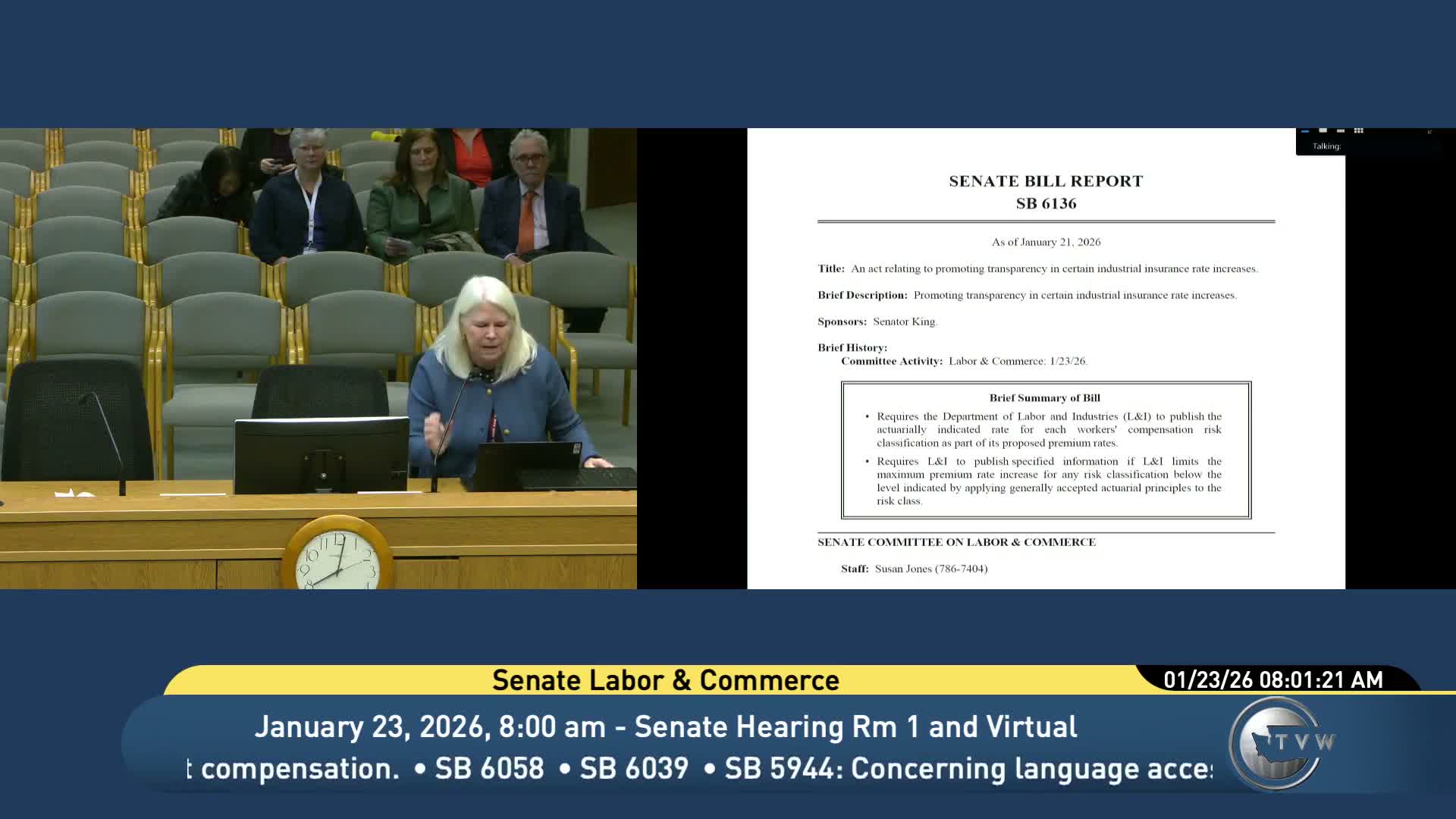
Senate Bill 6,136, sponsored by Senator King, would require the Department of Labor & Industries (L&I) to publish the actuarial-indicated premium rate for each workers' compensation risk classification whenever it proposes premium rates and to disclose when L&I limits increases for a class and the downstream effects of that limitation.
The sponsor told the Senate Labor and Commerce Committee the bill is aimed at transparency: ‘‘Caps are useful, but without the full information of what’s behind those caps and the true costs, we’re left with a misunderstanding of where we really are at,’’ Senator King said.
Committee staff explained the bill would make the department publish the indicated rate per class, identify classes capped at 15% and the rates those classes would have had absent caps, and show how capping some classes changes increases for other classes. The staff fiscal note attached to the bill showed no additional fiscal impact.
Business groups and industry witnesses testified in support. Tammy Phelan of L&I told the committee that L&I actuaries indicated a 13% break-even increase for 2026 while the department proposed and adopted a 4.9% increase. Phelan explained the department routinely applies an internal policy capping some administrative increases at 15% ‘‘to behave consistently with our priorities of steady and predictable rates.’’ She also said L&I used roughly $240,000,000 in reserves this year to reduce the adopted increase.
James Crandall of the Association of Washington Business and other business witnesses urged passage, citing long-term solvency concerns and a roughly 22% increase in Washington workers' compensation rates since 2020. ‘‘While reserves can smooth short-term volatility, repeated reliance raises questions about long-term sustainability,’’ Crandall said.
Committee members asked whether the state auditor could produce similar data and how investment returns factor into rate-setting. L&I witnesses said the department shares detailed rate information with oversight committees and external finance groups and that investment returns are used to buy down rates.
The bill’s sponsors and supporters said publishing indicated rates would help policymakers and stakeholders identify cost drivers earlier and lead to more informed decisions. No formal action on SB 6,136 was recorded at the hearing; the committee paused public testimony and proceeded to executive session on other bills.
The committee hearing included detailed questions about the role of advisory committees and whether the auditor already had statutory obligations to review the state fund. The record shows broad stakeholder engagement, with business, labor, and agency representatives expressing interest in continued dialogue.
Next steps: SB 6,136 remains at the committee stage following the public hearing; sponsors and L&I staff signaled willingness to continue discussions on implementation details.
The sponsor told the Senate Labor and Commerce Committee the bill is aimed at transparency: ‘‘Caps are useful, but without the full information of what’s behind those caps and the true costs, we’re left with a misunderstanding of where we really are at,’’ Senator King said.
Committee staff explained the bill would make the department publish the indicated rate per class, identify classes capped at 15% and the rates those classes would have had absent caps, and show how capping some classes changes increases for other classes. The staff fiscal note attached to the bill showed no additional fiscal impact.
Business groups and industry witnesses testified in support. Tammy Phelan of L&I told the committee that L&I actuaries indicated a 13% break-even increase for 2026 while the department proposed and adopted a 4.9% increase. Phelan explained the department routinely applies an internal policy capping some administrative increases at 15% ‘‘to behave consistently with our priorities of steady and predictable rates.’’ She also said L&I used roughly $240,000,000 in reserves this year to reduce the adopted increase.
James Crandall of the Association of Washington Business and other business witnesses urged passage, citing long-term solvency concerns and a roughly 22% increase in Washington workers' compensation rates since 2020. ‘‘While reserves can smooth short-term volatility, repeated reliance raises questions about long-term sustainability,’’ Crandall said.
Committee members asked whether the state auditor could produce similar data and how investment returns factor into rate-setting. L&I witnesses said the department shares detailed rate information with oversight committees and external finance groups and that investment returns are used to buy down rates.
The bill’s sponsors and supporters said publishing indicated rates would help policymakers and stakeholders identify cost drivers earlier and lead to more informed decisions. No formal action on SB 6,136 was recorded at the hearing; the committee paused public testimony and proceeded to executive session on other bills.
The committee hearing included detailed questions about the role of advisory committees and whether the auditor already had statutory obligations to review the state fund. The record shows broad stakeholder engagement, with business, labor, and agency representatives expressing interest in continued dialogue.
Next steps: SB 6,136 remains at the committee stage following the public hearing; sponsors and L&I staff signaled willingness to continue discussions on implementation details.
View the Full Meeting & All Its Details
This article offers just a summary. Unlock complete video, transcripts, and insights as a Founder Member.
✓
Watch full, unedited meeting videos
✓
Search every word spoken in unlimited transcripts
✓
AI summaries & real-time alerts (all government levels)
✓
Permanent access to expanding government content
30-day money-back guarantee
