Committee hears testimony for bill allowing family burial plots on private land
January 23, 2026 | Legislative Sessions, Washington
This article was created by AI summarizing key points discussed. AI makes mistakes, so for full details and context, please refer to the video of the full meeting. Please report any errors so we can fix them. Report an error »
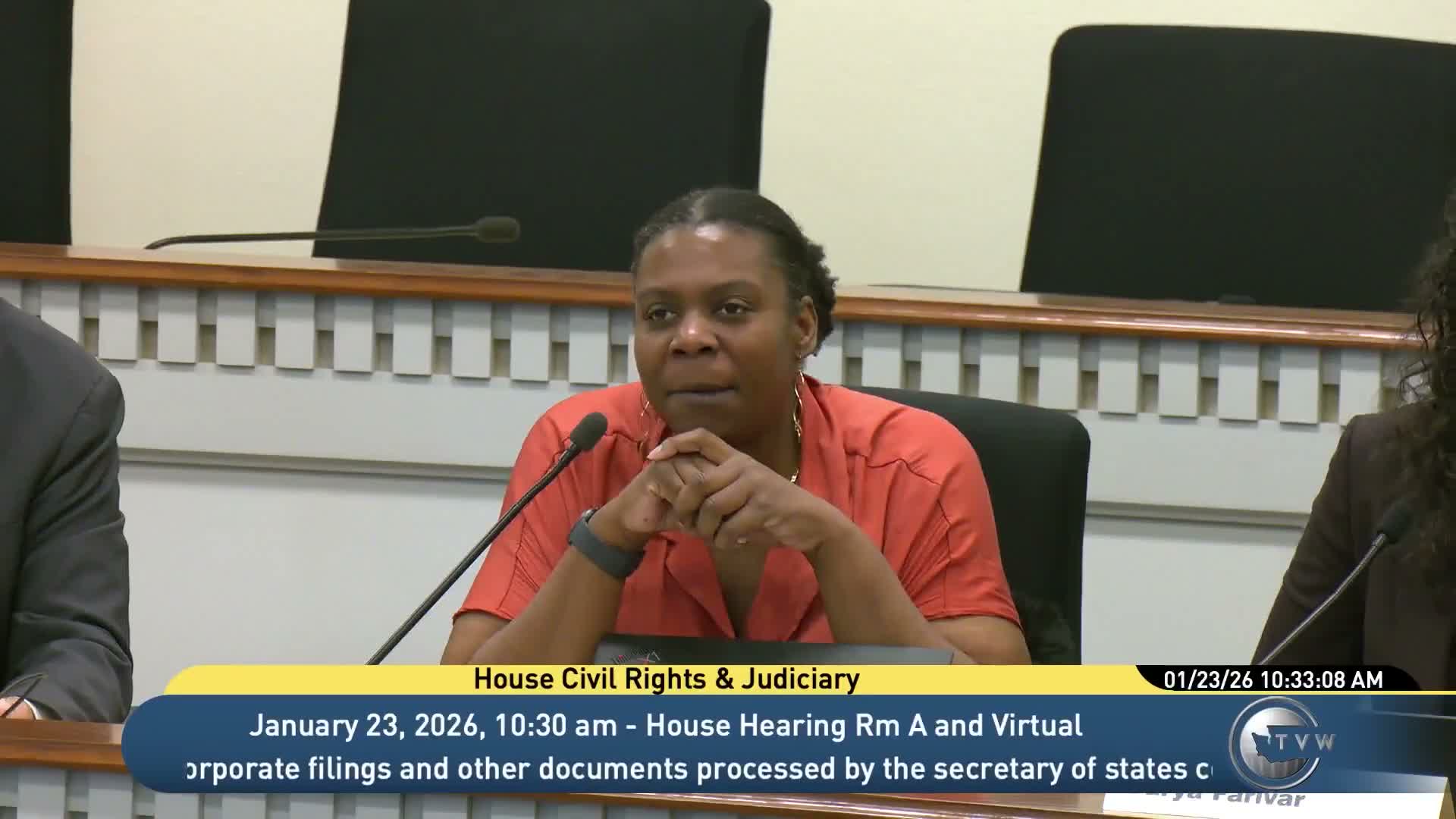
The Civil Rights & Judiciary Committee on Jan. 23 heard House Bill 2239, which would allow designated family burial grounds on privately owned property and set requirements for how those grounds are recorded and maintained.
Elena Baker, staff to the committee, told members the bill “relates to establishing family burial grounds on privately owned land,” and summarized key provisions including that owners must record every burial with the county auditor and that a family burial ground may not comprise more than 10% of a parcel. Baker said some current practices — such as burial on private land with the owner’s consent — already occur, but the bill would create an explicit statutory framework and construction standards for mausoleums and columbaria.
Representative Abel, sponsor of the bill, said the measure builds on similar prior legislation and adds explicit coverage for above-ground interment used by some faith traditions. Abel said the change is “largely similar” to previous legislation but was revised after stakeholder feedback to include mausoleums and columbaria and to leave local governments room to regulate or prohibit family burial grounds.
Several witnesses described why these provisions matter to rural families. Ewing Stringfellow, a King County farmer testifying in support, recounted his family’s multigenerational ties to their roughly 100-acre farm and said burial on the land reflects family continuity and sacred traditions. Mark Strueley, representing the Washington Cattlemen’s Association, said the group supports the bill and Stringfellow’s desire to preserve family burial practices.
Staff noted the bill requires sellers to notify prospective buyers that a property contains a family burial ground but is silent on the subsequent owner’s obligation to maintain or honor those interments; staff also said the bill does not explicitly limit local authorities’ ability to order relocation or other remedies. The committee took no final action on HB 2239 during the hearing.
The hearing record closed after supporters and stakeholders finished testimony; no committee vote was recorded on the bill that day.
Elena Baker, staff to the committee, told members the bill “relates to establishing family burial grounds on privately owned land,” and summarized key provisions including that owners must record every burial with the county auditor and that a family burial ground may not comprise more than 10% of a parcel. Baker said some current practices — such as burial on private land with the owner’s consent — already occur, but the bill would create an explicit statutory framework and construction standards for mausoleums and columbaria.
Representative Abel, sponsor of the bill, said the measure builds on similar prior legislation and adds explicit coverage for above-ground interment used by some faith traditions. Abel said the change is “largely similar” to previous legislation but was revised after stakeholder feedback to include mausoleums and columbaria and to leave local governments room to regulate or prohibit family burial grounds.
Several witnesses described why these provisions matter to rural families. Ewing Stringfellow, a King County farmer testifying in support, recounted his family’s multigenerational ties to their roughly 100-acre farm and said burial on the land reflects family continuity and sacred traditions. Mark Strueley, representing the Washington Cattlemen’s Association, said the group supports the bill and Stringfellow’s desire to preserve family burial practices.
Staff noted the bill requires sellers to notify prospective buyers that a property contains a family burial ground but is silent on the subsequent owner’s obligation to maintain or honor those interments; staff also said the bill does not explicitly limit local authorities’ ability to order relocation or other remedies. The committee took no final action on HB 2239 during the hearing.
The hearing record closed after supporters and stakeholders finished testimony; no committee vote was recorded on the bill that day.
View the Full Meeting & All Its Details
This article offers just a summary. Unlock complete video, transcripts, and insights as a Founder Member.
✓
Watch full, unedited meeting videos
✓
Search every word spoken in unlimited transcripts
✓
AI summaries & real-time alerts (all government levels)
✓
Permanent access to expanding government content
30-day money-back guarantee
