Committee hears broad support for expanding 2-10 warranty to stacked flats and mid‑rise condos
January 23, 2026 | Legislative Sessions, Washington
This article was created by AI summarizing key points discussed. AI makes mistakes, so for full details and context, please refer to the video of the full meeting. Please report any errors so we can fix them. Report an error »
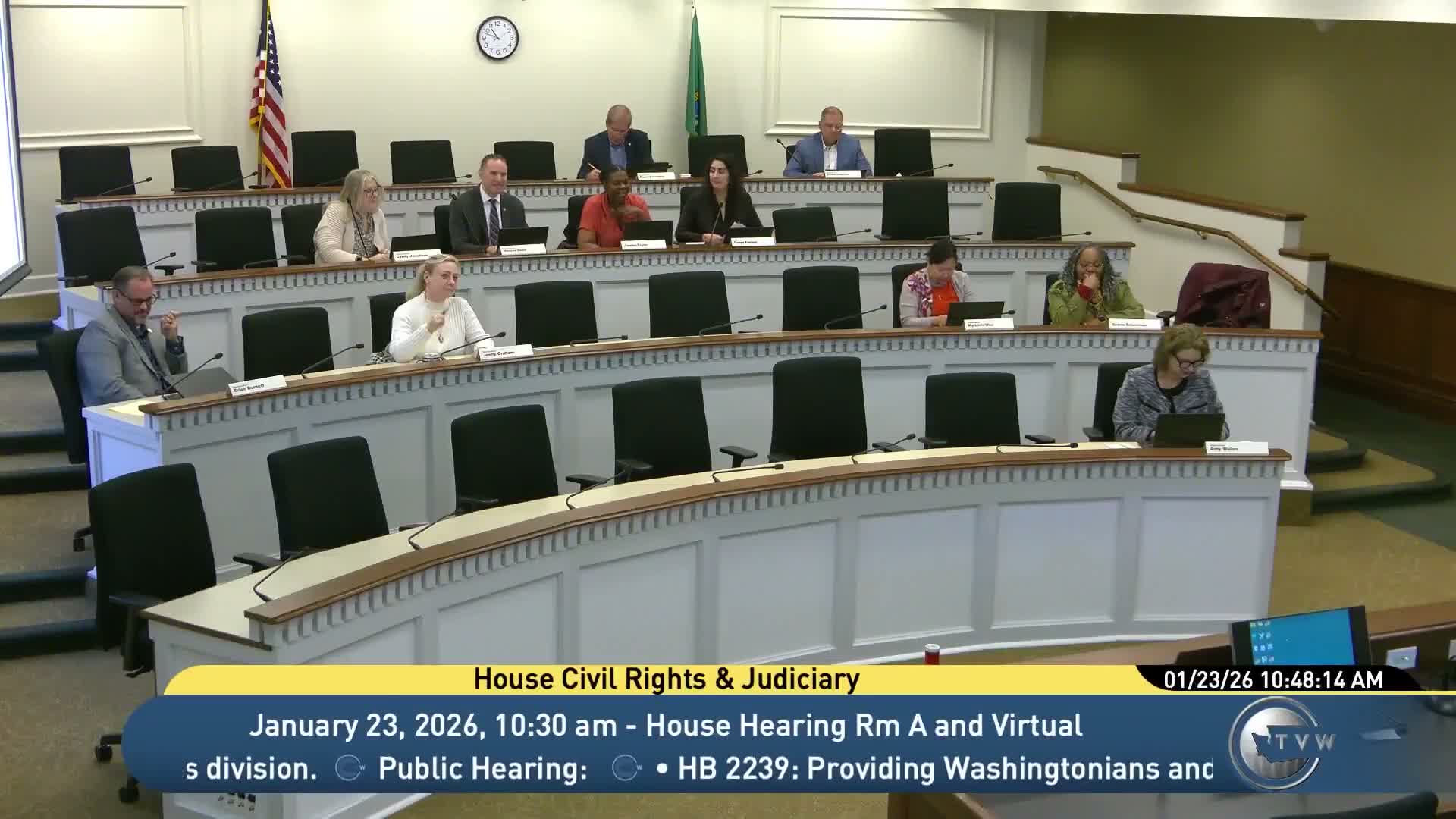
The Civil Rights & Judiciary Committee on Jan. 23 received extensive testimony in favor of House Bill 2304, which would broaden eligibility for the 2-10 warranty framework under the Washington Uniform Common Interest Ownership Act to additional condominium building types, including stacked flats and buildings up to four stories.
Representative Jamila Taylor, sponsor, said the bill is intended as a follow-up to earlier condominium-liability reforms and to help address housing supply challenges by allowing small-scale builders to offer predictable warranty structures for units that look and are built like single-family homes but are sold as condominiums.
Private builders, housing advocates, and local officials testified in support. Jason Gano of 1 Drop Homes said expanding the 2-10 warranty will restore predictability for builders and make mid-rise condo projects feasible again. Brady Nordstrom of the Housing Development Consortium and other nonprofit and industry witnesses cited data on condo prices being substantially lower than single-family homes and argued that the change would expand attainable homeownership.
Tyler Langford of the Office of the Insurance Commissioner told the committee the OIC supports the bill’s intent but recommended a technical amendment: replace references to “express warranty insurance coverage” with “express warranty extended coverage” to avoid implying the warranties are regulated as insurance products under the insurance code. Committee staff and members discussed that warranties are typically distinct from insurance products.
Speakers representing Sightline Institute, Chicago Title, AARP, Futurewise, Washington Realtors, the Building Industry Association of Washington, the City of Seattle’s Office of Planning and Community Development, and Habitat for Humanity offered testimony emphasizing accessibility, economic feasibility for small developers, and local zoning reforms that would make stacked flats an important source of attainable housing.
Staff confirmed no fiscal note was requested because no state agency implementation was required. The committee closed the hearing on HB 2304 after receiving public testimony; no committee vote was taken that day.
Representative Jamila Taylor, sponsor, said the bill is intended as a follow-up to earlier condominium-liability reforms and to help address housing supply challenges by allowing small-scale builders to offer predictable warranty structures for units that look and are built like single-family homes but are sold as condominiums.
Private builders, housing advocates, and local officials testified in support. Jason Gano of 1 Drop Homes said expanding the 2-10 warranty will restore predictability for builders and make mid-rise condo projects feasible again. Brady Nordstrom of the Housing Development Consortium and other nonprofit and industry witnesses cited data on condo prices being substantially lower than single-family homes and argued that the change would expand attainable homeownership.
Tyler Langford of the Office of the Insurance Commissioner told the committee the OIC supports the bill’s intent but recommended a technical amendment: replace references to “express warranty insurance coverage” with “express warranty extended coverage” to avoid implying the warranties are regulated as insurance products under the insurance code. Committee staff and members discussed that warranties are typically distinct from insurance products.
Speakers representing Sightline Institute, Chicago Title, AARP, Futurewise, Washington Realtors, the Building Industry Association of Washington, the City of Seattle’s Office of Planning and Community Development, and Habitat for Humanity offered testimony emphasizing accessibility, economic feasibility for small developers, and local zoning reforms that would make stacked flats an important source of attainable housing.
Staff confirmed no fiscal note was requested because no state agency implementation was required. The committee closed the hearing on HB 2304 after receiving public testimony; no committee vote was taken that day.
View the Full Meeting & All Its Details
This article offers just a summary. Unlock complete video, transcripts, and insights as a Founder Member.
✓
Watch full, unedited meeting videos
✓
Search every word spoken in unlimited transcripts
✓
AI summaries & real-time alerts (all government levels)
✓
Permanent access to expanding government content
30-day money-back guarantee
