Senate committee hears wide debate on bill to regulate data centers; staff outlines tariffs, reporting and small fee
January 23, 2026 | Legislative Sessions, Washington
This article was created by AI summarizing key points discussed. AI makes mistakes, so for full details and context, please refer to the video of the full meeting. Please report any errors so we can fix them. Report an error »
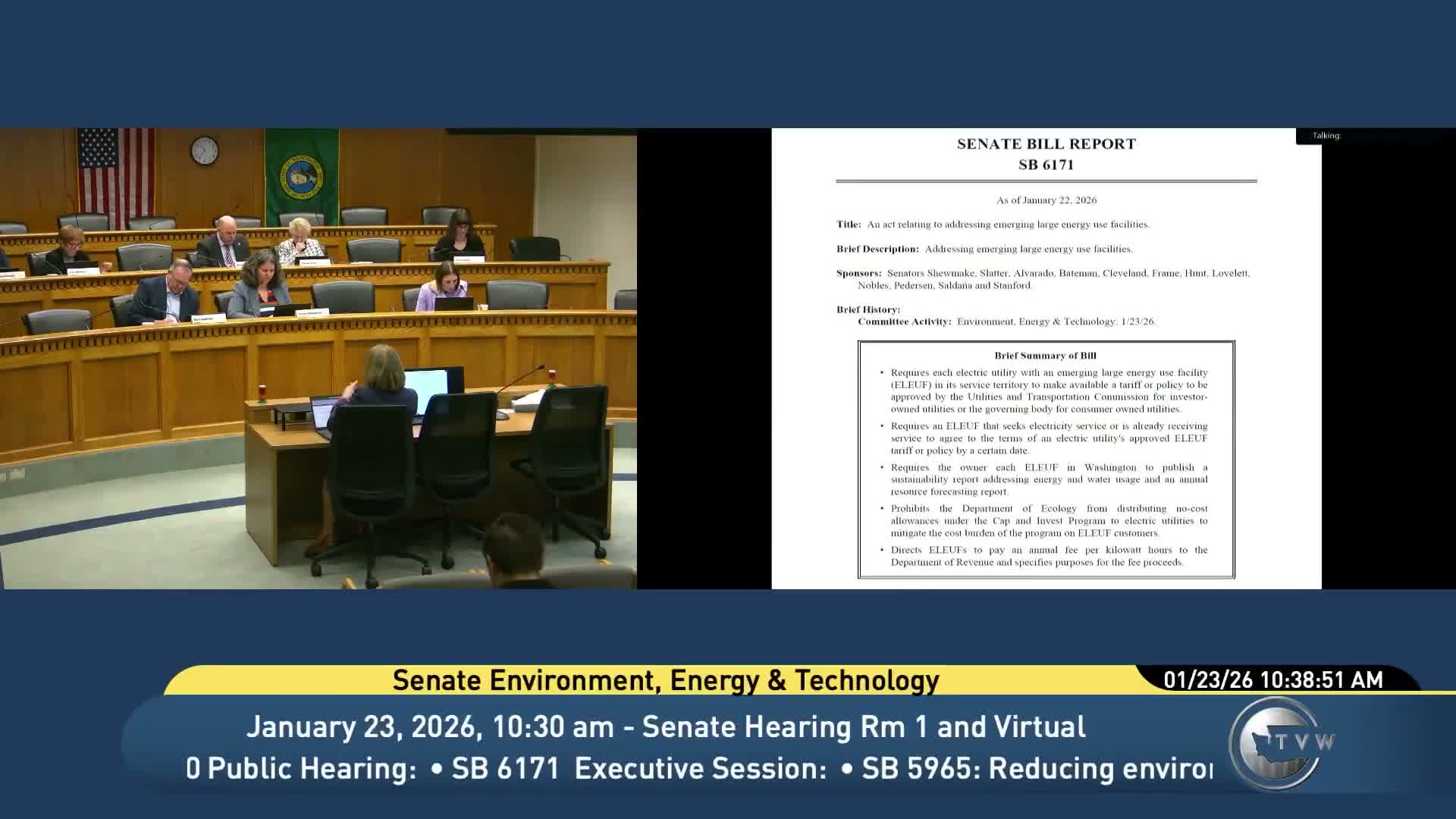
The Senate Environment, Energy and Technology Committee on the record heard hours of testimony on a substitute for Senate Bill 6,171, a measure that would require electric utilities to make available a tariff or policy for "emerging large energy use facilities" — defined in the bill as facilities with a maximum aggregate contract demand of 20 megawatts or more, primarily engaged in data-processing and related services.
Kim Cushing, staff to the committee, told lawmakers the substitute directs utilities to include elements such as a minimum contract length of 10 years, pricing structures that reflect cost causation and provisions requiring facilities to curtail or reduce load during energy emergency events. The bill also would require data centers to provide sustainability reports every three years and to certify that facilities that begin operation or expand after July 1, 2026, will use new renewable or non‑emitting generation for at least 80% of their load by 2030 and 100% by 2035. Utilities must have a tariff or policy approved by the Utilities and Transportation Commission (for investor‑owned utilities) or the governing body of a consumer‑owned utility by Oct. 1, 2026.
The substitute creates an annual fee of 0.005¢ per kilowatt-hour payable to the Department of Revenue; the bill directs distributions with 60% for energy assistance, weatherization and low‑income electrification, and 40% for higher‑education programs in career services, quantum computing and AI educator training. Staff presented a partial fiscal note estimating increased state revenues in the initial months and millions in the first full year of collections.
Supporters at the hearing urged the committee to preserve the fee and reporting components. Jeff DeLuca of the Washington State Community Action Partnership said community action agencies deliver energy bill assistance to more than 100,000 households annually and cited a statewide unmet energy assistance need of about $275 million. "As we see greater strain on our energy system resulting in rising costs for working families, seniors, and people with disabilities living on fixed incomes, it's critical that new large energy users pay their fair share," DeLuca said.
Environmental and community groups — including Climate Solutions, the Northwest Energy Coalition and the Natural Resources Defense Council — argued the bill provides necessary guardrails for rapid data center growth, stressing grid reliability, ratepayer protections and transparency on water and emissions.
Industry groups and some local public utilities countered that the bill is too prescriptive and risks making Washington less competitive for data center investment. Dan DiOrio of the Data Center Coalition said the proposal "singles out data centers" and urged the Legislature to consider a broader approach to all large loads; he also warned the bill could undermine the obligation to serve for consumer‑owned utilities and raise proprietary and competitive concerns tied to detailed reporting.
Multiple utilities and associations raised a specific concern about the relationship between the bill and the Climate Commitment Act (CCA) and the Clean Energy Transformation Act (CETA). Nicholas Garcia of the Washington Public Utility District Association said the substitute would remove a sentence from the CCA that helped ensure no‑cost allowances grew with load, and warned that could force utilities to purchase allowances and pass those costs to retail customers.
Other witnesses focused on water and environmental impacts, and on nondisclosure agreements (NDAs) that can limit public review of resource use. Neil Anderson, a graduate student in artificial intelligence, asked the committee to address NDAs that can hide aggregate energy and water usage from public view. Jeremy Takala, representing the Yakama Nation, cited a study the nation submitted showing high data center growth could substantially raise the annual chance of outages and stressed potential impacts to treaty fisheries if water withdrawals affect stream flows.
Proponents said the bill is not a moratorium, tax or blanket restriction; rather it aims to align new large loads with Washington's climate targets, ensure cost causation, and create transparency so policymaking is informed. "We want data centers to pay for their energy related costs," Leah Missick of Climate Solutions said, urging reporting and tariff standards to protect ratepayers.
No formal committee vote on SB 6,171 occurred during the public hearing; testimony concluded and the committee adjourned for the day.
Sources in the hearing highlighted several technical and policy issues that will likely be the focus of amendments as the bill moves forward: the precise interaction between SB 6,171 and CCA/CETA allowance accounting; whether reporting requirements create proprietary risks; the potential for curtailment provisions to drive backup generator use with air‑quality implications; and aligning deadlines with utility rate‑setting cycles.
Kim Cushing, staff to the committee, told lawmakers the substitute directs utilities to include elements such as a minimum contract length of 10 years, pricing structures that reflect cost causation and provisions requiring facilities to curtail or reduce load during energy emergency events. The bill also would require data centers to provide sustainability reports every three years and to certify that facilities that begin operation or expand after July 1, 2026, will use new renewable or non‑emitting generation for at least 80% of their load by 2030 and 100% by 2035. Utilities must have a tariff or policy approved by the Utilities and Transportation Commission (for investor‑owned utilities) or the governing body of a consumer‑owned utility by Oct. 1, 2026.
The substitute creates an annual fee of 0.005¢ per kilowatt-hour payable to the Department of Revenue; the bill directs distributions with 60% for energy assistance, weatherization and low‑income electrification, and 40% for higher‑education programs in career services, quantum computing and AI educator training. Staff presented a partial fiscal note estimating increased state revenues in the initial months and millions in the first full year of collections.
Supporters at the hearing urged the committee to preserve the fee and reporting components. Jeff DeLuca of the Washington State Community Action Partnership said community action agencies deliver energy bill assistance to more than 100,000 households annually and cited a statewide unmet energy assistance need of about $275 million. "As we see greater strain on our energy system resulting in rising costs for working families, seniors, and people with disabilities living on fixed incomes, it's critical that new large energy users pay their fair share," DeLuca said.
Environmental and community groups — including Climate Solutions, the Northwest Energy Coalition and the Natural Resources Defense Council — argued the bill provides necessary guardrails for rapid data center growth, stressing grid reliability, ratepayer protections and transparency on water and emissions.
Industry groups and some local public utilities countered that the bill is too prescriptive and risks making Washington less competitive for data center investment. Dan DiOrio of the Data Center Coalition said the proposal "singles out data centers" and urged the Legislature to consider a broader approach to all large loads; he also warned the bill could undermine the obligation to serve for consumer‑owned utilities and raise proprietary and competitive concerns tied to detailed reporting.
Multiple utilities and associations raised a specific concern about the relationship between the bill and the Climate Commitment Act (CCA) and the Clean Energy Transformation Act (CETA). Nicholas Garcia of the Washington Public Utility District Association said the substitute would remove a sentence from the CCA that helped ensure no‑cost allowances grew with load, and warned that could force utilities to purchase allowances and pass those costs to retail customers.
Other witnesses focused on water and environmental impacts, and on nondisclosure agreements (NDAs) that can limit public review of resource use. Neil Anderson, a graduate student in artificial intelligence, asked the committee to address NDAs that can hide aggregate energy and water usage from public view. Jeremy Takala, representing the Yakama Nation, cited a study the nation submitted showing high data center growth could substantially raise the annual chance of outages and stressed potential impacts to treaty fisheries if water withdrawals affect stream flows.
Proponents said the bill is not a moratorium, tax or blanket restriction; rather it aims to align new large loads with Washington's climate targets, ensure cost causation, and create transparency so policymaking is informed. "We want data centers to pay for their energy related costs," Leah Missick of Climate Solutions said, urging reporting and tariff standards to protect ratepayers.
No formal committee vote on SB 6,171 occurred during the public hearing; testimony concluded and the committee adjourned for the day.
Sources in the hearing highlighted several technical and policy issues that will likely be the focus of amendments as the bill moves forward: the precise interaction between SB 6,171 and CCA/CETA allowance accounting; whether reporting requirements create proprietary risks; the potential for curtailment provisions to drive backup generator use with air‑quality implications; and aligning deadlines with utility rate‑setting cycles.
Don't Miss a Word: See the Full Meeting!
Go beyond summaries. Unlock every video, transcript, and key insight with a Founder Membership.
✓
Get instant access to full meeting videos
✓
Search and clip any phrase from complete transcripts
✓
Receive AI-powered summaries & custom alerts
✓
Enjoy lifetime, unrestricted access to government data
30-day money-back guarantee
