Committee hears broad support for Wage Recovery Act to speed payments to low‑wage workers
January 23, 2026 | Legislative Sessions, Washington
This article was created by AI summarizing key points discussed. AI makes mistakes, so for full details and context, please refer to the video of the full meeting. Please report any errors so we can fix them. Report an error »
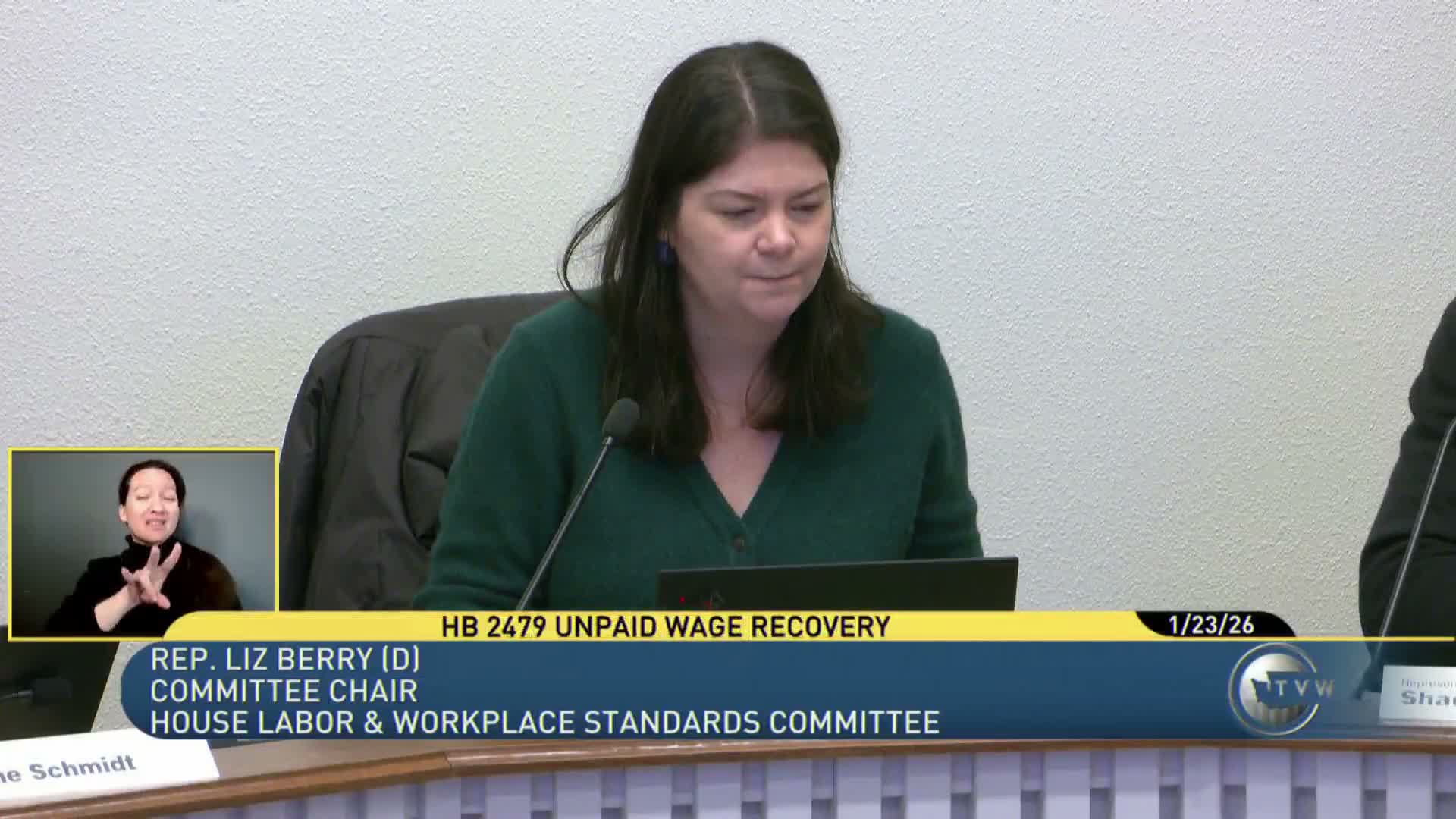
A state House committee heard bipartisan, business and labor-backed support on Jan. 23 for House Bill 2479, the Wage Recovery Act, which would create a wage recovery program intended to get unpaid wages into the hands of low‑wage employees before a formal citation is issued.
Committee staff told members the bill has two primary parts: creating a wage recovery program and account to make urgent disbursements, and granting the Department of Labor and Industries discretion to prioritize investigations and change civil penalties for willful violations. Under the bill, an eligible employee could receive up to 85% of wages owed, capped at $2,500, with disbursements permitted beginning July 1, 2028, or when the wage recovery account contains at least $130,000, whichever is later.
Representative Mary Fossey (38th Legislative District), the bill sponsor, said the bill is a consensus product of a bipartisan work group and framed the measure as an effort to ensure fairness for low‑wage workers. "This bill is really about fairness. It's about supporting the workers that keep our economy going," Fossey said. She cited work‑group recommendations and a claim cited in testimony that about $600,000,000 is stolen from Washington workers each year.
Elizabeth Ford, co‑chair of the Labor and Business Working Group and a law professor, and Patrick Connor of the National Federation of Independent Business, who co‑chaired the work group for business representatives, both described the bill as balanced. Ford summarized the bill’s three core elements: a penalty‑funded wage recovery fund for vulnerable workers, inflation‑adjusted penalty minimums and penalties to deter serial offenders, and tools for L&I to prioritize and aggregate complaints. "Those recommendations are reflected in the bill that you now have before you," Ford said.
Business trade groups including the Associated General Contractors, the Associated Builders and Contractors Inland Pacific Chapter, and the Building Industry Association of Washington testified in support, saying the bill was the product of a long, deliberate process that struck a balance between protecting workers and avoiding unnecessary disruptions for compliant employers.
Carissa Larson, deputy director for government affairs at the Washington State Labor Council, AFL‑CIO, urged support on behalf of labor, emphasizing that wage theft disproportionately affects low‑wage workers, women, people of color and immigrants and that delay in recovery can cause immediate economic harm.
On enforcement provisions, staff said the bill raises the minimum civil penalty for willful violations from $1,000 to $1,500 and removes the current $20,000 cap; beginning in 2030 and every three years thereafter the department must increase the base penalty by the cumulative rate of inflation and create a penalty matrix for imposition criteria. The bill would also require the Joint Legislative Audit and Review Committee to evaluate the program and report back to the Legislature by 2034.
Supporters said the combination of earlier, capped disbursements and stronger penalties will protect vulnerable workers and improve enforcement efficiency. No members asked questions during the public hearing portion; the Chair closed the public hearing and moved the committee into executive session to consider other bills.
Committee staff told members the bill has two primary parts: creating a wage recovery program and account to make urgent disbursements, and granting the Department of Labor and Industries discretion to prioritize investigations and change civil penalties for willful violations. Under the bill, an eligible employee could receive up to 85% of wages owed, capped at $2,500, with disbursements permitted beginning July 1, 2028, or when the wage recovery account contains at least $130,000, whichever is later.
Representative Mary Fossey (38th Legislative District), the bill sponsor, said the bill is a consensus product of a bipartisan work group and framed the measure as an effort to ensure fairness for low‑wage workers. "This bill is really about fairness. It's about supporting the workers that keep our economy going," Fossey said. She cited work‑group recommendations and a claim cited in testimony that about $600,000,000 is stolen from Washington workers each year.
Elizabeth Ford, co‑chair of the Labor and Business Working Group and a law professor, and Patrick Connor of the National Federation of Independent Business, who co‑chaired the work group for business representatives, both described the bill as balanced. Ford summarized the bill’s three core elements: a penalty‑funded wage recovery fund for vulnerable workers, inflation‑adjusted penalty minimums and penalties to deter serial offenders, and tools for L&I to prioritize and aggregate complaints. "Those recommendations are reflected in the bill that you now have before you," Ford said.
Business trade groups including the Associated General Contractors, the Associated Builders and Contractors Inland Pacific Chapter, and the Building Industry Association of Washington testified in support, saying the bill was the product of a long, deliberate process that struck a balance between protecting workers and avoiding unnecessary disruptions for compliant employers.
Carissa Larson, deputy director for government affairs at the Washington State Labor Council, AFL‑CIO, urged support on behalf of labor, emphasizing that wage theft disproportionately affects low‑wage workers, women, people of color and immigrants and that delay in recovery can cause immediate economic harm.
On enforcement provisions, staff said the bill raises the minimum civil penalty for willful violations from $1,000 to $1,500 and removes the current $20,000 cap; beginning in 2030 and every three years thereafter the department must increase the base penalty by the cumulative rate of inflation and create a penalty matrix for imposition criteria. The bill would also require the Joint Legislative Audit and Review Committee to evaluate the program and report back to the Legislature by 2034.
Supporters said the combination of earlier, capped disbursements and stronger penalties will protect vulnerable workers and improve enforcement efficiency. No members asked questions during the public hearing portion; the Chair closed the public hearing and moved the committee into executive session to consider other bills.
Don't Miss a Word: See the Full Meeting!
Go beyond summaries. Unlock every video, transcript, and key insight with a Founder Membership.
✓
Get instant access to full meeting videos
✓
Search and clip any phrase from complete transcripts
✓
Receive AI-powered summaries & custom alerts
✓
Enjoy lifetime, unrestricted access to government data
30-day money-back guarantee
