Committee Hears Bill Letting Cities and Counties Both Use Cultural-access Sales Tax
January 23, 2026 | Legislative Sessions, Washington
This article was created by AI summarizing key points discussed. AI makes mistakes, so for full details and context, please refer to the video of the full meeting. Please report any errors so we can fix them. Report an error »
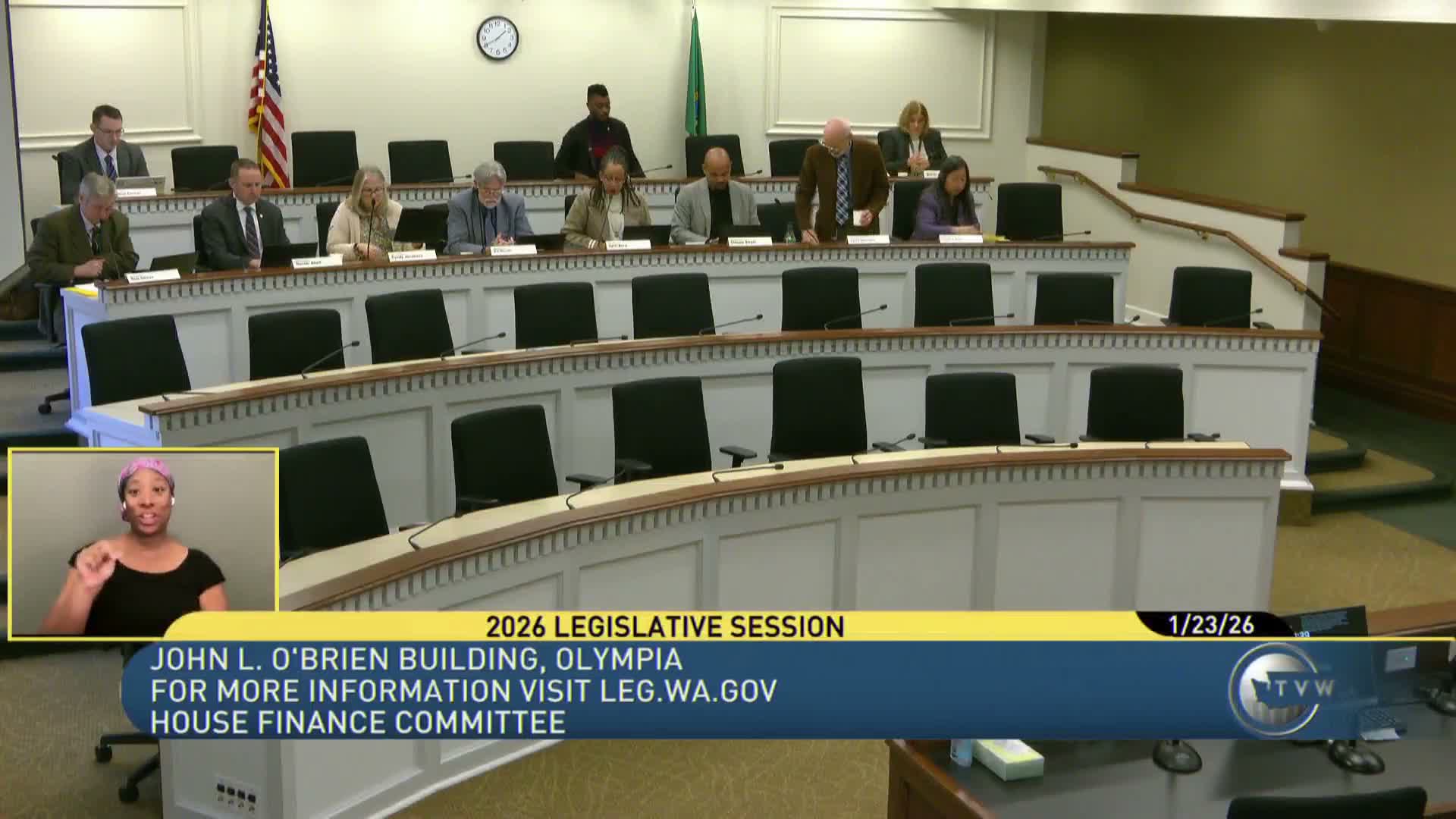
House Finance Committee members heard testimony on House Bill 2194 on Jan. 23, which would allow both a county and a city in the same county to impose a sales-and-use tax dedicated to cultural access programs, with a county required to credit the full amount of any city tax.
The bill was described by Serena Dolly, staff to the committee, as preserving existing limits: a tax rate not to exceed one-tenth of 1% for up to seven years with the option to reimpose for additional seven-year periods. "A preliminary fiscal note from the Department of Revenue estimates no impact to the state general fund," Dolly said, and DOR estimated implementation costs of "$76,000 in the current biennium and $115,000 in the next biennium."
Why it matters: proponents say local cultural-access taxes fund nonprofit cultural organizations, expand free programming and reach students. Ian Quinn, who identified himself as Olympia’s mayor pro tem, told the committee that "Inspire Olympia distributed 2,300,000.0 to 60 local cultural organizations, supporting programs that served more than 271,000 participants," and that in the 2024–25 school year the program supported programming in every Olympia public elementary and middle school, reaching "more than 25 or 23,000 student attendees." Quinn urged the committee to allow the statute’s benefits to be extended countywide while preventing double-taxing for cities with existing programs.
Thurston County Commissioner Wayne Fournier also testified in support, saying the change is "a fiscally responsible, locally controlled financing tool" that keeps decision-making at the local level and helps arts organizations support small businesses and tourism.
Representative Penner asked whether city adoption of the tax could jeopardize county bonds that had used the revenue stream for repayment; staff said they would follow up with a written answer. No formal action or vote occurred; the committee closed the hearing on HB 2194 and moved to the next bill.
The committee did not take a vote on the bill at this hearing; staff agreed to follow up on outstanding technical questions about bond impacts and implementation mechanics.
The bill was described by Serena Dolly, staff to the committee, as preserving existing limits: a tax rate not to exceed one-tenth of 1% for up to seven years with the option to reimpose for additional seven-year periods. "A preliminary fiscal note from the Department of Revenue estimates no impact to the state general fund," Dolly said, and DOR estimated implementation costs of "$76,000 in the current biennium and $115,000 in the next biennium."
Why it matters: proponents say local cultural-access taxes fund nonprofit cultural organizations, expand free programming and reach students. Ian Quinn, who identified himself as Olympia’s mayor pro tem, told the committee that "Inspire Olympia distributed 2,300,000.0 to 60 local cultural organizations, supporting programs that served more than 271,000 participants," and that in the 2024–25 school year the program supported programming in every Olympia public elementary and middle school, reaching "more than 25 or 23,000 student attendees." Quinn urged the committee to allow the statute’s benefits to be extended countywide while preventing double-taxing for cities with existing programs.
Thurston County Commissioner Wayne Fournier also testified in support, saying the change is "a fiscally responsible, locally controlled financing tool" that keeps decision-making at the local level and helps arts organizations support small businesses and tourism.
Representative Penner asked whether city adoption of the tax could jeopardize county bonds that had used the revenue stream for repayment; staff said they would follow up with a written answer. No formal action or vote occurred; the committee closed the hearing on HB 2194 and moved to the next bill.
The committee did not take a vote on the bill at this hearing; staff agreed to follow up on outstanding technical questions about bond impacts and implementation mechanics.
Don't Miss a Word: See the Full Meeting!
Go beyond summaries. Unlock every video, transcript, and key insight with a Founder Membership.
✓
Get instant access to full meeting videos
✓
Search and clip any phrase from complete transcripts
✓
Receive AI-powered summaries & custom alerts
✓
Enjoy lifetime, unrestricted access to government data
30-day money-back guarantee
