Sponsor Says Narrowing Bank Tax Preference Will Restore Wildfire- preparedness Funding
January 23, 2026 | Legislative Sessions, Washington
This article was created by AI summarizing key points discussed. AI makes mistakes, so for full details and context, please refer to the video of the full meeting. Please report any errors so we can fix them. Report an error »
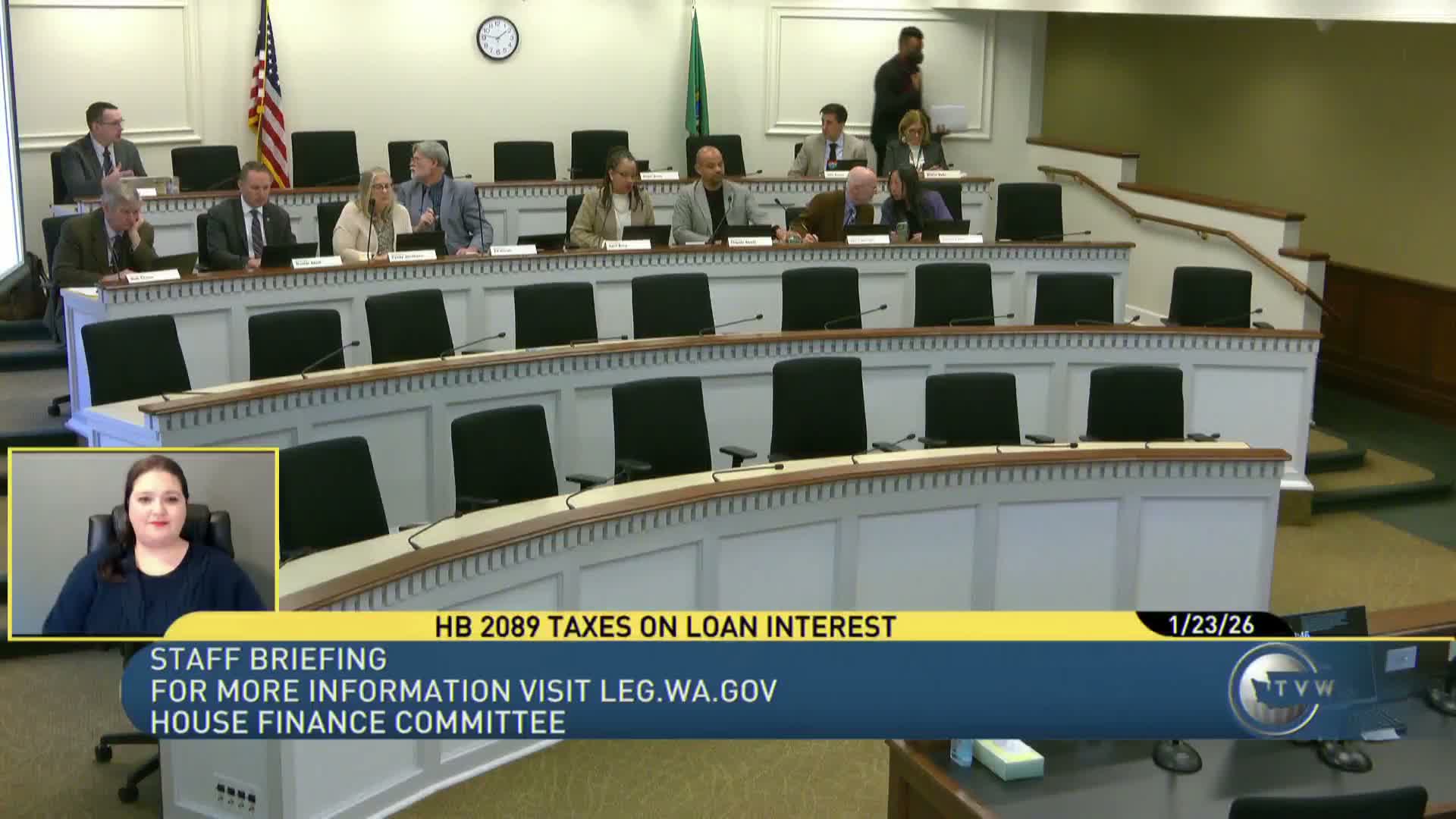
The House Finance Committee heard House Bill 2089 on Jan. 23, a measure the sponsor said would redirect revenue by narrowing a business-and-occupation (B&O) tax preference previously extended to certain financial institutions.
Tracy Taylor, staff to the committee, said the bill removes the requirement that financial institutions be located in 10 or more states to be required to pay B&O tax on interest income from investments or loans secured by first mortgages on non-transient residential properties. Taylor summarized a DOR estimate that the change would impact roughly 450 taxpayers and increase state revenues by approximately $25,900,000 over the first five years and by $64,800,000 in fiscal year 2028 (the first full year), with DOR incurring system and administrative costs estimated at roughly $665,000 in the current biennium and $793,000 in 2027–29.
Representative Sean Scott (43rd District), the bill’s prime sponsor, framed the measure as restoring funding to the Wildfire Response, Forest Restoration and Community Resilience account after reductions in recent budgets. Scott said the change aligns the definition of "community bank" with the federal standard (excluding banks with more than $10,000,000,000 in assets) so large, placeless institutions will not continue to benefit from the preference. "The revenue that's resulting from that is gonna go towards helping our state fight fires," Scott said.
Supporters included Pat Sullivan, director for governmental and external affairs at the Department of Natural Resources, who said restoring a permanent funding source for wildfire preparedness "is a strong step in the right direction" and highlighted programs (including post-fire landslide teams) that rely on prior HB 1168 funding. Seamus Petrie of the Washington Public Employees Association said frontline firefighters and related teams "are absolutely certain" the sponsor does not want to 'fight' them and voiced support for restoring the account.
Opponents from the banking sector urged more precise drafting. Megan Mannigan, director of public affairs for the Washington Bankers Association, said the bank group is "in the other position" and that careful language is needed to ensure community banks that make local mortgages are not harmed; Brad Tower of the Community Bankers of Washington said the bill as written could apply the B&O tax to interest received by banks with a branch in any state and warned of unintended effects on local mortgage lending.
Committee members raised questions about the bill’s intent and distributional effects; staff offered to follow up on technical questions. No vote was taken at the hearing.
Tracy Taylor, staff to the committee, said the bill removes the requirement that financial institutions be located in 10 or more states to be required to pay B&O tax on interest income from investments or loans secured by first mortgages on non-transient residential properties. Taylor summarized a DOR estimate that the change would impact roughly 450 taxpayers and increase state revenues by approximately $25,900,000 over the first five years and by $64,800,000 in fiscal year 2028 (the first full year), with DOR incurring system and administrative costs estimated at roughly $665,000 in the current biennium and $793,000 in 2027–29.
Representative Sean Scott (43rd District), the bill’s prime sponsor, framed the measure as restoring funding to the Wildfire Response, Forest Restoration and Community Resilience account after reductions in recent budgets. Scott said the change aligns the definition of "community bank" with the federal standard (excluding banks with more than $10,000,000,000 in assets) so large, placeless institutions will not continue to benefit from the preference. "The revenue that's resulting from that is gonna go towards helping our state fight fires," Scott said.
Supporters included Pat Sullivan, director for governmental and external affairs at the Department of Natural Resources, who said restoring a permanent funding source for wildfire preparedness "is a strong step in the right direction" and highlighted programs (including post-fire landslide teams) that rely on prior HB 1168 funding. Seamus Petrie of the Washington Public Employees Association said frontline firefighters and related teams "are absolutely certain" the sponsor does not want to 'fight' them and voiced support for restoring the account.
Opponents from the banking sector urged more precise drafting. Megan Mannigan, director of public affairs for the Washington Bankers Association, said the bank group is "in the other position" and that careful language is needed to ensure community banks that make local mortgages are not harmed; Brad Tower of the Community Bankers of Washington said the bill as written could apply the B&O tax to interest received by banks with a branch in any state and warned of unintended effects on local mortgage lending.
Committee members raised questions about the bill’s intent and distributional effects; staff offered to follow up on technical questions. No vote was taken at the hearing.
Don't Miss a Word: See the Full Meeting!
Go beyond summaries. Unlock every video, transcript, and key insight with a Founder Membership.
✓
Get instant access to full meeting videos
✓
Search and clip any phrase from complete transcripts
✓
Receive AI-powered summaries & custom alerts
✓
Enjoy lifetime, unrestricted access to government data
30-day money-back guarantee
