Bill would make post-conviction DNA testing easier to obtain; supporters say it speeds justice, prosecutors warn of resource strain
January 26, 2026 | Legislative Sessions, Washington
This article was created by AI summarizing key points discussed. AI makes mistakes, so for full details and context, please refer to the video of the full meeting. Please report any errors so we can fix them. Report an error »
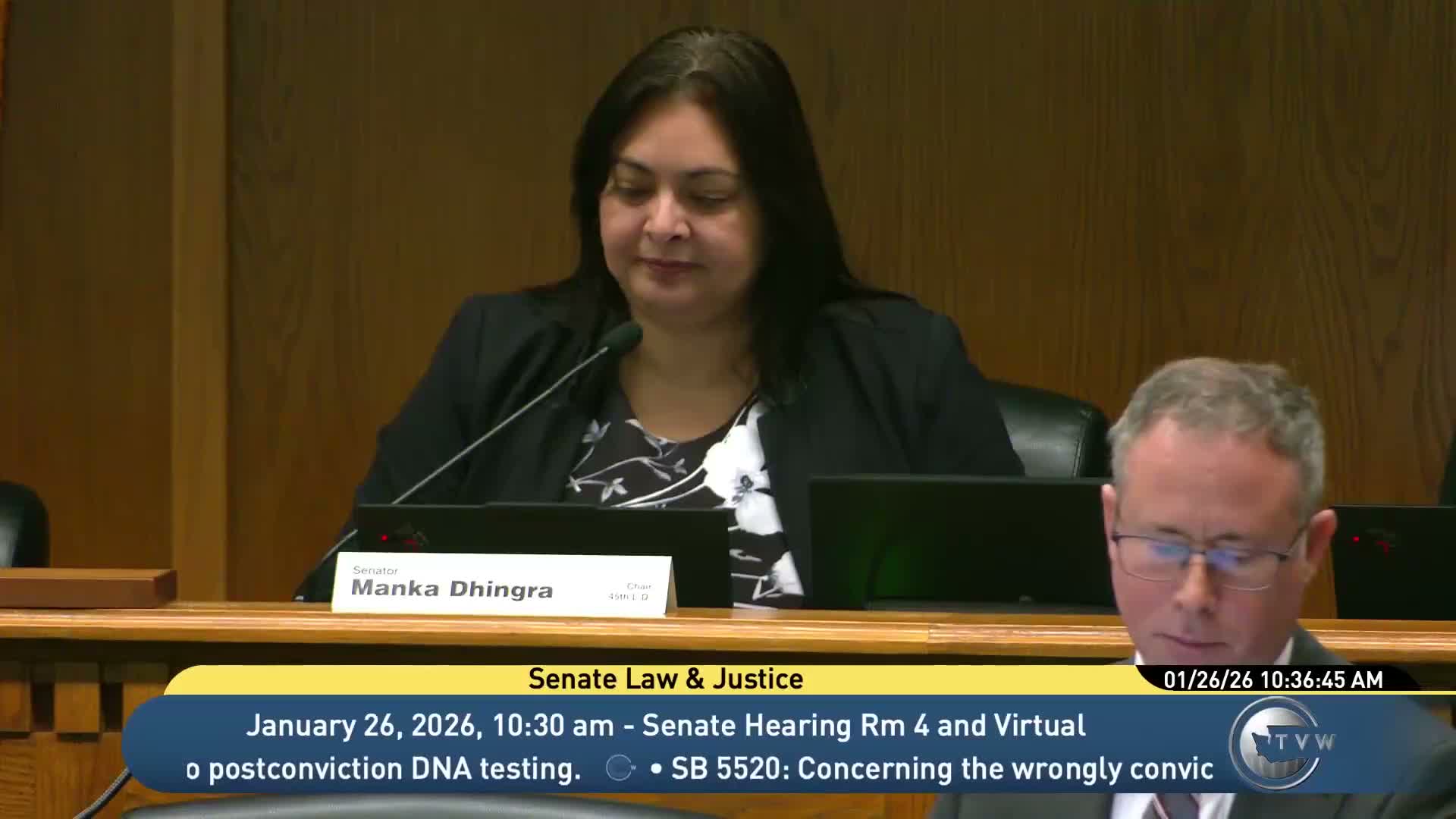
A bill before the Senate Law and Justice Committee would lower the legal barrier for post-conviction DNA testing by directing courts to grant testing unless the state proves by clear and convincing evidence that testing could not demonstrate a likelihood of innocence.
Tim Ford, committee staff, told lawmakers the substitute would require courts to grant motions for DNA testing "if the motion's in proper form unless the state shows by clear and convincing evidence that the DNA evidence could not demonstrate a likelihood of innocence." The proposal also details preservation and transfer procedures for biological material and anticipates consultation with the Washington State Patrol crime lab.
Supporters, including the Washington Innocence Project and litigators who represent convicted people seeking testing, said the current standard forces judges to guess about hypothetical DNA results and yields lengthy litigation. "SB 5,934 replaces guesswork with science," Lindsay White, a litigation attorney at the Washington Innocence Project, told the committee.
Laura Zaretsky, the group's executive and policy director, emphasized the bill applies only to a small, narrow set of cases — people convicted whose convictions are final and who have cleared earlier statutory eligibility hurdles — and said the change would not expand eligibility but would streamline access to testing.
Ted Bradford, Washington's first post-conviction DNA exoneree, described how DNA testing ultimately proved his innocence and said the bill would let others reach scientific truth sooner.
Opponents, including Russell Brown of the Washington Association of Prosecuting Attorneys and James McMahon of the Association of Sheriffs and Police Chiefs, warned the bill would flip the burden onto prosecutors, increase the number of motions, strain laboratory and prosecutorial resources, and undermine finality. "My appellate attorneys believe that the vast majority, 90 to 95% of requests, would be granted because it would just be almost impossible to defeat," Russell Brown told the committee.
The committee heard both extensive survivor and practitioner testimony. No formal action was taken during the hearing; staff noted a fiscal note had been requested.
Tim Ford, committee staff, told lawmakers the substitute would require courts to grant motions for DNA testing "if the motion's in proper form unless the state shows by clear and convincing evidence that the DNA evidence could not demonstrate a likelihood of innocence." The proposal also details preservation and transfer procedures for biological material and anticipates consultation with the Washington State Patrol crime lab.
Supporters, including the Washington Innocence Project and litigators who represent convicted people seeking testing, said the current standard forces judges to guess about hypothetical DNA results and yields lengthy litigation. "SB 5,934 replaces guesswork with science," Lindsay White, a litigation attorney at the Washington Innocence Project, told the committee.
Laura Zaretsky, the group's executive and policy director, emphasized the bill applies only to a small, narrow set of cases — people convicted whose convictions are final and who have cleared earlier statutory eligibility hurdles — and said the change would not expand eligibility but would streamline access to testing.
Ted Bradford, Washington's first post-conviction DNA exoneree, described how DNA testing ultimately proved his innocence and said the bill would let others reach scientific truth sooner.
Opponents, including Russell Brown of the Washington Association of Prosecuting Attorneys and James McMahon of the Association of Sheriffs and Police Chiefs, warned the bill would flip the burden onto prosecutors, increase the number of motions, strain laboratory and prosecutorial resources, and undermine finality. "My appellate attorneys believe that the vast majority, 90 to 95% of requests, would be granted because it would just be almost impossible to defeat," Russell Brown told the committee.
The committee heard both extensive survivor and practitioner testimony. No formal action was taken during the hearing; staff noted a fiscal note had been requested.
Don't Miss a Word: See the Full Meeting!
Go beyond summaries. Unlock every video, transcript, and key insight with a Founder Membership.
✓
Get instant access to full meeting videos
✓
Search and clip any phrase from complete transcripts
✓
Receive AI-powered summaries & custom alerts
✓
Enjoy lifetime, unrestricted access to government data
30-day money-back guarantee
