Senate bill would let judges appoint a designee to question victims when defendants represent themselves and expand survivor protections for FGM and strangling
January 26, 2026 | Legislative Sessions, Washington
This article was created by AI summarizing key points discussed. AI makes mistakes, so for full details and context, please refer to the video of the full meeting. Please report any errors so we can fix them. Report an error »
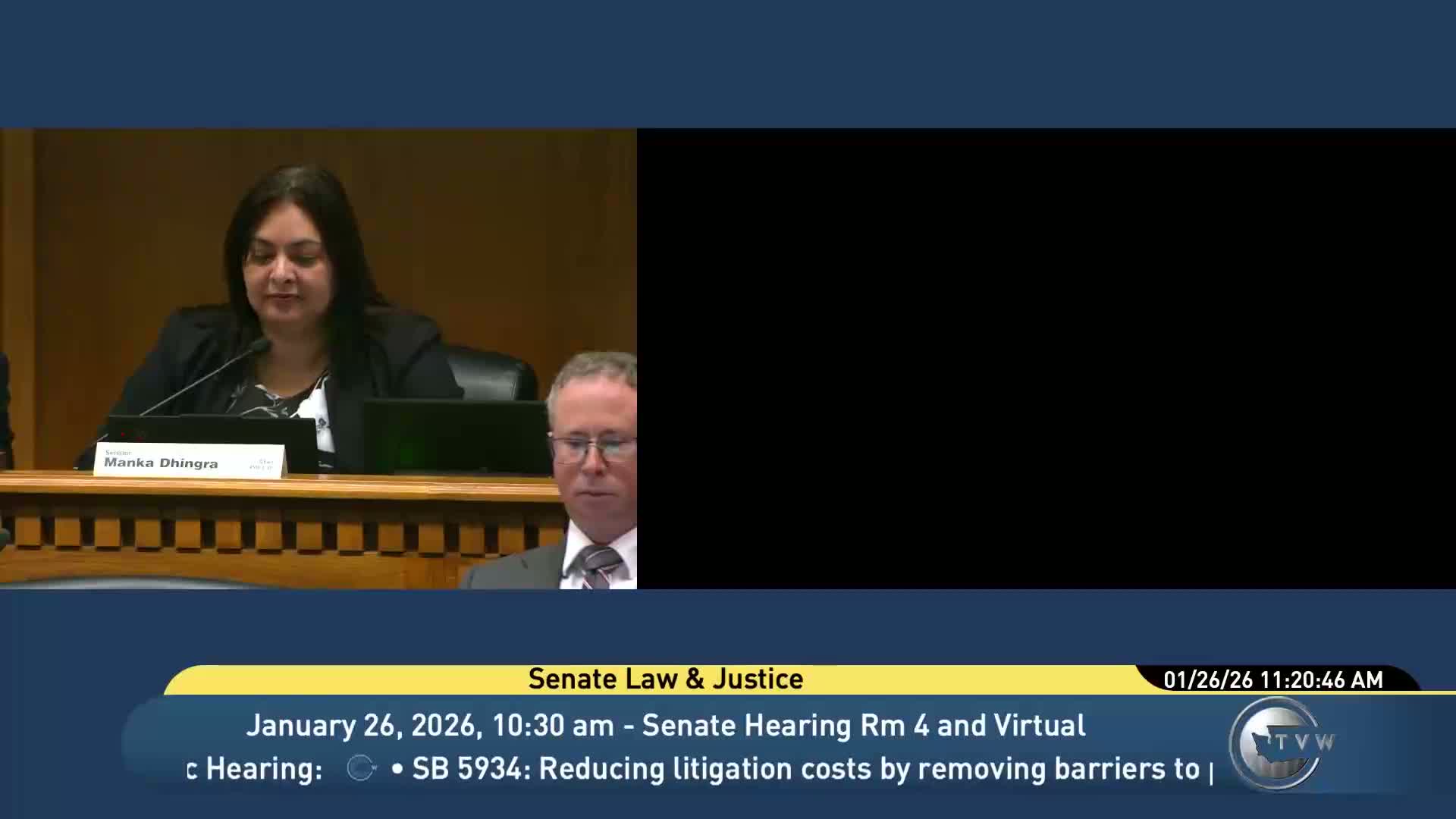
Senate Bill 6,017 would add tools intended to reduce courtroom retraumatization and expand survivor protections. The bill would allow a court, at the request of a prosecutor or plaintiff, to appoint a representative to conduct direct questioning of the victim when a defendant represents themself. It would also let minors aged 13 and older consent to forensic examinations for nonfatal strangulation and extend statutory survivor rights to victims of female genital mutilation (FGM).
Sen. Tina Orwall, the bill sponsor, framed the bill as advancing trauma-informed, culturally sensitive practices: "We really want to make sure the survivor bill of rights addresses all [gender-based] violence so that we can be supporting all survivors," she told the committee.
Survivors and providers gave the committee extensive testimony about courtroom harm when defendants act as their own counsel. Abigail Echo Hawk of the Seattle Indian Health Board said she had watched a pro se defendant "berate, humiliate, and further traumatize" survivors in court and urged passage. Jocelyn Cooney, a senior deputy prosecutor in King County, described a recent case in which a defendant representing himself questioned six survivors for days and said the bill would preserve both a defendant's Sixth Amendment rights and victims' protections.
Defense organizations, however, urged changes. Ramona Brandes of the Washington Defender Association and the Washington Association of Criminal Defense Lawyers warned the committee of constitutional risks in curtailing a pro se defendant’s personal confrontation rights and recommended adding individualized guardrails and fiscal accounting for appointed representatives.
Health and victim-service groups, including the Attorney General’s Office, the SAFE Advisory Group, and child-advocacy organizations, spoke in support and asked for complementary funding to sustain victim services and accommodate expanded referrals for care (one witness asked for roughly $21.38 million in supplemental funding to stabilize crime-victim services).
The committee did not vote during the public hearing; staff recorded over 100 sign-ins in support and a small number opposed.
Sen. Tina Orwall, the bill sponsor, framed the bill as advancing trauma-informed, culturally sensitive practices: "We really want to make sure the survivor bill of rights addresses all [gender-based] violence so that we can be supporting all survivors," she told the committee.
Survivors and providers gave the committee extensive testimony about courtroom harm when defendants act as their own counsel. Abigail Echo Hawk of the Seattle Indian Health Board said she had watched a pro se defendant "berate, humiliate, and further traumatize" survivors in court and urged passage. Jocelyn Cooney, a senior deputy prosecutor in King County, described a recent case in which a defendant representing himself questioned six survivors for days and said the bill would preserve both a defendant's Sixth Amendment rights and victims' protections.
Defense organizations, however, urged changes. Ramona Brandes of the Washington Defender Association and the Washington Association of Criminal Defense Lawyers warned the committee of constitutional risks in curtailing a pro se defendant’s personal confrontation rights and recommended adding individualized guardrails and fiscal accounting for appointed representatives.
Health and victim-service groups, including the Attorney General’s Office, the SAFE Advisory Group, and child-advocacy organizations, spoke in support and asked for complementary funding to sustain victim services and accommodate expanded referrals for care (one witness asked for roughly $21.38 million in supplemental funding to stabilize crime-victim services).
The committee did not vote during the public hearing; staff recorded over 100 sign-ins in support and a small number opposed.
View the Full Meeting & All Its Details
This article offers just a summary. Unlock complete video, transcripts, and insights as a Founder Member.
✓
Watch full, unedited meeting videos
✓
Search every word spoken in unlimited transcripts
✓
AI summaries & real-time alerts (all government levels)
✓
Permanent access to expanding government content
30-day money-back guarantee
