Senate committee hears bill to allow spouses of irrigation directors to be employed by districts
January 26, 2026 | Legislative Sessions, Washington
This article was created by AI summarizing key points discussed. AI makes mistakes, so for full details and context, please refer to the video of the full meeting. Please report any errors so we can fix them. Report an error »
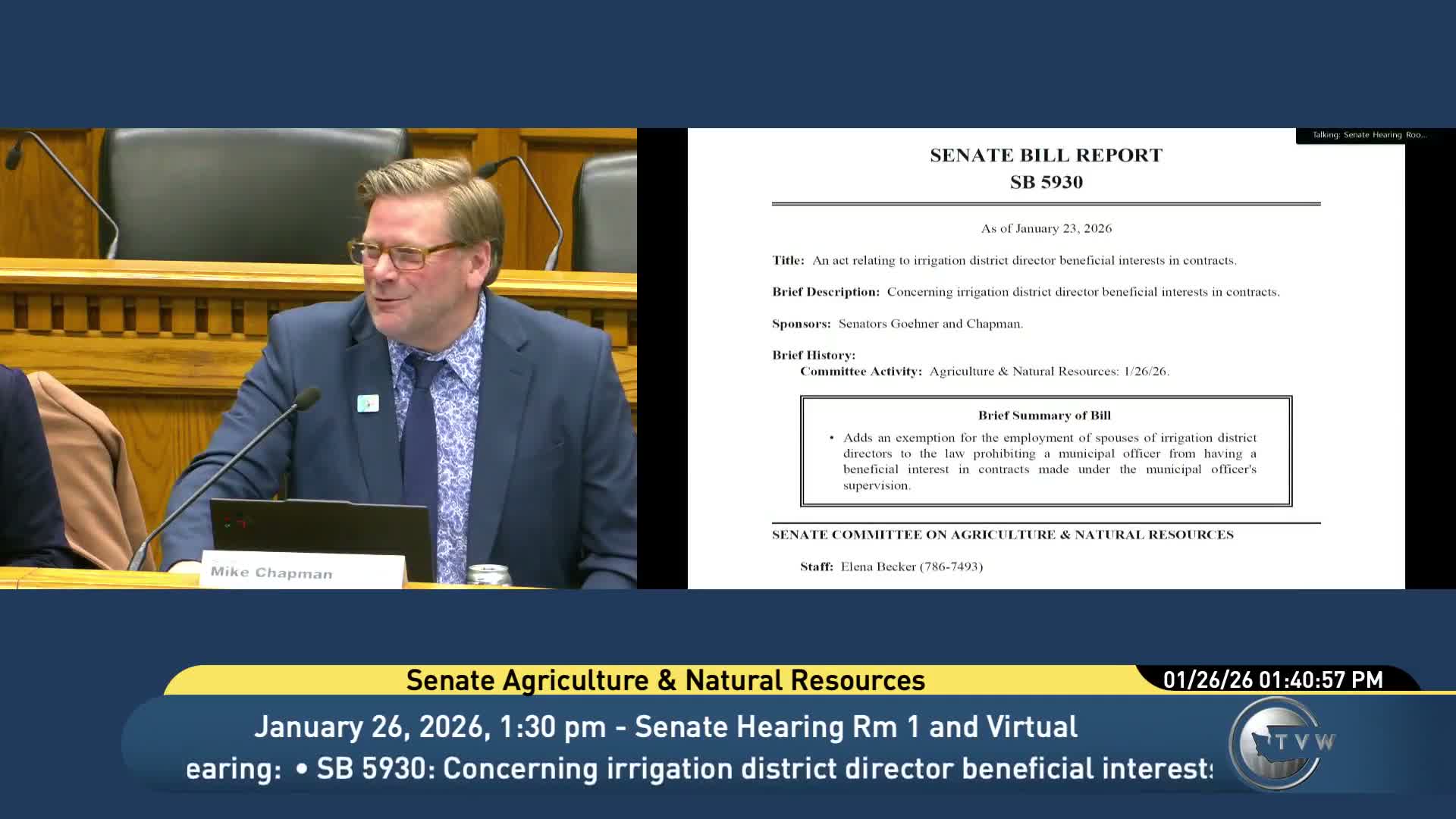
Senate Bill 5930 would create an exception allowing the spouse of an irrigation district director to be employed by that district if the spouse’s employment began before the director’s initial election, committee staff told lawmakers.
The bill’s sponsor, Sen. Keith Gaynor (12th District), said the measure is "a pretty simple straightforward bill" intended to align irrigation districts with similar exceptions already in law for school and hospital districts. He told the Senate Agriculture and Natural Resources Committee that rural districts sometimes struggle to find people willing or qualified to serve as directors or employees, and that the bill adds needed flexibility while preserving safeguards.
Committee staff Elena Becker summarized the bill’s key safeguards: contract terms must be commensurate with pay plans or collective-bargaining agreements for similar employees; the director must disclose the interest to the board and the disclosure must be noted in official district minutes before awarding or continuing the contract; and the director may not vote on the contract’s authorization, approval or ratification. Becker told the committee the fiscal note was not yet available.
John Stumiller, representing the Washington State Water Resources Association, testified in support, saying the bill "puts that safeguard in" and that requiring recusal and disclosure prevents conflicts while allowing districts to hire locally when staffing is scarce.
No one testified in opposition during the in-person hearing; the vice chair reported 58 written pro submissions and one written con submission.
The committee closed the public hearing on SB 5930 and did not take a vote on final passage during the session recorded in the transcript. The next procedural step for the bill will depend on committee scheduling and the availability of a fiscal note.
The bill’s sponsor, Sen. Keith Gaynor (12th District), said the measure is "a pretty simple straightforward bill" intended to align irrigation districts with similar exceptions already in law for school and hospital districts. He told the Senate Agriculture and Natural Resources Committee that rural districts sometimes struggle to find people willing or qualified to serve as directors or employees, and that the bill adds needed flexibility while preserving safeguards.
Committee staff Elena Becker summarized the bill’s key safeguards: contract terms must be commensurate with pay plans or collective-bargaining agreements for similar employees; the director must disclose the interest to the board and the disclosure must be noted in official district minutes before awarding or continuing the contract; and the director may not vote on the contract’s authorization, approval or ratification. Becker told the committee the fiscal note was not yet available.
John Stumiller, representing the Washington State Water Resources Association, testified in support, saying the bill "puts that safeguard in" and that requiring recusal and disclosure prevents conflicts while allowing districts to hire locally when staffing is scarce.
No one testified in opposition during the in-person hearing; the vice chair reported 58 written pro submissions and one written con submission.
The committee closed the public hearing on SB 5930 and did not take a vote on final passage during the session recorded in the transcript. The next procedural step for the bill will depend on committee scheduling and the availability of a fiscal note.
View the Full Meeting & All Its Details
This article offers just a summary. Unlock complete video, transcripts, and insights as a Founder Member.
✓
Watch full, unedited meeting videos
✓
Search every word spoken in unlimited transcripts
✓
AI summaries & real-time alerts (all government levels)
✓
Permanent access to expanding government content
30-day money-back guarantee
