House committee hears bill expanding exploitation-of-minor statute to cover coerced viewing and recorded reactions
January 26, 2026 | Legislative Sessions, Washington
This article was created by AI summarizing key points discussed. AI makes mistakes, so for full details and context, please refer to the video of the full meeting. Please report any errors so we can fix them. Report an error »
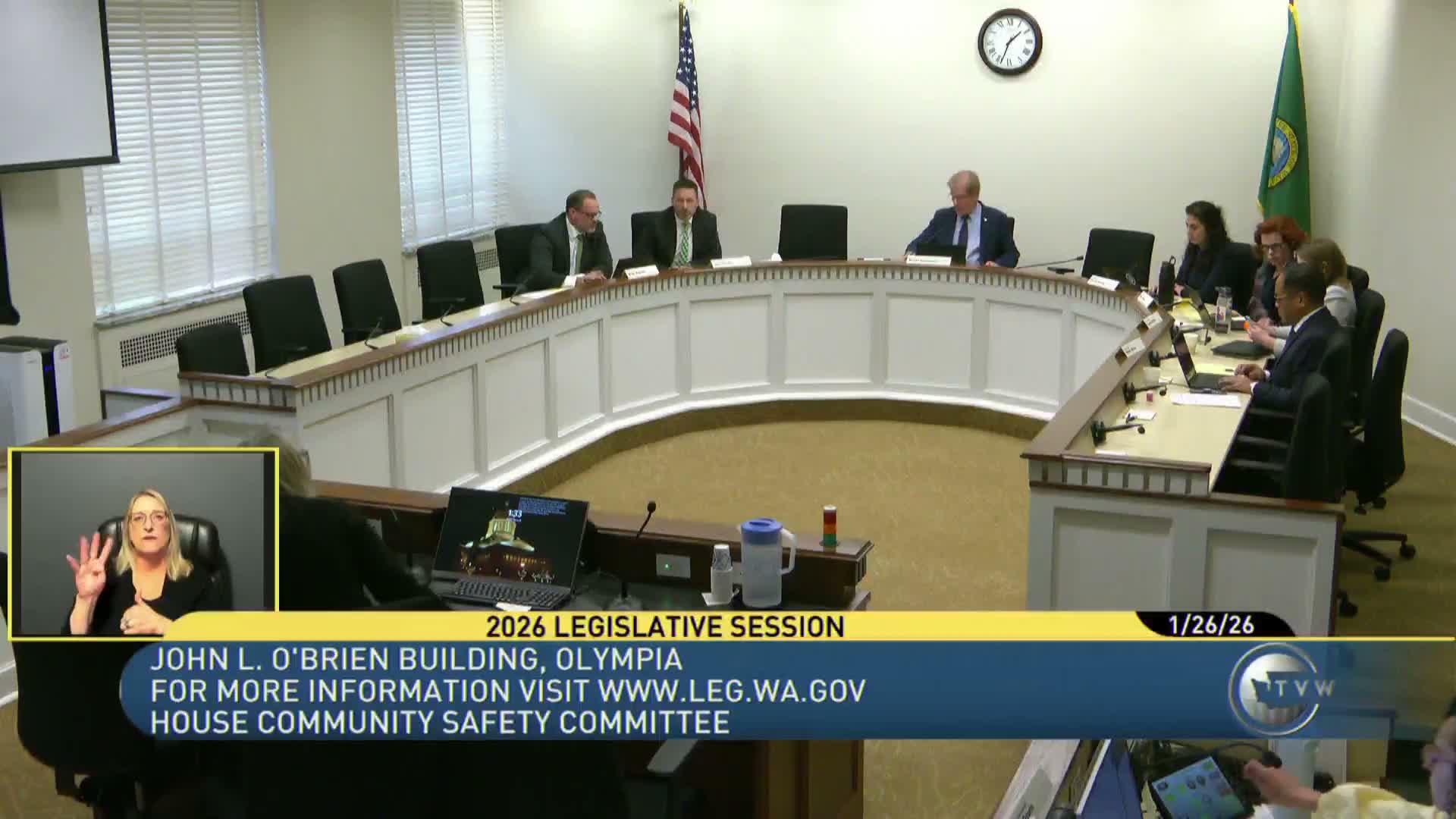
Corey Patton, staff to the House Community Safety Committee, opened the public hearing on House Bill 21-46, describing a measure that would expand the state's exploitation-of-a-minor statute to include causing a minor to view explicit conduct when the actor knows the conduct will be photographed or part of a live performance.
Steven Thomas, a special victims detective with the Olympia Police Department, told the committee an OPD investigation found an adult had uploaded videos of himself engaging in explicit conduct while his 9-year-old daughter was present and interacting with viewers. Thomas said existing options — typically misdemeanor indecent exposure — did not reflect the gravity of the conduct in that case and left victims without the protections and penalties of a felony. "The best RCW option that we found that fit was indecent exposure, a gross misdemeanor, but this statute does not address the gravity of this activity," Thomas said.
Deputy prosecuting attorney Robin Sand, team lead of Pierce County's special assault unit, and deputy prosecutor Ivy Rose Kramer described similar patterns of livestreaming and recorded material. Sand said such cases are often prosecuted only as misdemeanors (communication with a minor for immoral purposes or indecent exposure), which limits access to forensic interviews, longer statutes of limitation, no registry requirement and lesser sentencing and supervisory tools. "With this proposed amendment, we're hoping to...give us the tools in order to prevent these child [sexual] abuse acts," Sand said.
Pierce County prosecutor Bryce Nelson explained the sentencing and investigative differences between misdemeanor and felony charges: felony-level exploitation is a level 9, class B felony with extended no-contact protections and longer community custody, whereas common misdemeanor charges carry far lighter sanctions and shorter no-contact orders. Nelson urged the committee to support the bill so victims would receive better statutory protections and prosecutors would have appropriate charging options.
Members asked about interstate comparators and whether other jurisdictions criminalize similar conduct; Thomas and Sand said they could not provide a comprehensive survey of other states during the hearing but noted the UCMJ provided one useful comparison. Committee members also questioned forensic interview protocols; prosecutors emphasized that forensic interviews are typically available only for suspected felony abuse, which is one reason proponents said the statutory change matters.
The committee concluded the public testimony on HB 21-46 and moved on to other bills on the agenda. No formal vote was taken during the hearing — staff and witnesses indicated they were available to answer follow-up questions and provide additional information.
Steven Thomas, a special victims detective with the Olympia Police Department, told the committee an OPD investigation found an adult had uploaded videos of himself engaging in explicit conduct while his 9-year-old daughter was present and interacting with viewers. Thomas said existing options — typically misdemeanor indecent exposure — did not reflect the gravity of the conduct in that case and left victims without the protections and penalties of a felony. "The best RCW option that we found that fit was indecent exposure, a gross misdemeanor, but this statute does not address the gravity of this activity," Thomas said.
Deputy prosecuting attorney Robin Sand, team lead of Pierce County's special assault unit, and deputy prosecutor Ivy Rose Kramer described similar patterns of livestreaming and recorded material. Sand said such cases are often prosecuted only as misdemeanors (communication with a minor for immoral purposes or indecent exposure), which limits access to forensic interviews, longer statutes of limitation, no registry requirement and lesser sentencing and supervisory tools. "With this proposed amendment, we're hoping to...give us the tools in order to prevent these child [sexual] abuse acts," Sand said.
Pierce County prosecutor Bryce Nelson explained the sentencing and investigative differences between misdemeanor and felony charges: felony-level exploitation is a level 9, class B felony with extended no-contact protections and longer community custody, whereas common misdemeanor charges carry far lighter sanctions and shorter no-contact orders. Nelson urged the committee to support the bill so victims would receive better statutory protections and prosecutors would have appropriate charging options.
Members asked about interstate comparators and whether other jurisdictions criminalize similar conduct; Thomas and Sand said they could not provide a comprehensive survey of other states during the hearing but noted the UCMJ provided one useful comparison. Committee members also questioned forensic interview protocols; prosecutors emphasized that forensic interviews are typically available only for suspected felony abuse, which is one reason proponents said the statutory change matters.
The committee concluded the public testimony on HB 21-46 and moved on to other bills on the agenda. No formal vote was taken during the hearing — staff and witnesses indicated they were available to answer follow-up questions and provide additional information.
View the Full Meeting & All Its Details
This article offers just a summary. Unlock complete video, transcripts, and insights as a Founder Member.
✓
Watch full, unedited meeting videos
✓
Search every word spoken in unlimited transcripts
✓
AI summaries & real-time alerts (all government levels)
✓
Permanent access to expanding government content
30-day money-back guarantee
