Industry pushes revenue‑based limits to curb cannabis oversupply; stakeholders urge implementation fixes
January 26, 2026 | Legislative Sessions, Washington
This article was created by AI summarizing key points discussed. AI makes mistakes, so for full details and context, please refer to the video of the full meeting. Please report any errors so we can fix them. Report an error »
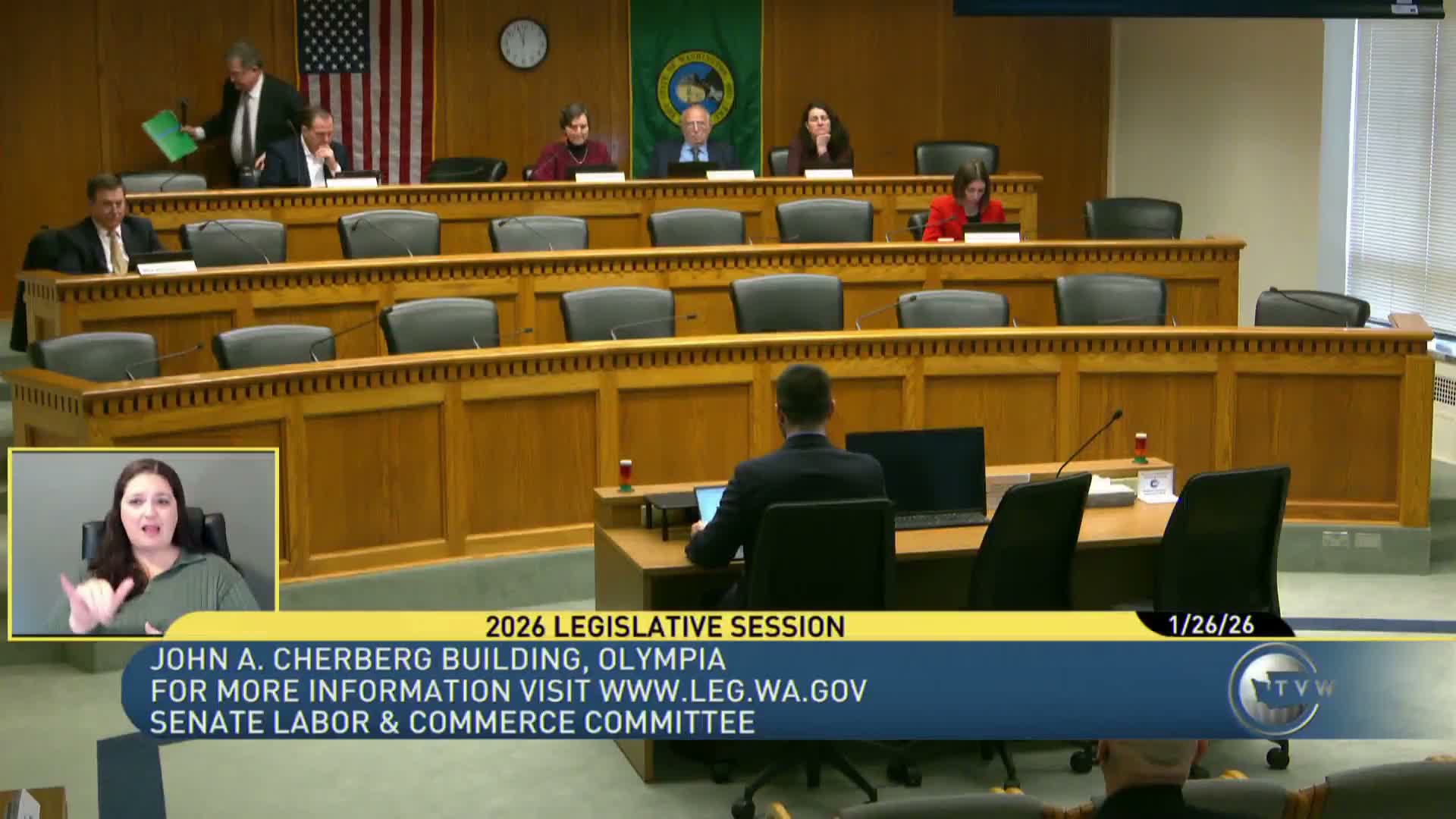
Senate Bill 6,195, aimed at reining in a long‑running oversupply problem in Washington’s regulated cannabis market, drew broad support from licensees and retailers at the Senate Labor & Commerce hearing.
Committee staff Marlon Yanes said the bill requires tier 3 producers to demonstrate minimum gross sales of $24,000 per month ($288,000 annually) in the two years before renewal; tier 2 must demonstrate $8,000 per month ($96,000 annually). Failure to meet thresholds would convert a license to a lower tier; tier 1 producers (smallest tier) would be protected from down‑tiering based on revenue. The bill allows for a one‑year exemption request for extenuating circumstances. A fiscal note was requested but not yet available.
Proponents—represented by the Washington Cannabis Licensee Association and dozens of producers, processors and retailers—told the committee oversupply has driven wholesale prices down, forced noncompliant actors to enter the market and eroded tax revenue. Trent Mattson (WCLA) described the bill as a measured, data‑driven response consistent with JLARC’s findings; Jason Hutto and multiple producers recounted price pressure, dormant licenses contributing to oversupply, and illicit diversion risks.
Several witnesses from social equity and producer groups urged care in implementation. Ezra Eichmeier (Producers Northwest) and others said the concept is sound but the bill’s language needs fixes to avoid unintentionally penalizing legitimate businesses, to account for different cultivation methods and to allow LCB flexibility based on improved traceability and data.
Retailers and long‑time operators emphasized the need to link canopy to actual market demand to restore long‑term viability of small businesses. The chair invited technical amendments and stakeholder input to address implementation concerns; no committee vote occurred during the session.
Committee staff Marlon Yanes said the bill requires tier 3 producers to demonstrate minimum gross sales of $24,000 per month ($288,000 annually) in the two years before renewal; tier 2 must demonstrate $8,000 per month ($96,000 annually). Failure to meet thresholds would convert a license to a lower tier; tier 1 producers (smallest tier) would be protected from down‑tiering based on revenue. The bill allows for a one‑year exemption request for extenuating circumstances. A fiscal note was requested but not yet available.
Proponents—represented by the Washington Cannabis Licensee Association and dozens of producers, processors and retailers—told the committee oversupply has driven wholesale prices down, forced noncompliant actors to enter the market and eroded tax revenue. Trent Mattson (WCLA) described the bill as a measured, data‑driven response consistent with JLARC’s findings; Jason Hutto and multiple producers recounted price pressure, dormant licenses contributing to oversupply, and illicit diversion risks.
Several witnesses from social equity and producer groups urged care in implementation. Ezra Eichmeier (Producers Northwest) and others said the concept is sound but the bill’s language needs fixes to avoid unintentionally penalizing legitimate businesses, to account for different cultivation methods and to allow LCB flexibility based on improved traceability and data.
Retailers and long‑time operators emphasized the need to link canopy to actual market demand to restore long‑term viability of small businesses. The chair invited technical amendments and stakeholder input to address implementation concerns; no committee vote occurred during the session.
View the Full Meeting & All Its Details
This article offers just a summary. Unlock complete video, transcripts, and insights as a Founder Member.
✓
Watch full, unedited meeting videos
✓
Search every word spoken in unlimited transcripts
✓
AI summaries & real-time alerts (all government levels)
✓
Permanent access to expanding government content
30-day money-back guarantee
