Committee considers raising penalties for trafficking covered species, directing funds to UW forensic center
January 26, 2026 | Legislative Sessions, Washington
This article was created by AI summarizing key points discussed. AI makes mistakes, so for full details and context, please refer to the video of the full meeting. Please report any errors so we can fix them. Report an error »
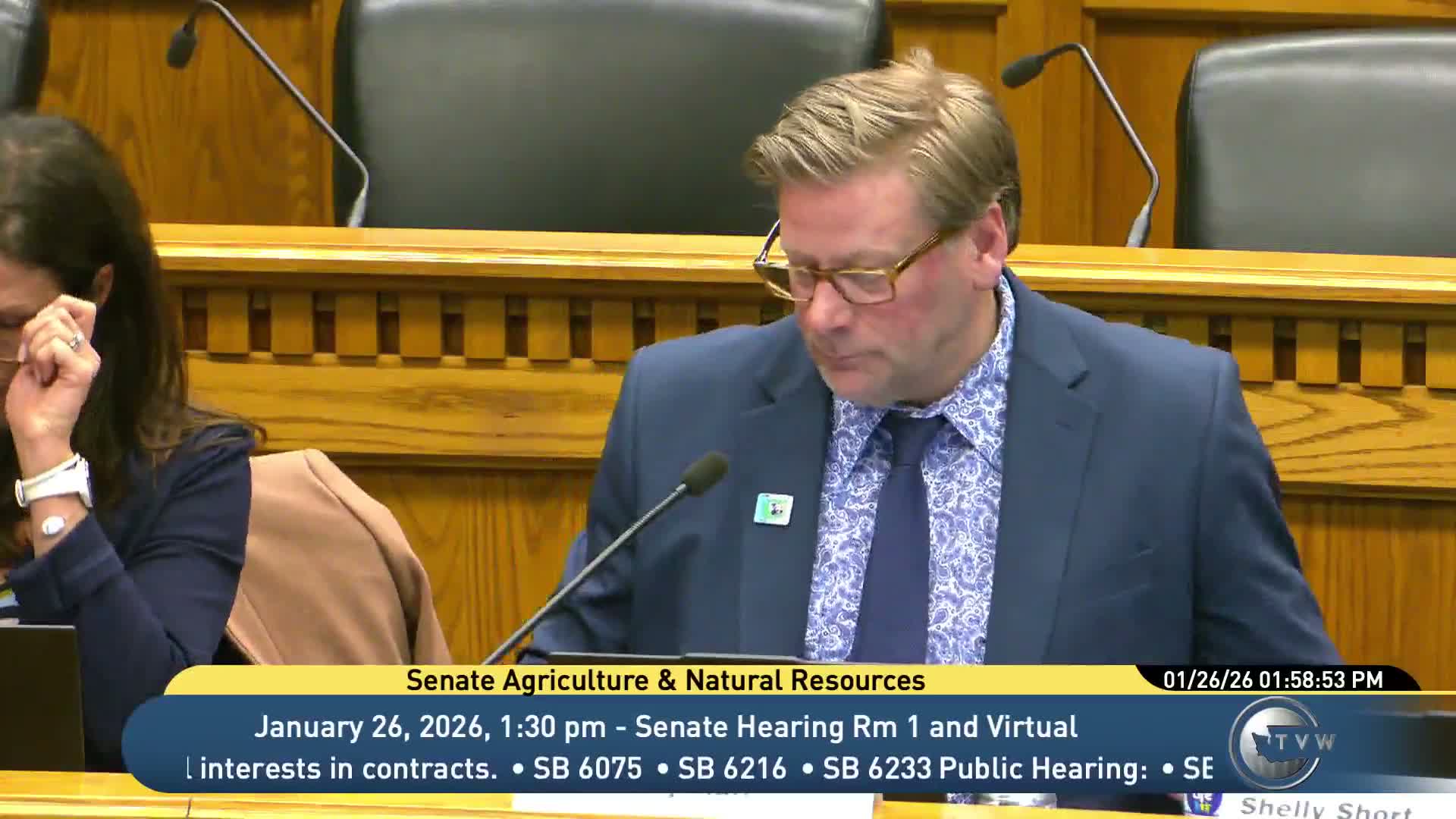
Senate Bill 6233 would raise criminal wildlife penalty assessments for unlawful trade in covered species under Initiative 1401 and direct half of the penalty revenues to the University of Washington’s Center for Environmental Forensic Science (CEFS).
Committee staff Jeff Olson said the bill increases the mandatory criminal wildlife penalty assessment from $2,000 to $4,000 for second-degree trafficking offenses, and from $4,000 to $8,000 for first-degree offenses, and requires Fish and Wildlife to transfer 50% of the penalty amounts to the UW center. Olson said the fiscal note shows roughly $8,000 per year in additional penalty revenues would be generated and transferred to the university under the proposal.
Senators asked staff follow-up questions about how many citations are issued under the covered-species law, how the statute defines "trade," and why revenues would be directed to the UW Center for Environmental Forensic Science. Staff said he would follow up with committee members by email with more detailed information.
Samuel Wasser, executive director of CEFS at the University of Washington, testified remotely and described the center’s wildlife forensic work, including DNA methods used to trace illegal ivory shipments and to link transnational trafficking to poaching hotspots. Wasser told the committee that when wildlife is harvested illegally in another country, "by use of the Lacey Act, they can be, tried here in The United States for, those kinds of issues." He said CEFS methods also apply to timber and other wildlife products and supported the bill’s intent to fund forensic science capacity.
The committee also voted to waive the five-day notice rule to consider SB 6233; that motion was moved from the vice chair and the committee recorded an "Aye" and the motion carried. The transcript records written comments and the committee closed its business for the day; no final passage vote on SB 6233 is recorded.
Committee staff Jeff Olson said the bill increases the mandatory criminal wildlife penalty assessment from $2,000 to $4,000 for second-degree trafficking offenses, and from $4,000 to $8,000 for first-degree offenses, and requires Fish and Wildlife to transfer 50% of the penalty amounts to the UW center. Olson said the fiscal note shows roughly $8,000 per year in additional penalty revenues would be generated and transferred to the university under the proposal.
Senators asked staff follow-up questions about how many citations are issued under the covered-species law, how the statute defines "trade," and why revenues would be directed to the UW Center for Environmental Forensic Science. Staff said he would follow up with committee members by email with more detailed information.
Samuel Wasser, executive director of CEFS at the University of Washington, testified remotely and described the center’s wildlife forensic work, including DNA methods used to trace illegal ivory shipments and to link transnational trafficking to poaching hotspots. Wasser told the committee that when wildlife is harvested illegally in another country, "by use of the Lacey Act, they can be, tried here in The United States for, those kinds of issues." He said CEFS methods also apply to timber and other wildlife products and supported the bill’s intent to fund forensic science capacity.
The committee also voted to waive the five-day notice rule to consider SB 6233; that motion was moved from the vice chair and the committee recorded an "Aye" and the motion carried. The transcript records written comments and the committee closed its business for the day; no final passage vote on SB 6233 is recorded.
View the Full Meeting & All Its Details
This article offers just a summary. Unlock complete video, transcripts, and insights as a Founder Member.
✓
Watch full, unedited meeting videos
✓
Search every word spoken in unlimited transcripts
✓
AI summaries & real-time alerts (all government levels)
✓
Permanent access to expanding government content
30-day money-back guarantee
