Debate over restoring and raising the victim penalty assessment centers on funding for victim services
January 26, 2026 | Legislative Sessions, Washington
This article was created by AI summarizing key points discussed. AI makes mistakes, so for full details and context, please refer to the video of the full meeting. Please report any errors so we can fix them. Report an error »
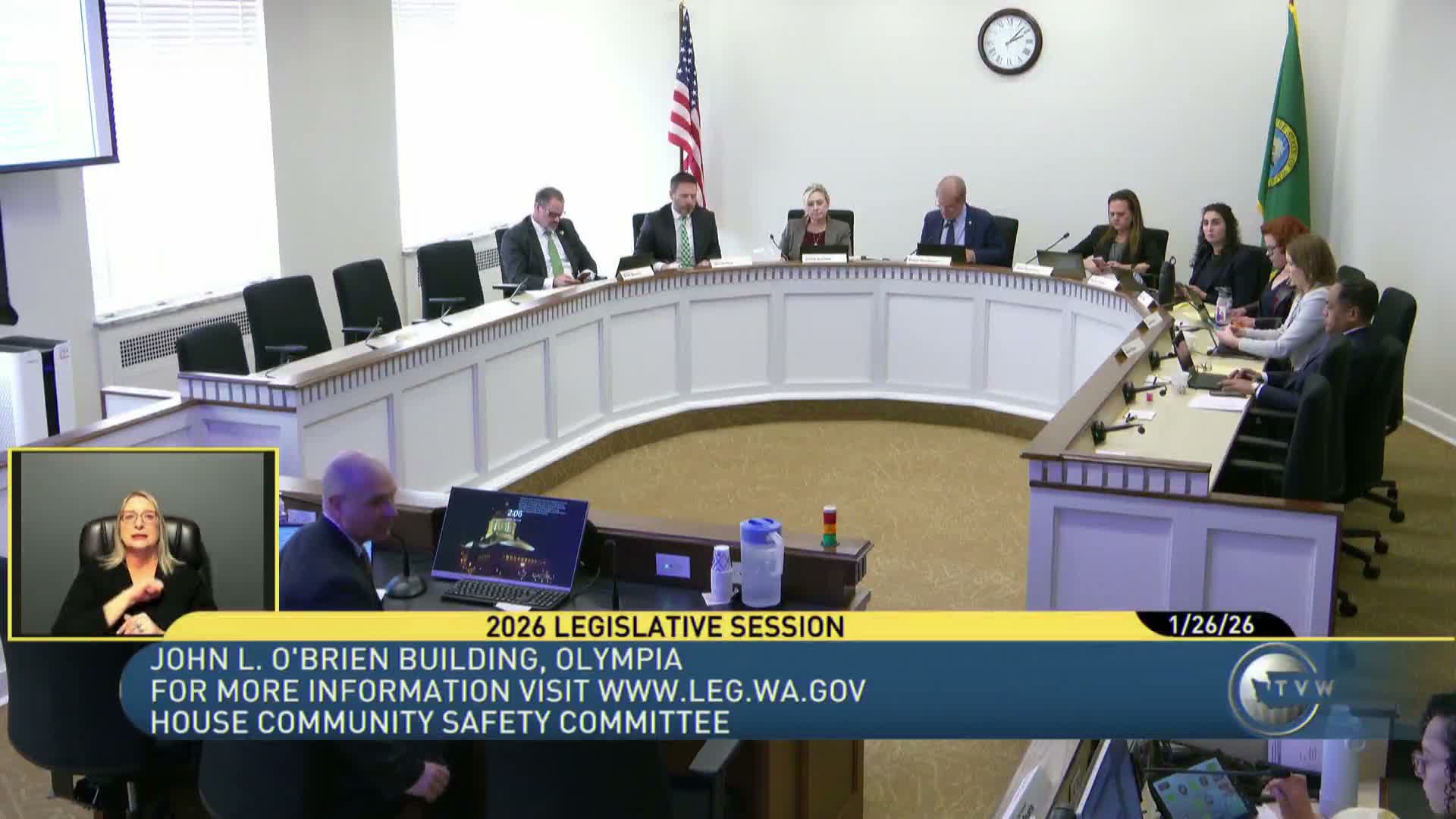
Lena Langer provided background on the crime-victim penalty assessment (CVPA), noting the current assessment is $500 for felonies/gross misdemeanors and $250 for misdemeanors and that revenue must be deposited into a fund supporting comprehensive victim services. She briefed the committee on two related bills heard together: HB 24-30 would reinstate or require the CVPA more broadly, while HB 24-57 would raise the CVPA to $2,000 for felonies/gross misdemeanors and $1,000 for misdemeanors, add an indigency-definition change and allow courts to impose an additional surcharge up to $50,000 where defendants possess substantial financial resources.
Representative Peter Abarno presented HB 24-30 emphasizing accountability and the funding gap for victim services; Representative Lauren Davis presented HB 24-57 stressing that the state had previously committed to backfilling victim services but that local programs have experienced a roughly 75% funding reduction since that promise was not fully kept.
Victim advocates, prosecutors and county officials testified in favor. Tiffany Atrill, Natasha Wilson, John Tunheim (Thurston County prosecuting attorney) and Jason Cummins (Snohomish County prosecuting attorney) said recent state funding changes left local offices and victim-programs deeply cut; Tunheim said his office had fallen to about 25% of the funds it previously received from the VPA and had eliminated several full-time victim-advocate positions. Witnesses argued restoring or increasing the assessment would sustain crisis response, advocacy, forensic and hospital support and improve victim services.
Opponents — including Ramona Brandes (Washington Defender Association), Hannah Warner (Columbia Legal Services) and others — argued mandatory fees and increased assessments would disproportionately harm people living in poverty, exacerbate court debt that is difficult to collect, and create collateral consequences (warrants, probation violations) that increase system costs. Brandes urged mirroring indigency definitions from other statutes to prevent contradictory standards.
Speakers urged sponsors to work together; the chair assigned Representatives Abarno and Davis to produce a single, merged proposal for committee consideration the following week. The committee closed public testimony on both bills to allow sponsor collaboration.
Representative Peter Abarno presented HB 24-30 emphasizing accountability and the funding gap for victim services; Representative Lauren Davis presented HB 24-57 stressing that the state had previously committed to backfilling victim services but that local programs have experienced a roughly 75% funding reduction since that promise was not fully kept.
Victim advocates, prosecutors and county officials testified in favor. Tiffany Atrill, Natasha Wilson, John Tunheim (Thurston County prosecuting attorney) and Jason Cummins (Snohomish County prosecuting attorney) said recent state funding changes left local offices and victim-programs deeply cut; Tunheim said his office had fallen to about 25% of the funds it previously received from the VPA and had eliminated several full-time victim-advocate positions. Witnesses argued restoring or increasing the assessment would sustain crisis response, advocacy, forensic and hospital support and improve victim services.
Opponents — including Ramona Brandes (Washington Defender Association), Hannah Warner (Columbia Legal Services) and others — argued mandatory fees and increased assessments would disproportionately harm people living in poverty, exacerbate court debt that is difficult to collect, and create collateral consequences (warrants, probation violations) that increase system costs. Brandes urged mirroring indigency definitions from other statutes to prevent contradictory standards.
Speakers urged sponsors to work together; the chair assigned Representatives Abarno and Davis to produce a single, merged proposal for committee consideration the following week. The committee closed public testimony on both bills to allow sponsor collaboration.
Don't Miss a Word: See the Full Meeting!
Go beyond summaries. Unlock every video, transcript, and key insight with a Founder Membership.
✓
Get instant access to full meeting videos
✓
Search and clip any phrase from complete transcripts
✓
Receive AI-powered summaries & custom alerts
✓
Enjoy lifetime, unrestricted access to government data
30-day money-back guarantee
