Committee hears bill to require school district reserve minimums, monthly OSPI reporting amid objections from rural districts
January 26, 2026 | Legislative Sessions, Washington
This article was created by AI summarizing key points discussed. AI makes mistakes, so for full details and context, please refer to the video of the full meeting. Please report any errors so we can fix them. Report an error »
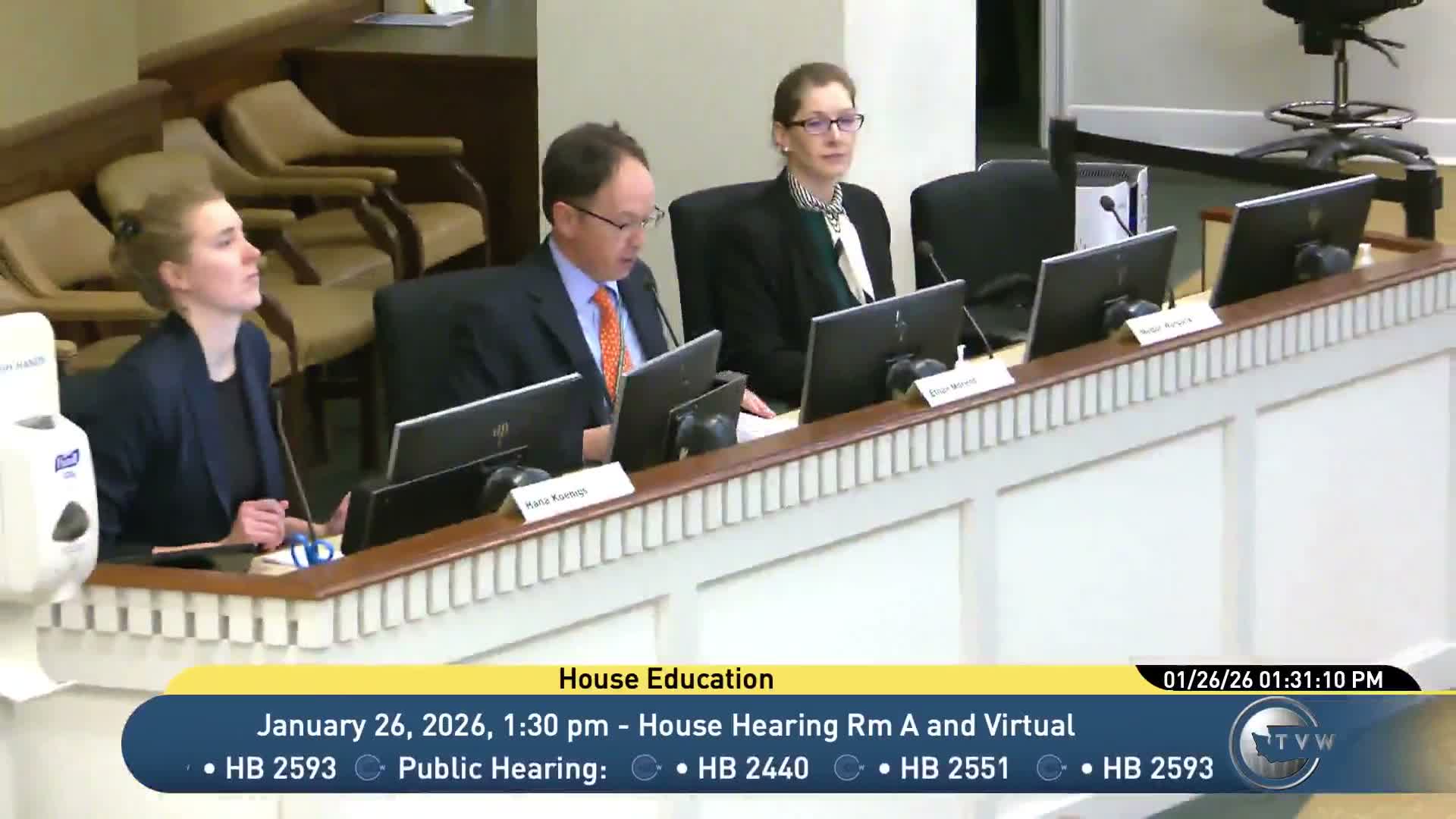
A bill that would require Washington school districts to hold minimum general‑fund reserves and file monthly financial reports with the Office of the Superintendent of Public Instruction drew support from state education officials and concern from school leaders on Monday.
Ethan Moreno, nonpartisan committee staff, described HB 2,593 as an OSPI request that would require school district boards to “include a restriction for a minimum fund balance within the district's general fund,” direct OSPI to calculate district‑specific minimum and maximum amounts, and create monthly data‑submission rules. Moreno also noted the bill would bar using restricted minimum funds for ongoing salaries and allow OSPI, under the bill, to withhold monthly apportionment payments if required data are not submitted within 45 days.
OSPI officials framed the bill as a cash‑flow and solvency tool. “This bill sets a minimum fund balance requirement, 6% for large districts, 8.5% for small districts,” Sean Lewis, OSPI’s director of school apportionment and financial services, told the committee, explaining those percentages respond to the timing of state apportionment (about 22.5% arrives in July and August) and to likely emergency costs such as HVAC failures.
Why it matters: Sponsors and OSPI say setting and monitoring minimum reserves will let the state identify struggling districts earlier and intervene before they reach binding financial conditions that can lead to district dissolution and loss of local control. Critics say the bill’s proposed minimums and especially the proposed maximums could punish prudent saving, fail to account for federal funding volatility, and leave small rural districts at heightened risk.
Rural and small‑district testimony highlighted implementation risks. Jim Kolkowsky of the Rural Education Center said the bill “does not address the current inequities in education funding” and warned that caps could prevent districts from saving for foreseeable large costs. Amber Porter, chief financial officer for Oak Harbor Public Schools, said Impact Aid timing makes revenue “very lumpy” and that Oak Harbor’s five‑year simulation showed a 6% floor and a 12% ceiling could create an “insolvency trap,” requiring a 9% starting balance to avoid a February shortfall.
Associations and local leaders also pressed on practical consequences. Jeff Snell of the Washington Association of School Administrators said districts already monitor reserves and that mandating rigid minimums and maximums “does not address the underlying systemic challenge” of underfunding and rising costs. Eric Pickens, a teacher and school board president, warned the bill’s restriction on using restricted ending balances for salaries could force layoffs rather than allowing boards to spend down reserves to retain staff.
Questions from legislators focused on three implementation areas: (1) timing and burden of the proposed monthly electronic reporting to OSPI (OSPI says it expects the required fields to be limited and could work with districts on low‑cost electronic transmission), (2) whether caps would block districts from saving for planned capital projects (OSPI signaled willingness to revise maximums), and (3) what targeted interventions or corrective actions would accompany earlier identification of distress (witnesses urged clearer mechanisms beyond reporting and the withholding penalty).
Supporters said the measure is intended as a preventive tool, not a substitute for additional funding. Lewis said OSPI wants early warning and the ability to provide strategic supports so districts do not fall into binding conditions. Opponents urged the committee to instead use OSPI’s existing indicators to target supports and to consider more real‑time data before adopting a one‑size‑fits‑all rule.
The committee took public testimony and closed the hearing on HB 2,593; no executive action or amendments were taken during the session. The chair noted the bill may be eligible for executive action beginning next Monday.
Ethan Moreno, nonpartisan committee staff, described HB 2,593 as an OSPI request that would require school district boards to “include a restriction for a minimum fund balance within the district's general fund,” direct OSPI to calculate district‑specific minimum and maximum amounts, and create monthly data‑submission rules. Moreno also noted the bill would bar using restricted minimum funds for ongoing salaries and allow OSPI, under the bill, to withhold monthly apportionment payments if required data are not submitted within 45 days.
OSPI officials framed the bill as a cash‑flow and solvency tool. “This bill sets a minimum fund balance requirement, 6% for large districts, 8.5% for small districts,” Sean Lewis, OSPI’s director of school apportionment and financial services, told the committee, explaining those percentages respond to the timing of state apportionment (about 22.5% arrives in July and August) and to likely emergency costs such as HVAC failures.
Why it matters: Sponsors and OSPI say setting and monitoring minimum reserves will let the state identify struggling districts earlier and intervene before they reach binding financial conditions that can lead to district dissolution and loss of local control. Critics say the bill’s proposed minimums and especially the proposed maximums could punish prudent saving, fail to account for federal funding volatility, and leave small rural districts at heightened risk.
Rural and small‑district testimony highlighted implementation risks. Jim Kolkowsky of the Rural Education Center said the bill “does not address the current inequities in education funding” and warned that caps could prevent districts from saving for foreseeable large costs. Amber Porter, chief financial officer for Oak Harbor Public Schools, said Impact Aid timing makes revenue “very lumpy” and that Oak Harbor’s five‑year simulation showed a 6% floor and a 12% ceiling could create an “insolvency trap,” requiring a 9% starting balance to avoid a February shortfall.
Associations and local leaders also pressed on practical consequences. Jeff Snell of the Washington Association of School Administrators said districts already monitor reserves and that mandating rigid minimums and maximums “does not address the underlying systemic challenge” of underfunding and rising costs. Eric Pickens, a teacher and school board president, warned the bill’s restriction on using restricted ending balances for salaries could force layoffs rather than allowing boards to spend down reserves to retain staff.
Questions from legislators focused on three implementation areas: (1) timing and burden of the proposed monthly electronic reporting to OSPI (OSPI says it expects the required fields to be limited and could work with districts on low‑cost electronic transmission), (2) whether caps would block districts from saving for planned capital projects (OSPI signaled willingness to revise maximums), and (3) what targeted interventions or corrective actions would accompany earlier identification of distress (witnesses urged clearer mechanisms beyond reporting and the withholding penalty).
Supporters said the measure is intended as a preventive tool, not a substitute for additional funding. Lewis said OSPI wants early warning and the ability to provide strategic supports so districts do not fall into binding conditions. Opponents urged the committee to instead use OSPI’s existing indicators to target supports and to consider more real‑time data before adopting a one‑size‑fits‑all rule.
The committee took public testimony and closed the hearing on HB 2,593; no executive action or amendments were taken during the session. The chair noted the bill may be eligible for executive action beginning next Monday.
View the Full Meeting & All Its Details
This article offers just a summary. Unlock complete video, transcripts, and insights as a Founder Member.
✓
Watch full, unedited meeting videos
✓
Search every word spoken in unlimited transcripts
✓
AI summaries & real-time alerts (all government levels)
✓
Permanent access to expanding government content
30-day money-back guarantee
