Bill would create resident rights for 'senior independent housing' and allow Consumer Protection Act enforcement
January 26, 2026 | Legislative Sessions, Washington
This article was created by AI summarizing key points discussed. AI makes mistakes, so for full details and context, please refer to the video of the full meeting. Please report any errors so we can fix them. Report an error »
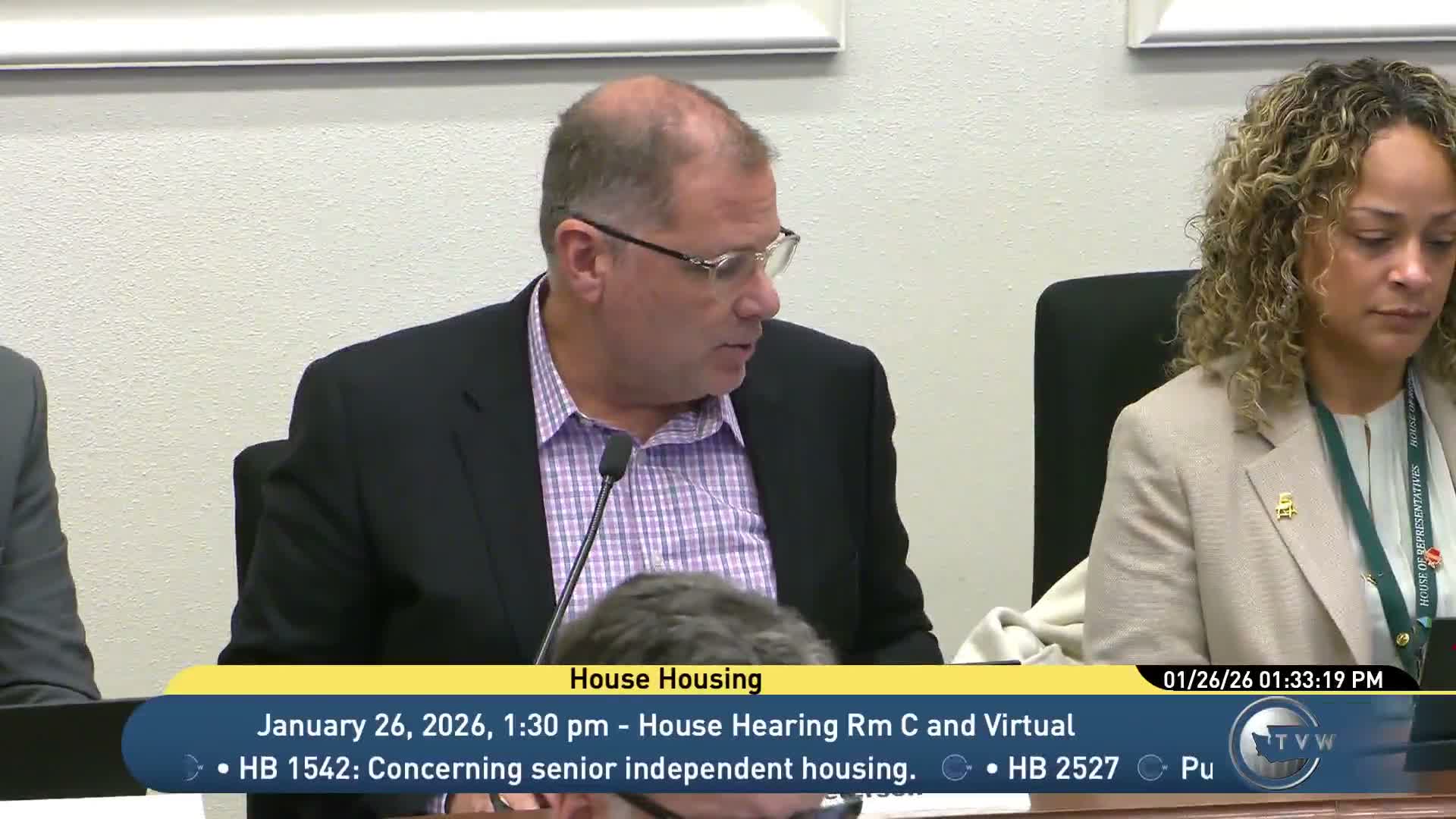
Lawmakers heard testimony Jan. 26 on HB 1542, which would establish minimum rights for residents of 'senior independent housing' and require the Department of Commerce to report to the legislature by July 1, 2026.
Audrey Veil, staff to the committee, summarized the bill’s core elements: it defines senior independent housing as residential properties advertised or designed for persons age 55 or older who are independent and do not require assistance with activities of daily living; the bill exempts licensed assisted-living and long-term-care facilities. The measure would create resident protections — including the right to be treated respectfully, the ability to install certain safety and security devices, the right to organize and hold resident meetings, and guaranteed emergency communications with management — and allow enforcement as unfair or deceptive acts under the Washington Consumer Protection Act.
Representative Christine Reeves, sponsor of HB 1542, said the bill resulted from months of local stakeholder engagement in Federal Way and called it a "Bill of Rights" for senior independent living residents who can fall through regulatory gaps when those settings are treated as multifamily housing rather than senior-care facilities. Reeves asked for an amendment to extend the reporting timeline to give the Department of Commerce sufficient time to prepare the required report and said stakeholders had suggested creating or linking to a registry to ensure effective communication with residents.
Supporters included the Alzheimer’s Association and AARP. Brad Forbes (Alzheimer’s Association) said more than 127,000 Washingtonians live with dementia and argued that vulnerable seniors living outside licensed long-term-care settings lack statutory protections the bill would provide. Kathy McCall (AARP) emphasized residents’ rights in the bill and that violations would provide consumers a remedy under the Consumer Protection Act.
Other testifiers asked for refinements. Stacy Valenzuela urged inclusion of 55+ manufactured-home communities; Brad Tower (Commonwealth Real Estate Services) supported resident protections but recommended narrowing the bill’s definition to avoid discouraging voluntary 55+ communities that provide only limited services; LeadingAge Washington (Alyssa Odegard) supported the bill as a starting point but requested additional stakeholder work to ensure the bill does not conflict with recent statutory changes affecting continuing care retirement communities (CCRCs).
Committee members did not vote on HB 1542 during the Jan. 26 hearing. The chair indicated a possible future work session and asked staff and agencies to share guidebooks and audit links with members.
Audrey Veil, staff to the committee, summarized the bill’s core elements: it defines senior independent housing as residential properties advertised or designed for persons age 55 or older who are independent and do not require assistance with activities of daily living; the bill exempts licensed assisted-living and long-term-care facilities. The measure would create resident protections — including the right to be treated respectfully, the ability to install certain safety and security devices, the right to organize and hold resident meetings, and guaranteed emergency communications with management — and allow enforcement as unfair or deceptive acts under the Washington Consumer Protection Act.
Representative Christine Reeves, sponsor of HB 1542, said the bill resulted from months of local stakeholder engagement in Federal Way and called it a "Bill of Rights" for senior independent living residents who can fall through regulatory gaps when those settings are treated as multifamily housing rather than senior-care facilities. Reeves asked for an amendment to extend the reporting timeline to give the Department of Commerce sufficient time to prepare the required report and said stakeholders had suggested creating or linking to a registry to ensure effective communication with residents.
Supporters included the Alzheimer’s Association and AARP. Brad Forbes (Alzheimer’s Association) said more than 127,000 Washingtonians live with dementia and argued that vulnerable seniors living outside licensed long-term-care settings lack statutory protections the bill would provide. Kathy McCall (AARP) emphasized residents’ rights in the bill and that violations would provide consumers a remedy under the Consumer Protection Act.
Other testifiers asked for refinements. Stacy Valenzuela urged inclusion of 55+ manufactured-home communities; Brad Tower (Commonwealth Real Estate Services) supported resident protections but recommended narrowing the bill’s definition to avoid discouraging voluntary 55+ communities that provide only limited services; LeadingAge Washington (Alyssa Odegard) supported the bill as a starting point but requested additional stakeholder work to ensure the bill does not conflict with recent statutory changes affecting continuing care retirement communities (CCRCs).
Committee members did not vote on HB 1542 during the Jan. 26 hearing. The chair indicated a possible future work session and asked staff and agencies to share guidebooks and audit links with members.
View the Full Meeting & All Its Details
This article offers just a summary. Unlock complete video, transcripts, and insights as a Founder Member.
✓
Watch full, unedited meeting videos
✓
Search every word spoken in unlimited transcripts
✓
AI summaries & real-time alerts (all government levels)
✓
Permanent access to expanding government content
30-day money-back guarantee
