Senate committee hears national trends and DCYF progress on juvenile rehabilitation
January 26, 2026 | Legislative Sessions, Washington
This article was created by AI summarizing key points discussed. AI makes mistakes, so for full details and context, please refer to the video of the full meeting. Please report any errors so we can fix them. Report an error »
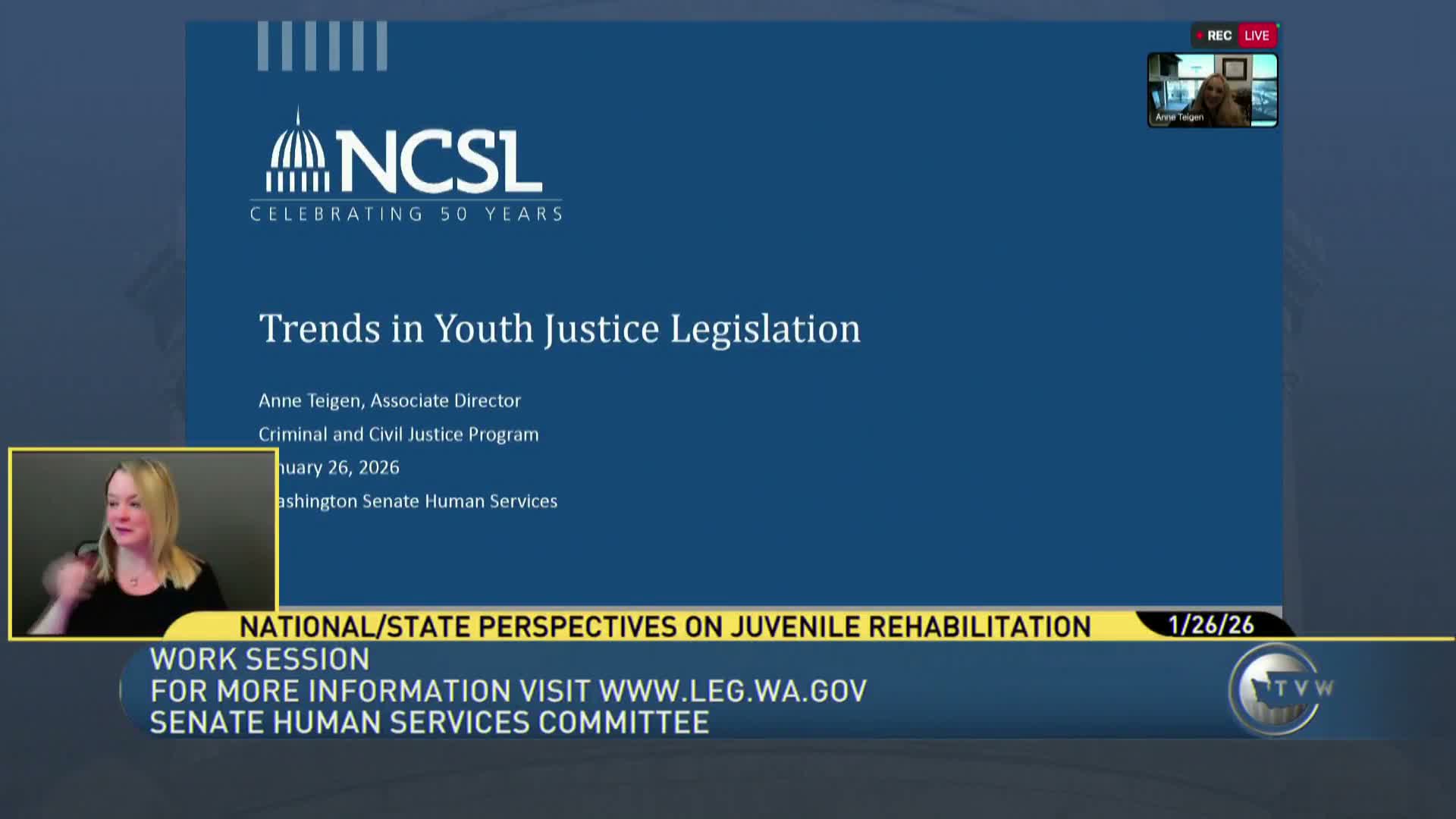
Anne Teegan of the National Conference of State Legislatures told the Senate Human Services Committee on Jan. 26 that states are broadly moving to rebalance juvenile sentencing toward community-based programs and away from the most extreme punishments, citing Supreme Court rulings and nine legislative trends now visible across the country.
Teegan, NCSL’s associate director covering juvenile justice, described reforms including limits on life without parole for juveniles, expanded diversion and reentry supports, strengthened due-process protections for youth, and efforts to reduce fines and fees that create collateral consequences. She pointed committee members to NCSL’s juvenile justice database for the bills she cited.
Jennifer Redmond, DCYF’s juvenile rehabilitation assistant secretary, briefed the committee on the department’s Behavior Management System (BMS), a three-tier rule-violation framework intended to create clearer expectations and more consistent, data-driven interventions. Redmond said the BMS is distinct from Residential Review Board proceedings and that confirmed violations may trigger restorative or therapeutic interventions, classification changes or, in serious cases, placement changes.
Redmond reported Harbor Heights opened in June 2025 and currently houses about 21 young people; the facility’s full buildout could hold about 46 beds but one wing remains closed while a medical portable is installed. Green Hill School’s population was reported at 202; DCYF said about 36% (roughly 72 individuals) are adult-sentenced youth. Redmond also said Community Transition Services (CTS) has had 35 participants to date with about a 70% successful completion rate and statewide capacity of about 22–24, and that a capacity feasibility study and an updated JR master plan are due in March.
Pierce County Executive Ryan Mello described two decades of local juvenile detention alternative work that drove Raymond Hall’s average daily population down from well over 100 in the early 2000s to roughly 30 in recent years, while noting longer lengths of stay for higher-acuity cases and severe facility limitations. Mello said a county task force will issue recommendations this spring and estimated rebuilding costs for a modern juvenile justice center at $185–$200 million.
Community partners including Northwest Credible Messengers and Team Child highlighted healing-centered engagement, culturally responsive peer support training, and a Medicaid transformation project that DCYF and providers plan to pilot in March to expand behavioral health services and reentry planning.
Taken together, presenters urged the committee to pair policy changes with funding, implementation planning and clearer operational criteria—particularly for emergency transfers and how capacity limits would be managed—to avoid abrupt or punitive consequences for youth and families.
Teegan, NCSL’s associate director covering juvenile justice, described reforms including limits on life without parole for juveniles, expanded diversion and reentry supports, strengthened due-process protections for youth, and efforts to reduce fines and fees that create collateral consequences. She pointed committee members to NCSL’s juvenile justice database for the bills she cited.
Jennifer Redmond, DCYF’s juvenile rehabilitation assistant secretary, briefed the committee on the department’s Behavior Management System (BMS), a three-tier rule-violation framework intended to create clearer expectations and more consistent, data-driven interventions. Redmond said the BMS is distinct from Residential Review Board proceedings and that confirmed violations may trigger restorative or therapeutic interventions, classification changes or, in serious cases, placement changes.
Redmond reported Harbor Heights opened in June 2025 and currently houses about 21 young people; the facility’s full buildout could hold about 46 beds but one wing remains closed while a medical portable is installed. Green Hill School’s population was reported at 202; DCYF said about 36% (roughly 72 individuals) are adult-sentenced youth. Redmond also said Community Transition Services (CTS) has had 35 participants to date with about a 70% successful completion rate and statewide capacity of about 22–24, and that a capacity feasibility study and an updated JR master plan are due in March.
Pierce County Executive Ryan Mello described two decades of local juvenile detention alternative work that drove Raymond Hall’s average daily population down from well over 100 in the early 2000s to roughly 30 in recent years, while noting longer lengths of stay for higher-acuity cases and severe facility limitations. Mello said a county task force will issue recommendations this spring and estimated rebuilding costs for a modern juvenile justice center at $185–$200 million.
Community partners including Northwest Credible Messengers and Team Child highlighted healing-centered engagement, culturally responsive peer support training, and a Medicaid transformation project that DCYF and providers plan to pilot in March to expand behavioral health services and reentry planning.
Taken together, presenters urged the committee to pair policy changes with funding, implementation planning and clearer operational criteria—particularly for emergency transfers and how capacity limits would be managed—to avoid abrupt or punitive consequences for youth and families.
View the Full Meeting & All Its Details
This article offers just a summary. Unlock complete video, transcripts, and insights as a Founder Member.
✓
Watch full, unedited meeting videos
✓
Search every word spoken in unlimited transcripts
✓
AI summaries & real-time alerts (all government levels)
✓
Permanent access to expanding government content
30-day money-back guarantee
