Senate committee opens hearing on SB 6,062 to expand suspended disposition alternatives and mid-sentence review
January 26, 2026 | Legislative Sessions, Washington
This article was created by AI summarizing key points discussed. AI makes mistakes, so for full details and context, please refer to the video of the full meeting. Please report any errors so we can fix them. Report an error »
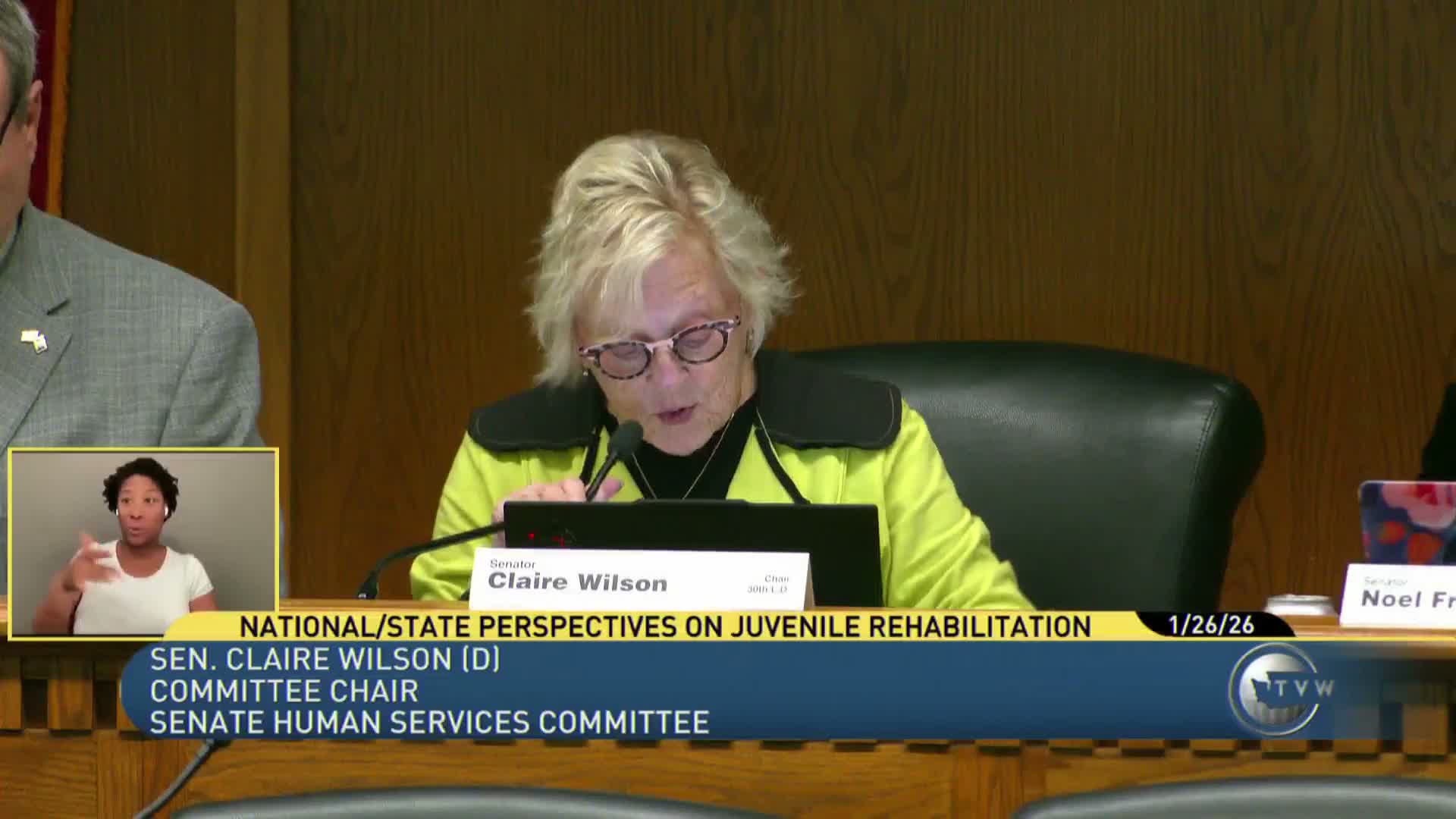
The Senate Human Services Committee on Jan. 26 opened public hearing on Senate Bill 6,062, a bill sponsored by Sen. Claire Wilson that would expand eligibility for suspended disposition alternatives (options B and C), require a midpoint review after six months, and direct courts and DCYF to share information in evaluating community-based supervision.
Committee staff summarized key provisions: the bill presumes suspension under options B or C for eligible juveniles unless a court finds community supervision would not protect the public, expands eligibility for some offenses (with specific exclusions listed in the bill report), creates a midpoint review hearing with DCYF reporting requirements on services and infractions, requires courts to maintain concurrent jurisdiction, defines rated bed capacity and directs the Department to adopt monitoring rules, and authorizes DCYF limited transfer authority to DOC when rated bed capacity exceeds 105% under narrow conditions through Jan. 1, 2031. A fiscal note request had been made but not returned at briefing time.
Witnesses and presenters were sharply divided. Supporters included young people from Green Hill who urged the committee to provide rehabilitation and clearer definitions of programming criteria, the Washington Association of Juvenile Court Administrators (which urged careful drafting to preserve judicial tools), academic and restorative-justice groups citing research on reduced recidivism from community-based programs, and defense and public-defense advocates calling for individualized sentencing discretion.
Opponents raised funding and safety concerns: the Washington State Association of Counties argued the bill shifts state responsibilities to counties without funding, and victim advocates recounted violent cases and urged broader exclusions for serious offenses such as first-degree robbery and assault in the second degree. DCYF staff said they generally support safely reducing JR admissions but asked for clearer emergency transfer language and noted Harbor Heights is not an unlimited overflow space.
Before public testimony the committee voted by voice to suspend the five-day notice rule to set hearings on related bills (SB 6319 and SB 5979). The committee closed the hearing after numerous supporters and opponents spoke and asked those who did not get to testify to submit written comments.
Committee staff summarized key provisions: the bill presumes suspension under options B or C for eligible juveniles unless a court finds community supervision would not protect the public, expands eligibility for some offenses (with specific exclusions listed in the bill report), creates a midpoint review hearing with DCYF reporting requirements on services and infractions, requires courts to maintain concurrent jurisdiction, defines rated bed capacity and directs the Department to adopt monitoring rules, and authorizes DCYF limited transfer authority to DOC when rated bed capacity exceeds 105% under narrow conditions through Jan. 1, 2031. A fiscal note request had been made but not returned at briefing time.
Witnesses and presenters were sharply divided. Supporters included young people from Green Hill who urged the committee to provide rehabilitation and clearer definitions of programming criteria, the Washington Association of Juvenile Court Administrators (which urged careful drafting to preserve judicial tools), academic and restorative-justice groups citing research on reduced recidivism from community-based programs, and defense and public-defense advocates calling for individualized sentencing discretion.
Opponents raised funding and safety concerns: the Washington State Association of Counties argued the bill shifts state responsibilities to counties without funding, and victim advocates recounted violent cases and urged broader exclusions for serious offenses such as first-degree robbery and assault in the second degree. DCYF staff said they generally support safely reducing JR admissions but asked for clearer emergency transfer language and noted Harbor Heights is not an unlimited overflow space.
Before public testimony the committee voted by voice to suspend the five-day notice rule to set hearings on related bills (SB 6319 and SB 5979). The committee closed the hearing after numerous supporters and opponents spoke and asked those who did not get to testify to submit written comments.
View the Full Meeting & All Its Details
This article offers just a summary. Unlock complete video, transcripts, and insights as a Founder Member.
✓
Watch full, unedited meeting videos
✓
Search every word spoken in unlimited transcripts
✓
AI summaries & real-time alerts (all government levels)
✓
Permanent access to expanding government content
30-day money-back guarantee
