Cities, utilities and developers split over bill to allow sewage grinder pumps statewide
January 26, 2026 | Legislative Sessions, Washington
This article was created by AI summarizing key points discussed. AI makes mistakes, so for full details and context, please refer to the video of the full meeting. Please report any errors so we can fix them. Report an error »
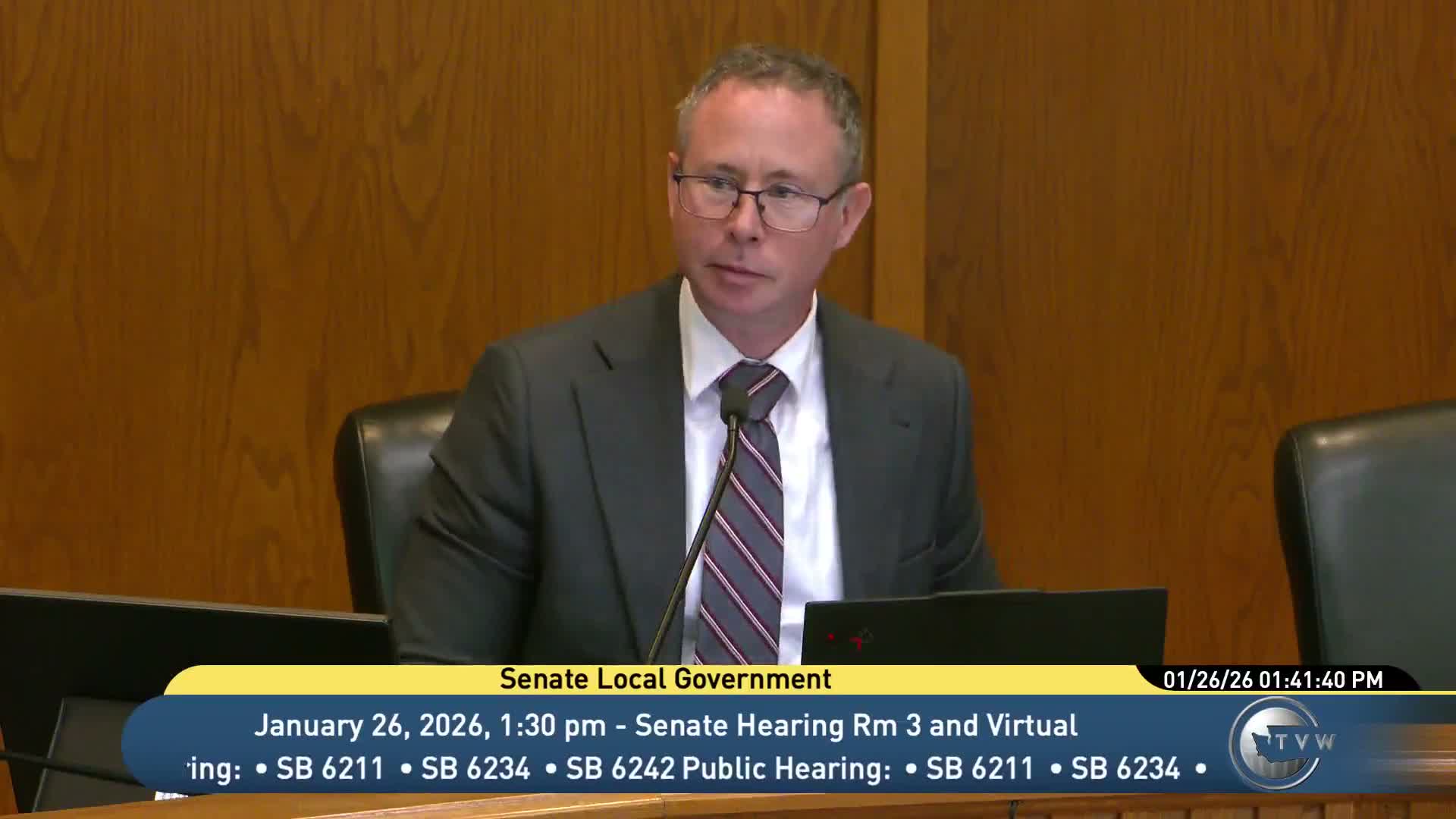
A state Senate committee heard competing views on SB 6,234, a bill that would prevent cities, counties and water/sewer districts from prohibiting the installation of sewage grinder pumps in new residential developments when gravity sewers are infeasible.
Jacob Ewing, committee staff, described situations where grinder pumps are used — lots below the grade of public sewer lines, steep topography, low-pressure systems or where wastewater must move vertically — and said the bill sets a statewide baseline allowing installation in those scenarios.
Industry and local-government witnesses split. Steven Ellis of the Association of Washington Cities said many cities already allow grinder pumps in comparable circumstances but raised concern about the bill's prescriptive language and its potential to preempt local engineering standards. "We're just concerned about, totally preempting city authority and using this sort of prescriptive list rather than kind of looking at the local characteristics," Ellis said.
Devin Gomboski of the Association of Water and Sewer Districts testified in respectful opposition, saying districts commonly approve grinder pumps when site conditions warrant it but that local technical decisions are necessary to protect system performance. "These often have the lowest upfront cost for developers, but they do impose some long term risks as many rely on small and technical systems located on individual properties, which can increase failure rates, service disruption, or long term operational costs," Gomboski said.
Land-use consultant David Toyer supported the bill as a tool for infill and small developments where the cost of extending gravity sewer or installing lift stations would be prohibitive. "There are very acceptable alternatives out there on the grinder pump front, and they can be very helpful in being able to make projects actually work," Toyer said.
Committee members asked technical questions about whether pre-grinding affects downstream treatment operations, who bears repair responsibility when pumps fail, and whether cities could retain flexibility in permitting. Witnesses agreed to follow up with technical information and said they would work with the sponsor on potential technical amendments.
The committee closed public testimony without taking a vote. Proponents urged the committee to preserve the bill's intent to reduce permitting barriers for infill; opponents urged maintaining local authority to ensure long-term system reliability and to protect ratepayers and homeowners from unexpected maintenance burdens.
Jacob Ewing, committee staff, described situations where grinder pumps are used — lots below the grade of public sewer lines, steep topography, low-pressure systems or where wastewater must move vertically — and said the bill sets a statewide baseline allowing installation in those scenarios.
Industry and local-government witnesses split. Steven Ellis of the Association of Washington Cities said many cities already allow grinder pumps in comparable circumstances but raised concern about the bill's prescriptive language and its potential to preempt local engineering standards. "We're just concerned about, totally preempting city authority and using this sort of prescriptive list rather than kind of looking at the local characteristics," Ellis said.
Devin Gomboski of the Association of Water and Sewer Districts testified in respectful opposition, saying districts commonly approve grinder pumps when site conditions warrant it but that local technical decisions are necessary to protect system performance. "These often have the lowest upfront cost for developers, but they do impose some long term risks as many rely on small and technical systems located on individual properties, which can increase failure rates, service disruption, or long term operational costs," Gomboski said.
Land-use consultant David Toyer supported the bill as a tool for infill and small developments where the cost of extending gravity sewer or installing lift stations would be prohibitive. "There are very acceptable alternatives out there on the grinder pump front, and they can be very helpful in being able to make projects actually work," Toyer said.
Committee members asked technical questions about whether pre-grinding affects downstream treatment operations, who bears repair responsibility when pumps fail, and whether cities could retain flexibility in permitting. Witnesses agreed to follow up with technical information and said they would work with the sponsor on potential technical amendments.
The committee closed public testimony without taking a vote. Proponents urged the committee to preserve the bill's intent to reduce permitting barriers for infill; opponents urged maintaining local authority to ensure long-term system reliability and to protect ratepayers and homeowners from unexpected maintenance burdens.
View the Full Meeting & All Its Details
This article offers just a summary. Unlock complete video, transcripts, and insights as a Founder Member.
✓
Watch full, unedited meeting videos
✓
Search every word spoken in unlimited transcripts
✓
AI summaries & real-time alerts (all government levels)
✓
Permanent access to expanding government content
30-day money-back guarantee
