Senate panel hears research, survivor testimony and agency support for lowering state BAC limit to 0.05
January 26, 2026 | Legislative Sessions, Washington
This article was created by AI summarizing key points discussed. AI makes mistakes, so for full details and context, please refer to the video of the full meeting. Please report any errors so we can fix them. Report an error »
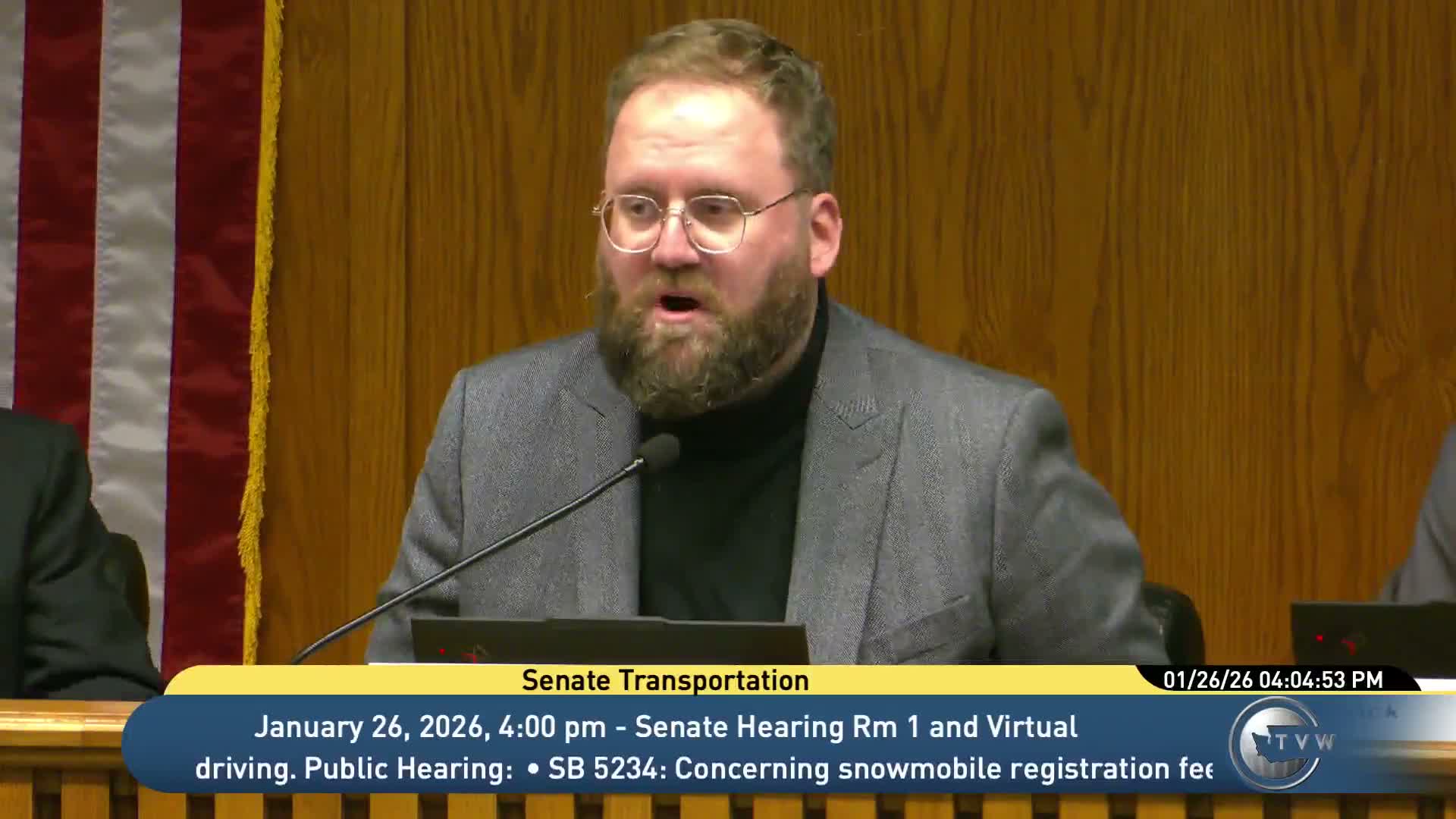
Mark McKechnie, external relations director at the Washington Traffic Safety Commission, told the Senate Transportation Committee that alcohol was involved in 57.7% of impaired-driving fatalities in recent years and that Washington recorded 809 traffic fatalities in 2023 and 737 in 2024. He said international studies show roughly an 11% decrease in alcohol-related traffic deaths after lowering per‑se limits and described a November 2025 AAA/Washington Traffic Safety Commission survey of 850 adults that found baseline support for reducing the per‑se limit from 0.08 to 0.05 rose from 54% to 71% after respondents were given safety information.
"Both legally and in terms of safety, you can [be impaired] below 0.08," McKechnie said, noting laboratory research that shows measurable impairment near 0.05.
Joshua Jackman, a Spokane-area resident who survived a 2007 crash in which a drunk driver struck him at high speed, described more than two dozen surgeries, long-term disabilities and roughly $1.5 million in medical bills. "This was an avoidable accident," Jackman said, urging lawmakers to support a lower per‑se limit as a way to save lives and change behavior.
Law-enforcement and transportation officials framed the proposal as preventive. John Battiste, chief of the Washington State Patrol, said the 0.05 proposal "is about prevention. It is not about punitiveness," and emphasized that officers must still have reasonable suspicion or probable cause to stop a driver and that DUI investigative practices would remain unchanged.
Julie Meredith, Washington State Department of Transportation secretary, described the toll impaired-driving crashes impose on road crews and work zones, saying 61% of work‑zone fatalities from 2022–2024 involved an impaired driver and citing equipment and replacement costs that strain agency budgets.
Speakers repeatedly tied the public-education component to any legal change: presenters said reducing the per‑se limit is most effective when combined with a broad campaign to help people plan alternatives such as rideshare and designated drivers. No formal vote or committee direction occurred at the session; the proceedings were a fact‑finding and public‑testimony format.
"Both legally and in terms of safety, you can [be impaired] below 0.08," McKechnie said, noting laboratory research that shows measurable impairment near 0.05.
Joshua Jackman, a Spokane-area resident who survived a 2007 crash in which a drunk driver struck him at high speed, described more than two dozen surgeries, long-term disabilities and roughly $1.5 million in medical bills. "This was an avoidable accident," Jackman said, urging lawmakers to support a lower per‑se limit as a way to save lives and change behavior.
Law-enforcement and transportation officials framed the proposal as preventive. John Battiste, chief of the Washington State Patrol, said the 0.05 proposal "is about prevention. It is not about punitiveness," and emphasized that officers must still have reasonable suspicion or probable cause to stop a driver and that DUI investigative practices would remain unchanged.
Julie Meredith, Washington State Department of Transportation secretary, described the toll impaired-driving crashes impose on road crews and work zones, saying 61% of work‑zone fatalities from 2022–2024 involved an impaired driver and citing equipment and replacement costs that strain agency budgets.
Speakers repeatedly tied the public-education component to any legal change: presenters said reducing the per‑se limit is most effective when combined with a broad campaign to help people plan alternatives such as rideshare and designated drivers. No formal vote or committee direction occurred at the session; the proceedings were a fact‑finding and public‑testimony format.
View the Full Meeting & All Its Details
This article offers just a summary. Unlock complete video, transcripts, and insights as a Founder Member.
✓
Watch full, unedited meeting videos
✓
Search every word spoken in unlimited transcripts
✓
AI summaries & real-time alerts (all government levels)
✓
Permanent access to expanding government content
30-day money-back guarantee
