Panel hears SPARK Act to fund AI economic-development grants, staff estimate modest administrative costs
January 26, 2026 | Legislative Sessions, Washington
This article was created by AI summarizing key points discussed. AI makes mistakes, so for full details and context, please refer to the video of the full meeting. Please report any errors so we can fix them. Report an error »
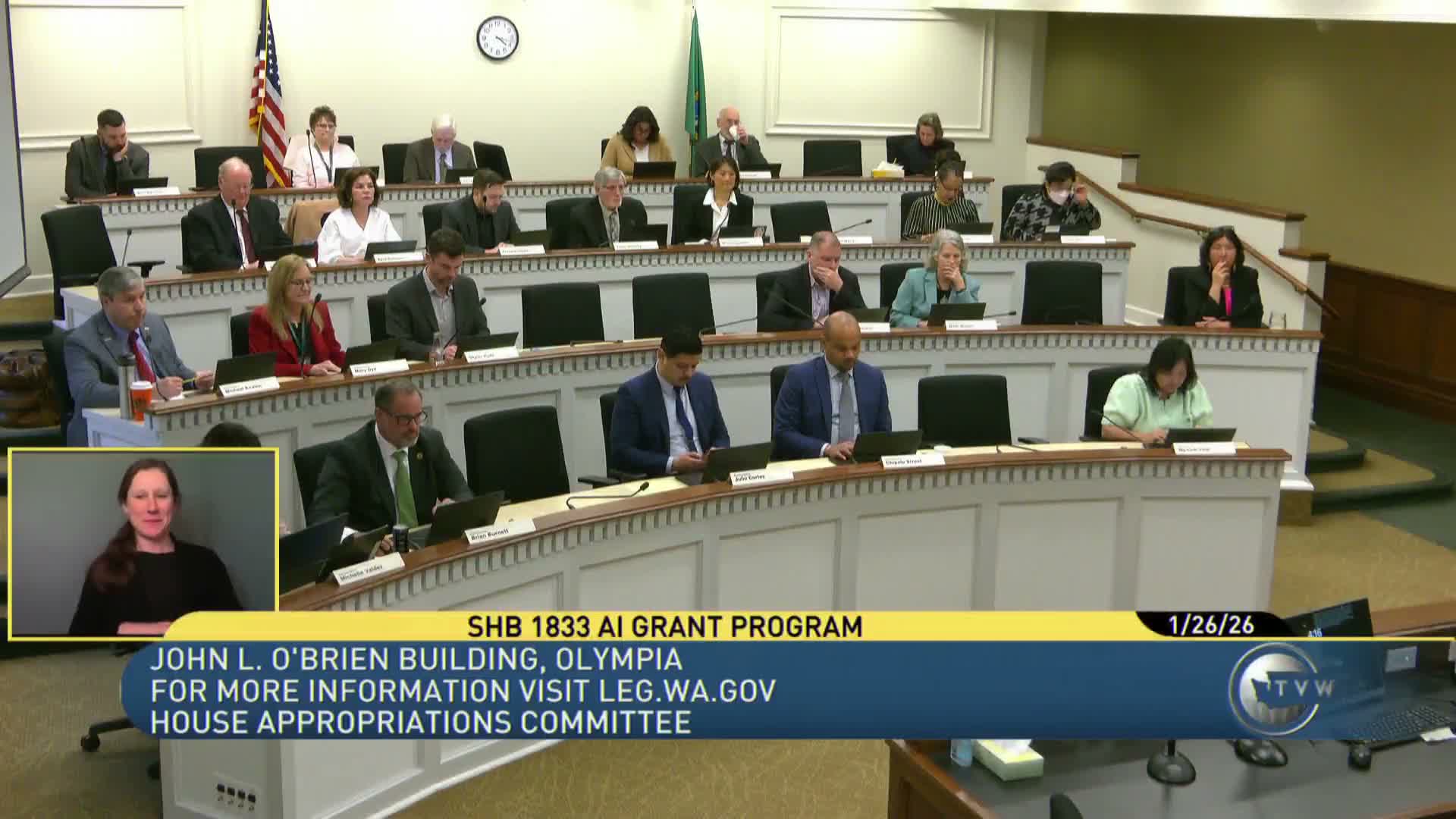
Committee staff briefed members on substitute House Bill 1833, known in the briefing as the SPARK Act, which would create a Commerce-administered grant program to promote economic development around innovative uses of artificial intelligence. Jessica Van Horn said eligible applicants must propose technology that will be shared with the state and that Commerce should prioritize factors listed in the bill report, consult the AG's AI task force at least annually through 2027, and report to the legislature on program results every two years.
Van Horn said Commerce assumes costs for one full-time equivalent staff position to administer the program at "around $160,000 per fiscal year," with additional grant costs dependent on legislative appropriations or successful solicitation of federal and private funding. "A reasonable total estimate of the program would be $660,000 to $1,600,000 per fiscal year," she said, while noting that the revenue source is likely to be the general fund in the program's first year unless other funds are secured.
Supporters at the public hearing said the SPARK Act would signal Washington's commitment to harnessing AI for economic growth while some witnesses suggested reducing task-force size and adding a right-to-compute provision. Kevin Frazier (Abundance Institute) and Crystal Leatherman (Washington Retail Association) urged the committee to move the bill forward and refine details through amendments.
The committee did not vote on HB 1833 at the hearing. Staff materials and the fiscal note in the electronic bill book contain further administration and grant-cost details.
Van Horn said Commerce assumes costs for one full-time equivalent staff position to administer the program at "around $160,000 per fiscal year," with additional grant costs dependent on legislative appropriations or successful solicitation of federal and private funding. "A reasonable total estimate of the program would be $660,000 to $1,600,000 per fiscal year," she said, while noting that the revenue source is likely to be the general fund in the program's first year unless other funds are secured.
Supporters at the public hearing said the SPARK Act would signal Washington's commitment to harnessing AI for economic growth while some witnesses suggested reducing task-force size and adding a right-to-compute provision. Kevin Frazier (Abundance Institute) and Crystal Leatherman (Washington Retail Association) urged the committee to move the bill forward and refine details through amendments.
The committee did not vote on HB 1833 at the hearing. Staff materials and the fiscal note in the electronic bill book contain further administration and grant-cost details.
Don't Miss a Word: See the Full Meeting!
Go beyond summaries. Unlock every video, transcript, and key insight with a Founder Membership.
✓
Get instant access to full meeting videos
✓
Search and clip any phrase from complete transcripts
✓
Receive AI-powered summaries & custom alerts
✓
Enjoy lifetime, unrestricted access to government data
30-day money-back guarantee
