Committee hears testimony on bill to clarify how 'fifth‑wheel' RVs are measured
January 26, 2026 | Legislative Sessions, Washington
This article was created by AI summarizing key points discussed. AI makes mistakes, so for full details and context, please refer to the video of the full meeting. Please report any errors so we can fix them. Report an error »
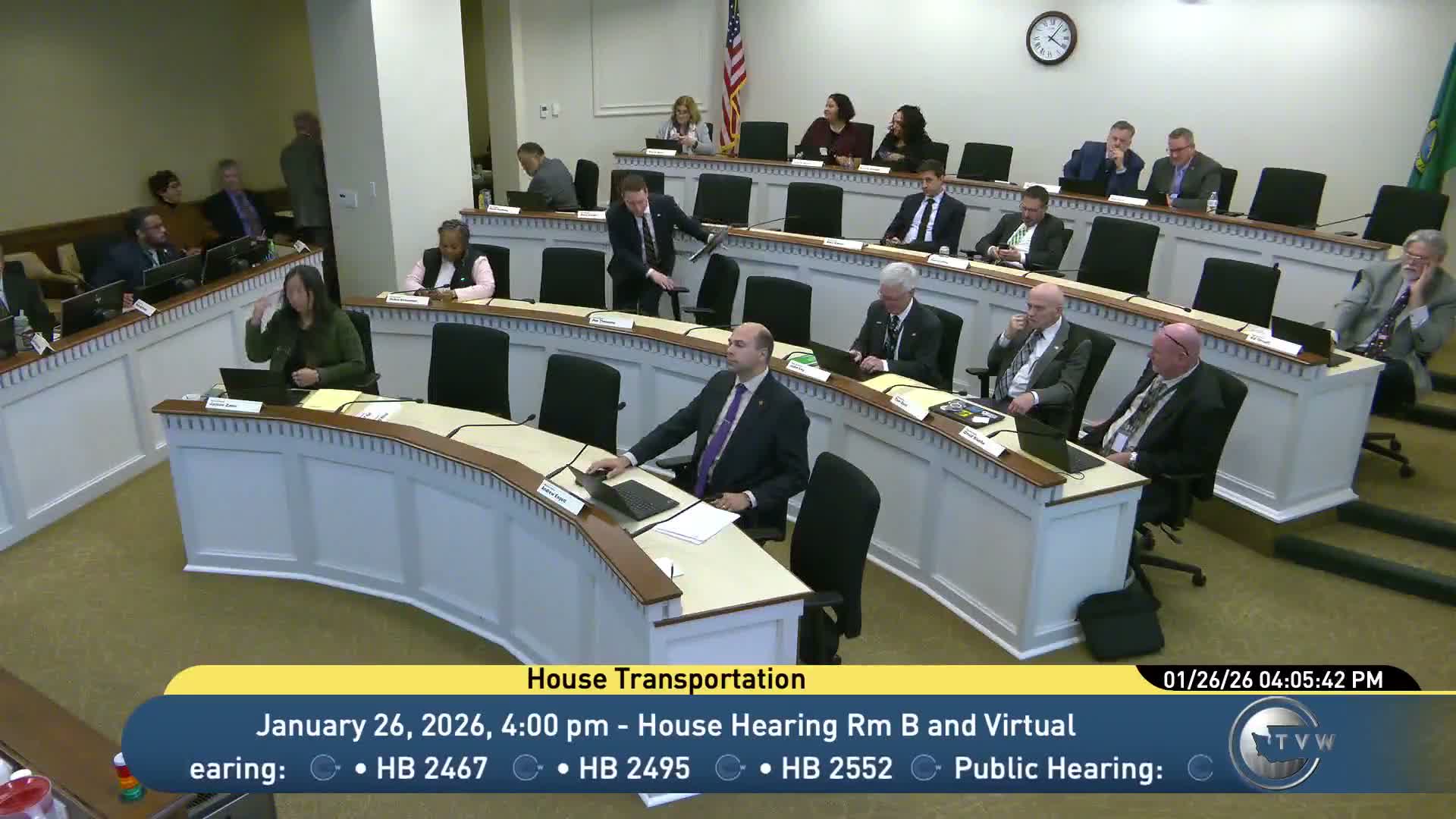
The House Transportation Committee took public testimony on HB 2,467 on a proposal to clarify how fifth‑wheel recreational vehicles are measured for legal length limits. The bill’s sponsor, Representative Joe Timmons, said the change would allow dealers to sell popular fifth‑wheel floor plans in Washington while preserving existing roadway length limits.
Sandy Myers, staff to the committee, summarized current law and the proposed change: “House Bill 2,467 relates to fifth wheels,” and the substitute would measure a fifth wheel from the center of the kingpin to the rearmost point of the vehicle. Myers told the committee the Washington State Patrol, Department of Licensing and Department of Transportation listed no fiscal impact, while the Department of Labor and Industries listed an indeterminate fiscal impact under $50,000 tied to manufacturer plan reviews.
Representative Joe Timmons, state representative in the 42nd Legislative District, said he was “deeply concerned about the rising injuries and fatalities on our roadways,” and emphasized the bill does not change the permitted length on highways but clarifies measurement so dealers can sell models that are commonly available in neighboring states. He said clarifying the rule would keep sales local and retain sales tax revenue.
Dealers and industry groups spoke in support. LaDonna Meadows, owner of Tacoma RV Center, explained technical differences between a fifth wheel and a bumper‑pull trailer, arguing that a 35‑foot fifth wheel typically leaves about 31 feet behind the tow vehicle and “decreases the overall length behind the truck by 4 to 5 feet.” Randy Edwards of RV Country, John McLeod of Campers Choice RV, Charlie Power (co‑owner of RV Country) and Ken Short of the Association of Washington Business said the bill preserves safety while restoring competitiveness with Oregon and California.
Michael Oakes, director of state affairs for the RV Industry Association, urged a yes vote and cited an economic impact study showing the RV industry’s annual output and employment footprint in Washington: “the total economic output of the RV industry in Washington yearly is $2,490,000,000,” with wages and jobs tied to manufacturers and dealers.
Committee members asked about employment and licensing; dealers reported single‑location shops employing roughly 16 people, larger regional dealers reporting on the order of 100 employees in Washington, and staff said they would follow up on whether specialty licensing applies to trailers up to 35 feet.
The committee closed the public hearing on HB 2,467 after testimony and did not take a final vote at the session.
Sandy Myers, staff to the committee, summarized current law and the proposed change: “House Bill 2,467 relates to fifth wheels,” and the substitute would measure a fifth wheel from the center of the kingpin to the rearmost point of the vehicle. Myers told the committee the Washington State Patrol, Department of Licensing and Department of Transportation listed no fiscal impact, while the Department of Labor and Industries listed an indeterminate fiscal impact under $50,000 tied to manufacturer plan reviews.
Representative Joe Timmons, state representative in the 42nd Legislative District, said he was “deeply concerned about the rising injuries and fatalities on our roadways,” and emphasized the bill does not change the permitted length on highways but clarifies measurement so dealers can sell models that are commonly available in neighboring states. He said clarifying the rule would keep sales local and retain sales tax revenue.
Dealers and industry groups spoke in support. LaDonna Meadows, owner of Tacoma RV Center, explained technical differences between a fifth wheel and a bumper‑pull trailer, arguing that a 35‑foot fifth wheel typically leaves about 31 feet behind the tow vehicle and “decreases the overall length behind the truck by 4 to 5 feet.” Randy Edwards of RV Country, John McLeod of Campers Choice RV, Charlie Power (co‑owner of RV Country) and Ken Short of the Association of Washington Business said the bill preserves safety while restoring competitiveness with Oregon and California.
Michael Oakes, director of state affairs for the RV Industry Association, urged a yes vote and cited an economic impact study showing the RV industry’s annual output and employment footprint in Washington: “the total economic output of the RV industry in Washington yearly is $2,490,000,000,” with wages and jobs tied to manufacturers and dealers.
Committee members asked about employment and licensing; dealers reported single‑location shops employing roughly 16 people, larger regional dealers reporting on the order of 100 employees in Washington, and staff said they would follow up on whether specialty licensing applies to trailers up to 35 feet.
The committee closed the public hearing on HB 2,467 after testimony and did not take a final vote at the session.
View the Full Meeting & All Its Details
This article offers just a summary. Unlock complete video, transcripts, and insights as a Founder Member.
✓
Watch full, unedited meeting videos
✓
Search every word spoken in unlimited transcripts
✓
AI summaries & real-time alerts (all government levels)
✓
Permanent access to expanding government content
30-day money-back guarantee
