Senate committee hears proposals to redirect aircraft fuel taxes as FAA pushes Washington to comply
January 26, 2026 | Legislative Sessions, Washington
This article was created by AI summarizing key points discussed. AI makes mistakes, so for full details and context, please refer to the video of the full meeting. Please report any errors so we can fix them. Report an error »
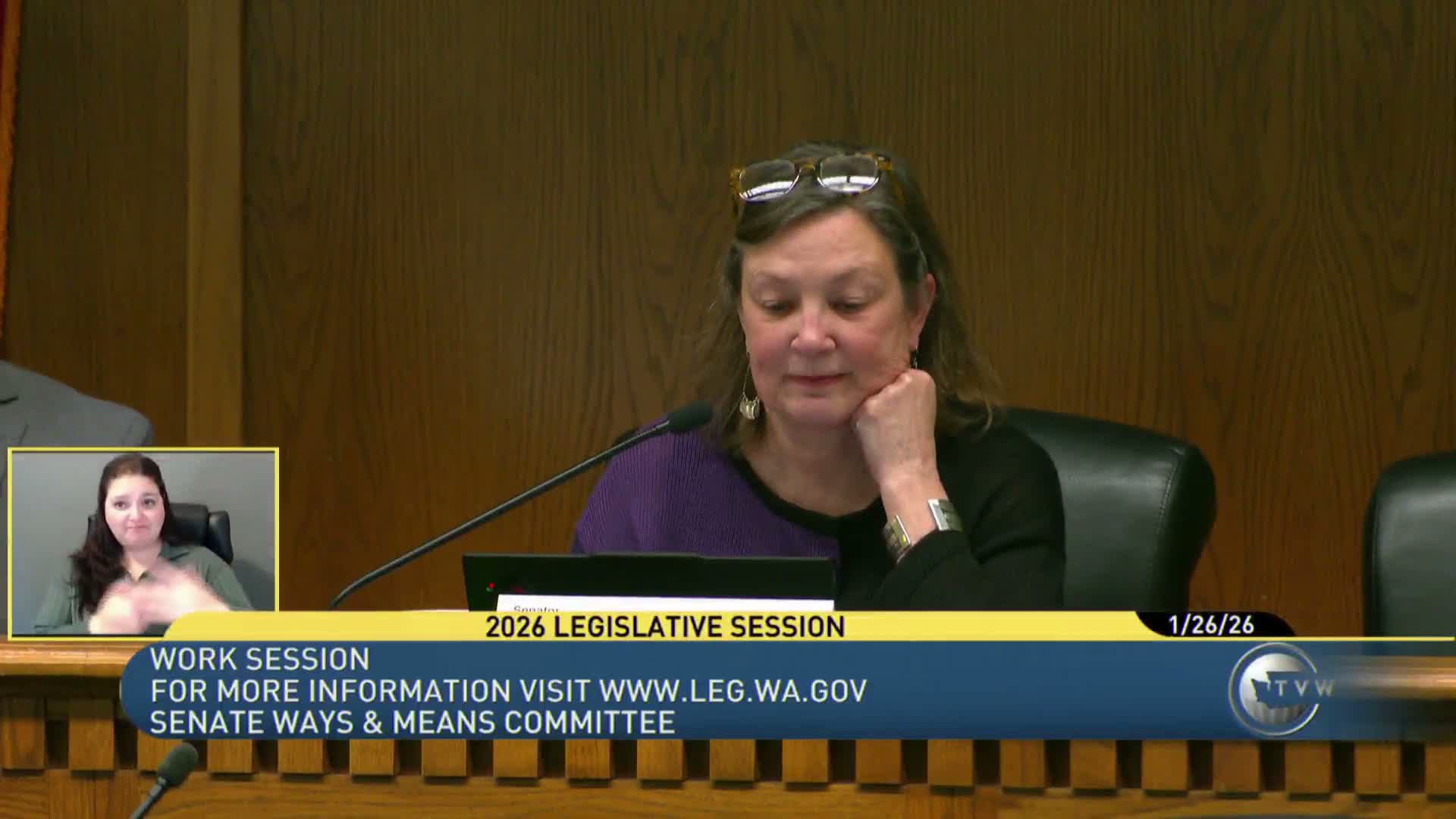
WASHINGTON — WSDOT aviation staff told the Senate Ways and Means Committee on Jan. 26 that federal scrutiny of how Washington spends aircraft fuel–related tax revenue has left the state at risk of significant enforcement by the U.S. Department of Transportation.
Richard, who represents the WSDOT Aviation Division, told senators the FAA’s guidance dates back to a policy that treats aviation fuel taxes enacted after Dec. 30, 1987 as subject to federal restrictions. He said the state submitted a compliance action plan in 2017 that FAA approved in 2022, but an FAA audit in 2024 flagged projects the state listed as offsets and asked for more information. The state received a 60‑day extension from the FAA to respond, to Feb. 18, 2026.
Richard said roughly $210 million of aircraft-fuel-related tax revenue collected since 2017 has not been documented as spent on aviation programs the FAA would accept. Under federal law that noncompliance could trigger withholding of federal DOT grants; the director’s estimate cited in the hearing placed the potential withholdings in the ballpark of $1.2 billion. Richard also said the FAA may bring litigation if it deems that necessary.
The committee then heard three bills aimed at addressing parts of that problem. Committee staff described SB 5,989 (sponsored by Sen. Behnke) as redirecting a portion of the state sales and use tax on aircraft fuel to the WSDOT Aeronautics Account (0.5% in FY 2027, rising to 1% in FY 2028). Staff noted the Department of Revenue cannot implement changes before Jan. 1, 2027; the fiscal estimate projects a general-fund reduction of about $900,000 in FY 2027 and $4.1 million in FY 2028.
A second bill, SB 5,898, would redirect revenues from the hazardous substance tax (HST), petroleum products tax (PPT) and oil-spill taxes to the Aeronautics Account. Committee staff estimated roughly $8.4 million would shift in FY 2027 and $21.6 million in FY 2028; staff cautioned the change could materially reduce funding available to the Model Toxics Control Account (MTCA) and related pollution-liability programs.
A third bill, SB 6,240, would create a state aircraft noise and air-quality mitigation account funded by the portion of the HST rate above $1.48 per barrel, with grant-making authority to the Department of Commerce for mitigation projects in impacted communities beginning Oct. 1, 2026. Staff said the bill’s initial revenue shift would be small but noted Ecology and other agencies warned of impacts to existing cleanup and capital programs if MTCA receipts are diverted.
Public testimony split in expected ways. Airport managers, pilots’ groups and the Port of Seattle urged the committee to adopt measures that return aviation-related tax dollars to airports and other aviation uses to regain FAA compliance. John Flanagan of the Port of Seattle said he supports a “measured and incremental approach.” Josh Marcy of the Washington Airport Management Association and other airports said redirecting funds to WSDOT would support capital projects and maintain FAA grant assurances.
Local governments, environmental agencies and community groups warned lawmakers to weigh tradeoffs. Carrie Sessions of the Department of Ecology and speakers representing counties and MTCA users said moving HST or other funds to aviation could undermine clean-up and environmental programs that rely on those revenues. Community members and city officials from areas beneath airport flight paths urged dedicated mitigation funding for noise and air-quality harms.
Committee staff and agency witnesses repeatedly emphasized the compliance imperative: the FAA has questioned prior uses the state listed as offsets, and future access to federal transportation grants could be at stake if the state does not document that aviation-related taxes are reinvested in aviation programs acceptable to the FAA.
The committee took testimony but did not take final action on the bills. The chairs left open work with stakeholders on details including implementation timing, DOR system changes and possible language to protect MTCA programs while addressing FAA concerns.
Richard, who represents the WSDOT Aviation Division, told senators the FAA’s guidance dates back to a policy that treats aviation fuel taxes enacted after Dec. 30, 1987 as subject to federal restrictions. He said the state submitted a compliance action plan in 2017 that FAA approved in 2022, but an FAA audit in 2024 flagged projects the state listed as offsets and asked for more information. The state received a 60‑day extension from the FAA to respond, to Feb. 18, 2026.
Richard said roughly $210 million of aircraft-fuel-related tax revenue collected since 2017 has not been documented as spent on aviation programs the FAA would accept. Under federal law that noncompliance could trigger withholding of federal DOT grants; the director’s estimate cited in the hearing placed the potential withholdings in the ballpark of $1.2 billion. Richard also said the FAA may bring litigation if it deems that necessary.
The committee then heard three bills aimed at addressing parts of that problem. Committee staff described SB 5,989 (sponsored by Sen. Behnke) as redirecting a portion of the state sales and use tax on aircraft fuel to the WSDOT Aeronautics Account (0.5% in FY 2027, rising to 1% in FY 2028). Staff noted the Department of Revenue cannot implement changes before Jan. 1, 2027; the fiscal estimate projects a general-fund reduction of about $900,000 in FY 2027 and $4.1 million in FY 2028.
A second bill, SB 5,898, would redirect revenues from the hazardous substance tax (HST), petroleum products tax (PPT) and oil-spill taxes to the Aeronautics Account. Committee staff estimated roughly $8.4 million would shift in FY 2027 and $21.6 million in FY 2028; staff cautioned the change could materially reduce funding available to the Model Toxics Control Account (MTCA) and related pollution-liability programs.
A third bill, SB 6,240, would create a state aircraft noise and air-quality mitigation account funded by the portion of the HST rate above $1.48 per barrel, with grant-making authority to the Department of Commerce for mitigation projects in impacted communities beginning Oct. 1, 2026. Staff said the bill’s initial revenue shift would be small but noted Ecology and other agencies warned of impacts to existing cleanup and capital programs if MTCA receipts are diverted.
Public testimony split in expected ways. Airport managers, pilots’ groups and the Port of Seattle urged the committee to adopt measures that return aviation-related tax dollars to airports and other aviation uses to regain FAA compliance. John Flanagan of the Port of Seattle said he supports a “measured and incremental approach.” Josh Marcy of the Washington Airport Management Association and other airports said redirecting funds to WSDOT would support capital projects and maintain FAA grant assurances.
Local governments, environmental agencies and community groups warned lawmakers to weigh tradeoffs. Carrie Sessions of the Department of Ecology and speakers representing counties and MTCA users said moving HST or other funds to aviation could undermine clean-up and environmental programs that rely on those revenues. Community members and city officials from areas beneath airport flight paths urged dedicated mitigation funding for noise and air-quality harms.
Committee staff and agency witnesses repeatedly emphasized the compliance imperative: the FAA has questioned prior uses the state listed as offsets, and future access to federal transportation grants could be at stake if the state does not document that aviation-related taxes are reinvested in aviation programs acceptable to the FAA.
The committee took testimony but did not take final action on the bills. The chairs left open work with stakeholders on details including implementation timing, DOR system changes and possible language to protect MTCA programs while addressing FAA concerns.
Don't Miss a Word: See the Full Meeting!
Go beyond summaries. Unlock every video, transcript, and key insight with a Founder Membership.
✓
Get instant access to full meeting videos
✓
Search and clip any phrase from complete transcripts
✓
Receive AI-powered summaries & custom alerts
✓
Enjoy lifetime, unrestricted access to government data
30-day money-back guarantee
