Warrick County School Corporation finance presentation flags $5.5 million operations-fund decline, outlines bond and investment plan
January 30, 2026 | Warrick County School Corp, School Boards, Indiana
This article was created by AI summarizing key points discussed. AI makes mistakes, so for full details and context, please refer to the video of the full meeting. Please report any errors so we can fix them. Report an error »
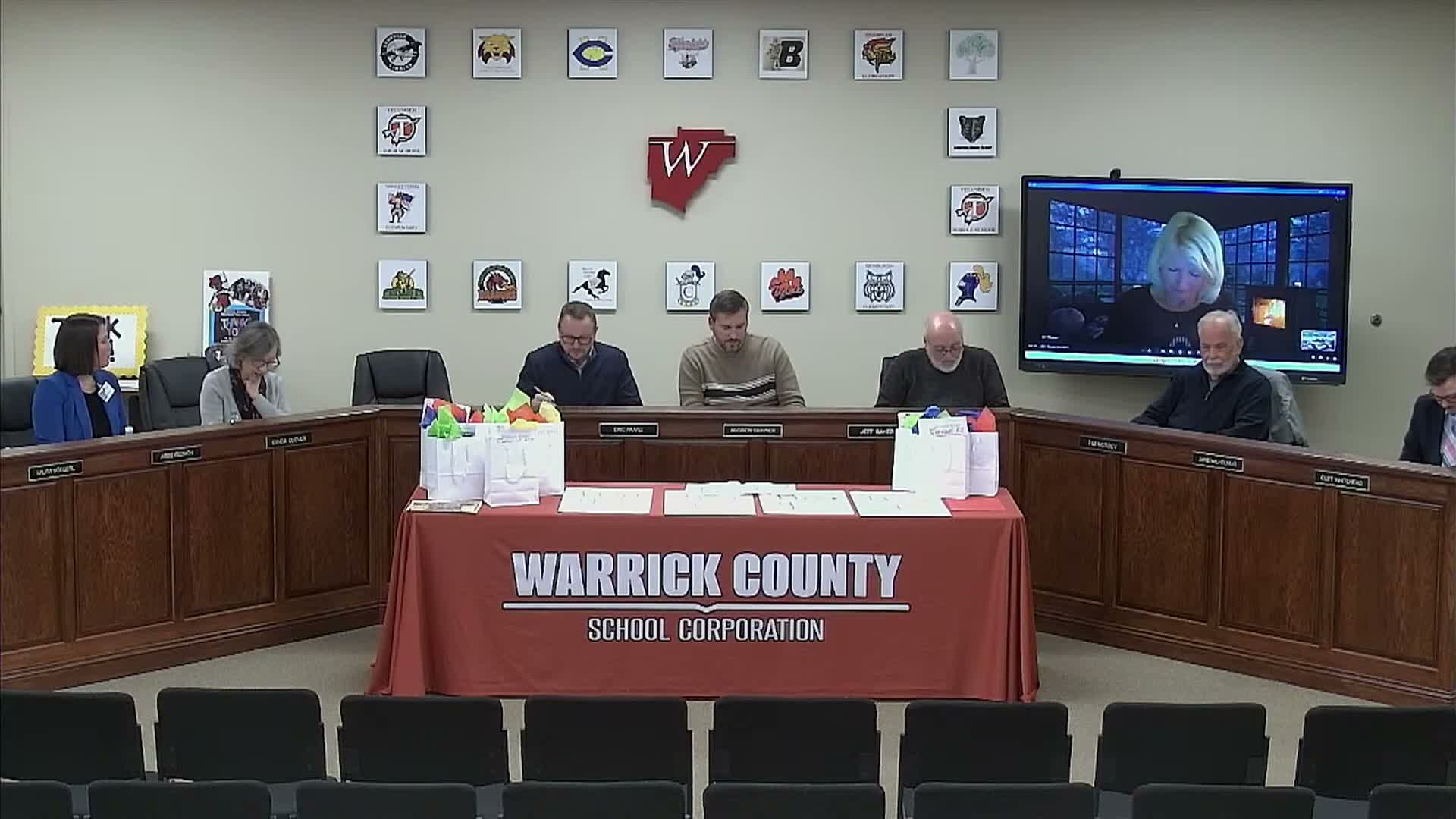
Todd Armstrong, presenting the district's fiscal indicators and investment report, told the Warrick County School Corporation board that the operations fund experienced "nearly a 5 and a half million dollar decline" after the district exceeded planned capital and maintenance spending last year.
Armstrong, who provided a four-page handout covering student demographics, fund balances, debt service and investment activity, said enrollment (ADM) declined this school year, the special-education share edged down, free-and-reduced lunch percentages fell slightly and English-language learner percentages rose modestly. He said the education fund showed a slight cash-balance decrease while the operations fund drop resulted from both transfers out of the education/operations fund and higher-than-budgeted capital spending.
Why it matters: the operations fund pays day-to-day district operations. Armstrong said the board intentionally ran elevated capital work last year, noting an initial maintenance/capital plan near $12 million that was exceeded. He said excluding the one-time bond effects, the district spent about $4.4 million more in 2025 than it received in operating revenue, primarily because of those capital projects.
Armstrong also described how recent bond activity affected reported cash balances. He said the district issued bonds late in the year and temporarily showed a higher overall cash balance because bond proceeds are tracked separately; he projected the district will pay approximately $6,565,000 in bond expense this year and that outstanding bond principal will total about $20,000,000 by Dec. 31, 2026. To diversify and improve short-term yields, Armstrong said the district moved $5,000,000 into a three-month certificate of deposit and another $5,000,000 into a four-month CD. He reported investment interest earnings of $1,552,000 last year.
Board members asked several clarifying questions about the cafeteria checking account, bond-account tracking and arbitrage rules; Armstrong explained that bond interest and related earnings must be tracked to avoid arbitrage penalties and that bond proceeds are intended to fund capital work over coming months. He said the district expects to spend roughly 50%–60% of current bond proceeds in the next eight months.
What's next: Armstrong recommended a conservative multi-year plan to rebuild fund balances and noted a projected gradual decline in the education fund across 2026–2031 under current assumptions. The board did not take an immediate action tied to the presentation; later in the meeting it approved a formal resolution to transfer funds from the education fund to the operations fund (Resolution 20-26-2).
Armstrong, who provided a four-page handout covering student demographics, fund balances, debt service and investment activity, said enrollment (ADM) declined this school year, the special-education share edged down, free-and-reduced lunch percentages fell slightly and English-language learner percentages rose modestly. He said the education fund showed a slight cash-balance decrease while the operations fund drop resulted from both transfers out of the education/operations fund and higher-than-budgeted capital spending.
Why it matters: the operations fund pays day-to-day district operations. Armstrong said the board intentionally ran elevated capital work last year, noting an initial maintenance/capital plan near $12 million that was exceeded. He said excluding the one-time bond effects, the district spent about $4.4 million more in 2025 than it received in operating revenue, primarily because of those capital projects.
Armstrong also described how recent bond activity affected reported cash balances. He said the district issued bonds late in the year and temporarily showed a higher overall cash balance because bond proceeds are tracked separately; he projected the district will pay approximately $6,565,000 in bond expense this year and that outstanding bond principal will total about $20,000,000 by Dec. 31, 2026. To diversify and improve short-term yields, Armstrong said the district moved $5,000,000 into a three-month certificate of deposit and another $5,000,000 into a four-month CD. He reported investment interest earnings of $1,552,000 last year.
Board members asked several clarifying questions about the cafeteria checking account, bond-account tracking and arbitrage rules; Armstrong explained that bond interest and related earnings must be tracked to avoid arbitrage penalties and that bond proceeds are intended to fund capital work over coming months. He said the district expects to spend roughly 50%–60% of current bond proceeds in the next eight months.
What's next: Armstrong recommended a conservative multi-year plan to rebuild fund balances and noted a projected gradual decline in the education fund across 2026–2031 under current assumptions. The board did not take an immediate action tied to the presentation; later in the meeting it approved a formal resolution to transfer funds from the education fund to the operations fund (Resolution 20-26-2).
Don't Miss a Word: See the Full Meeting!
Go beyond summaries. Unlock every video, transcript, and key insight with a Founder Membership.
✓
Get instant access to full meeting videos
✓
Search and clip any phrase from complete transcripts
✓
Receive AI-powered summaries & custom alerts
✓
Enjoy lifetime, unrestricted access to government data
30-day money-back guarantee
