State Water Board holds second day of Bay‑Delta Plan hearing as public splits over voluntary agreements
January 30, 2026 | State Water Resources Control Board, Agencies under Office of the Governor, Executive, California
This article was created by AI summarizing key points discussed. AI makes mistakes, so for full details and context, please refer to the video of the full meeting. Please report any errors so we can fix them. Report an error »
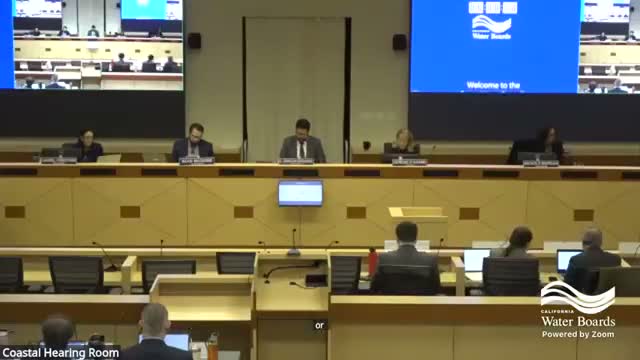
Chair Joaquin Escobel opened the State Water Resources Control Board’s second day of public hearings on the Sacramento‑Delta updates to the Bay‑Delta Plan on Jan. 29, telling attendees the board is listening to input on a December 12 staff release but will not take action at the hearing. "My name is Joaquin Escobel, chair of the State Water Resources Control Board," he said in opening remarks.
Diane Riddle, assistant deputy director in the Division of Water Rights, provided a condensed staff presentation to orient the audience. She described the revised draft plan and a new Chapter 13 and framed the Board’s dual approach: a regulatory pathway and a Healthy Rivers and Landscapes (HRL) voluntary agreement pathway. "The purpose of this hearing is to receive comments on the 2 documents that staff released in December, including the draft plan and chapter 13," Riddle said. Staff reiterated procedural items and the comment deadline: written comments are due Monday, Feb. 2, 2026.
The day’s testimony showed a sharp divide. A panel of fishing‑industry representatives told the Board that salmon runs and the coastal fishing economy remain under acute stress and pushed for clearer, enforceable flow benchmarks and faster, measurable triggers if voluntary efforts fail. John McManus of the Golden State Salmon Association and other panelists asked the Board to account for recent operational changes, including federal operational changes referred to during testimony as "Action 5." Andy Giuliano of the Bay Area charter fleet said, "When you drain the rivers, you aren't just moving water. You're emptying our plates and our pockets." Speakers from the recreational and commercial fishing sectors described three years of closures and economic loss.
Local officials and some water agencies presented a different view. Officials from Napa, Solano and Yolo counties — including Mayor Alma Hernandez of Suisun City and Yolo County representative Mary Kimball — urged the Board to adopt an implementation path that preserves local water reliability and supports regional investments. Jennifer Pierre, speaking for HRL parties, told the Board that the HRL parties have invested in habitat and flow commitments and asked the Board to incorporate those elements, noting some components had been subject to board adjustments during staff review.
A lengthy tribal panel pressed for enforceable protections for tribal beneficial uses, stronger CEQA analysis of cultural impacts, government‑to‑government consultation and funding to enable tribal technical participation. Vince Lapena of Wilton Rancheria said the draft plan and environmental analysis "fail to reasonably protect tribal beneficial uses" and warned that reliance on voluntary, discretionary measures without mandatory backstops is legally insufficient.
Representatives of the Bureau of Reclamation and Delta interests also briefed the Board on Action 5, reservoir reoperation and the programmatic relationship between federal operations and the HRL proposals. Reclamation’s Mario Manzo said certain reservoir reoperations remain part of Action 5 but that some early‑implementation provisions were removed.
Many individual members of the public — fishermen, tribal members, conservationists, municipal utilities and water contractors — spoke in roughly equal numbers for and against a VA pathway. Comments in favor of enforceable unimpaired flows repeatedly cited scientific reports and asked the Board to adopt stronger regulatory standards; comments in favor of HRL emphasized implementability, regional partnerships and potential economic impacts of a rigid regulatory path.
The Board did not act on the draft plan at the hearing. Staff said they will prepare written responses to oral and written comments and release responses and the final draft materials before any noticed adoption meeting. The hearing continues for a third day; the Board will accept written comments through Feb. 2, 2026.
Diane Riddle, assistant deputy director in the Division of Water Rights, provided a condensed staff presentation to orient the audience. She described the revised draft plan and a new Chapter 13 and framed the Board’s dual approach: a regulatory pathway and a Healthy Rivers and Landscapes (HRL) voluntary agreement pathway. "The purpose of this hearing is to receive comments on the 2 documents that staff released in December, including the draft plan and chapter 13," Riddle said. Staff reiterated procedural items and the comment deadline: written comments are due Monday, Feb. 2, 2026.
The day’s testimony showed a sharp divide. A panel of fishing‑industry representatives told the Board that salmon runs and the coastal fishing economy remain under acute stress and pushed for clearer, enforceable flow benchmarks and faster, measurable triggers if voluntary efforts fail. John McManus of the Golden State Salmon Association and other panelists asked the Board to account for recent operational changes, including federal operational changes referred to during testimony as "Action 5." Andy Giuliano of the Bay Area charter fleet said, "When you drain the rivers, you aren't just moving water. You're emptying our plates and our pockets." Speakers from the recreational and commercial fishing sectors described three years of closures and economic loss.
Local officials and some water agencies presented a different view. Officials from Napa, Solano and Yolo counties — including Mayor Alma Hernandez of Suisun City and Yolo County representative Mary Kimball — urged the Board to adopt an implementation path that preserves local water reliability and supports regional investments. Jennifer Pierre, speaking for HRL parties, told the Board that the HRL parties have invested in habitat and flow commitments and asked the Board to incorporate those elements, noting some components had been subject to board adjustments during staff review.
A lengthy tribal panel pressed for enforceable protections for tribal beneficial uses, stronger CEQA analysis of cultural impacts, government‑to‑government consultation and funding to enable tribal technical participation. Vince Lapena of Wilton Rancheria said the draft plan and environmental analysis "fail to reasonably protect tribal beneficial uses" and warned that reliance on voluntary, discretionary measures without mandatory backstops is legally insufficient.
Representatives of the Bureau of Reclamation and Delta interests also briefed the Board on Action 5, reservoir reoperation and the programmatic relationship between federal operations and the HRL proposals. Reclamation’s Mario Manzo said certain reservoir reoperations remain part of Action 5 but that some early‑implementation provisions were removed.
Many individual members of the public — fishermen, tribal members, conservationists, municipal utilities and water contractors — spoke in roughly equal numbers for and against a VA pathway. Comments in favor of enforceable unimpaired flows repeatedly cited scientific reports and asked the Board to adopt stronger regulatory standards; comments in favor of HRL emphasized implementability, regional partnerships and potential economic impacts of a rigid regulatory path.
The Board did not act on the draft plan at the hearing. Staff said they will prepare written responses to oral and written comments and release responses and the final draft materials before any noticed adoption meeting. The hearing continues for a third day; the Board will accept written comments through Feb. 2, 2026.
Don't Miss a Word: See the Full Meeting!
Go beyond summaries. Unlock every video, transcript, and key insight with a Founder Membership.
✓
Get instant access to full meeting videos
✓
Search and clip any phrase from complete transcripts
✓
Receive AI-powered summaries & custom alerts
✓
Enjoy lifetime, unrestricted access to government data
30-day money-back guarantee
