Senate Judiciary debates how narrowly to define sensitive locations in bill 209
January 30, 2026 | Judiciary, SENATE, Committees, Legislative , Vermont
This article was created by AI summarizing key points discussed. AI makes mistakes, so for full details and context, please refer to the video of the full meeting. Please report any errors so we can fix them. Report an error »
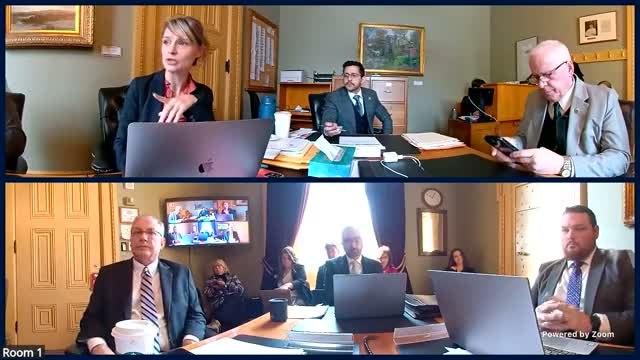
The Senate Judiciary met Jan. 29 to continue work on a bill referenced in the transcript as “209,” focusing on how to define the sensitive locations where certain arrests would be restricted and how to enforce violations. Committee members debated whether to limit coverage to state-owned buildings, adopt a fixed radius around sensitive sites, or create a specific list of locations such as schools, courthouses and health-care facilities.
Dolores, who updated the committee, told members she had no amendment for the day but sought direction on “what locations you definitely wanna include and definitions,” and asked staff to prepare a narrower draft for the next meeting. She proposed keeping the existing court-proceeding language for hearings while using a perimeter approach for other sensitive places, offering “maybe a radius of feet, 1000 feet, let’s just say, for example,” as a possible model.
Several members pushed back on an expansive ownership-based test. Unidentified Speaker 1 cautioned that expanding the bill’s scope “will turn into something that does constructively interfere entirely, with the federal government's enforcement of its laws,” saying the committee must consider the statute’s defensibility. Unidentified Speaker 3 and others raised practical concerns that a fixed radius could sweep in ordinary activities such as school drop-offs or ambulance transfers, asking how “traveling to” would be interpreted when parents drive children or when someone is en route to emergency care.
Former Senator Jeanette White (Unidentified Speaker 4) recommended explicitly listing schools, noting school districts can be municipal entities under statute, and urged care in adding municipal buildings because the term could be very broad. Members discussed examples — airports, bus and rail stations, salt sheds and multipurpose buildings — and suggested focusing on the function of a site (courthouse, school, shelter, health-care facility) rather than ownership alone.
On remedies, Dolores pointed to the bill’s current language in the remedy section that ties contempt proceedings and civil liability to court proceedings and said the Attorney General’s office would be responsible for civil enforcement for non-court locations. Committee discussion confirmed contempt likely applies only to courtroom contexts and that other enforcement would proceed through AG civil actions; “false imprisonment” and related civil claims were discussed as possible bases for suits.
Dolores said she would pull Department of Homeland Security guidance from prior years — a list of places DHS previously treated as sensitive — to inform subdivision D and promised staff would synthesize those examples for the committee. Members agreed to work with Legislative Counsel and staff (including Tucker and Rick) to tighten the municipal/building language and to return with a revised draft next week. The committee then prepared to take up a Supreme Court confirmation after a short break.
The committee did not vote on the bill during this session; members directed staff to draft narrower statutory language, consult DHS lists and related work in Government Operations, and reconvene next week to consider the revised text.
Dolores, who updated the committee, told members she had no amendment for the day but sought direction on “what locations you definitely wanna include and definitions,” and asked staff to prepare a narrower draft for the next meeting. She proposed keeping the existing court-proceeding language for hearings while using a perimeter approach for other sensitive places, offering “maybe a radius of feet, 1000 feet, let’s just say, for example,” as a possible model.
Several members pushed back on an expansive ownership-based test. Unidentified Speaker 1 cautioned that expanding the bill’s scope “will turn into something that does constructively interfere entirely, with the federal government's enforcement of its laws,” saying the committee must consider the statute’s defensibility. Unidentified Speaker 3 and others raised practical concerns that a fixed radius could sweep in ordinary activities such as school drop-offs or ambulance transfers, asking how “traveling to” would be interpreted when parents drive children or when someone is en route to emergency care.
Former Senator Jeanette White (Unidentified Speaker 4) recommended explicitly listing schools, noting school districts can be municipal entities under statute, and urged care in adding municipal buildings because the term could be very broad. Members discussed examples — airports, bus and rail stations, salt sheds and multipurpose buildings — and suggested focusing on the function of a site (courthouse, school, shelter, health-care facility) rather than ownership alone.
On remedies, Dolores pointed to the bill’s current language in the remedy section that ties contempt proceedings and civil liability to court proceedings and said the Attorney General’s office would be responsible for civil enforcement for non-court locations. Committee discussion confirmed contempt likely applies only to courtroom contexts and that other enforcement would proceed through AG civil actions; “false imprisonment” and related civil claims were discussed as possible bases for suits.
Dolores said she would pull Department of Homeland Security guidance from prior years — a list of places DHS previously treated as sensitive — to inform subdivision D and promised staff would synthesize those examples for the committee. Members agreed to work with Legislative Counsel and staff (including Tucker and Rick) to tighten the municipal/building language and to return with a revised draft next week. The committee then prepared to take up a Supreme Court confirmation after a short break.
The committee did not vote on the bill during this session; members directed staff to draft narrower statutory language, consult DHS lists and related work in Government Operations, and reconvene next week to consider the revised text.
Don't Miss a Word: See the Full Meeting!
Go beyond summaries. Unlock every video, transcript, and key insight with a Founder Membership.
✓
Get instant access to full meeting videos
✓
Search and clip any phrase from complete transcripts
✓
Receive AI-powered summaries & custom alerts
✓
Enjoy lifetime, unrestricted access to government data
30-day money-back guarantee
