Land Access Opportunity Board presents Resilience Hub toolkit, seeks pilot grants for community hubs
January 30, 2026 | Natural Resources & Energy, SENATE, Committees, Legislative , Vermont
This article was created by AI summarizing key points discussed. AI makes mistakes, so for full details and context, please refer to the video of the full meeting. Please report any errors so we can fix them. Report an error »
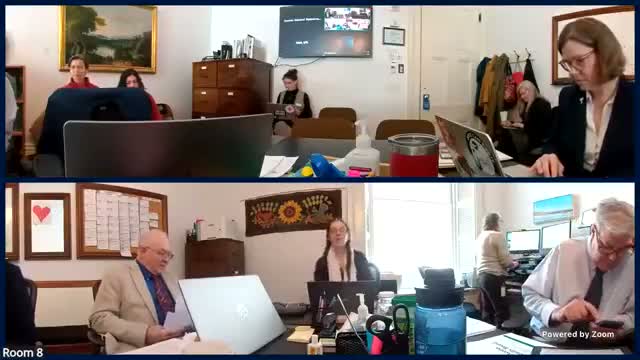
The Land Access Opportunity Board (LAOB) told the Senate Natural Resources & Energy Committee on Jan. 29 that it has developed a Resilience Hub Toolkit created by frontline community leaders after repeated floods and that the state can multiply local impacts by investing modest grant funds.
Lena Greenberg of Community Resilience Organizations, who co‑wrote the toolkit, described three core sections—community organizing, emergency preparedness and baseline resilience—and said the material is available online at resiliencetoolkit.org and as print templates that work offline. “There are three main sections in the toolkit. The first is guidance about how to organize your community,” Greenberg told the committee.
LAOB co‑directors said they have opened a first pilot grant round intended to fund roughly three resilience hubs and that they estimate typical grant sizes around $50,000. Presenters said they hope to add funds from an FY26 budget amendment (they referenced $250,000 as potential additional funding) to support five more hubs and that their long‑range goal is a cohort of 16–20 hubs to enable peer learning across regions. The board said it has received appropriations since 2022 (the committee referenced approximately $3,000,000 in cumulative appropriations) and that resilience hubs were proposed in the LAOB FY27 materials at a figure presented as $400,000.
Committee members asked how the toolkit would interact with municipal emergency management; presenters said the toolkit is designed to bridge grassroots organizers and official emergency management committees, to be plain‑language and to avoid duplicating existing systems. Presenters emphasized the locally‑led development process and said the toolkit is already being used in communities from Plainfield to Lindenville.
Why it matters: Committee members heard that funding small, community‑driven hubs could increase local capacity for disaster preparedness and recovery while improving the efficiency of state investments. LAOB framed the hubs as a preventative, community‑led investment that could reduce long‑term public costs from repeated disasters.
What’s next: LAOB requested committee help with a lunchtime appropriation to sustain expansion and offered to return with further details about the pilot and grant mechanics; the committee reserved time for additional stake‑holder testimony in upcoming meetings.
Lena Greenberg of Community Resilience Organizations, who co‑wrote the toolkit, described three core sections—community organizing, emergency preparedness and baseline resilience—and said the material is available online at resiliencetoolkit.org and as print templates that work offline. “There are three main sections in the toolkit. The first is guidance about how to organize your community,” Greenberg told the committee.
LAOB co‑directors said they have opened a first pilot grant round intended to fund roughly three resilience hubs and that they estimate typical grant sizes around $50,000. Presenters said they hope to add funds from an FY26 budget amendment (they referenced $250,000 as potential additional funding) to support five more hubs and that their long‑range goal is a cohort of 16–20 hubs to enable peer learning across regions. The board said it has received appropriations since 2022 (the committee referenced approximately $3,000,000 in cumulative appropriations) and that resilience hubs were proposed in the LAOB FY27 materials at a figure presented as $400,000.
Committee members asked how the toolkit would interact with municipal emergency management; presenters said the toolkit is designed to bridge grassroots organizers and official emergency management committees, to be plain‑language and to avoid duplicating existing systems. Presenters emphasized the locally‑led development process and said the toolkit is already being used in communities from Plainfield to Lindenville.
Why it matters: Committee members heard that funding small, community‑driven hubs could increase local capacity for disaster preparedness and recovery while improving the efficiency of state investments. LAOB framed the hubs as a preventative, community‑led investment that could reduce long‑term public costs from repeated disasters.
What’s next: LAOB requested committee help with a lunchtime appropriation to sustain expansion and offered to return with further details about the pilot and grant mechanics; the committee reserved time for additional stake‑holder testimony in upcoming meetings.
View the Full Meeting & All Its Details
This article offers just a summary. Unlock complete video, transcripts, and insights as a Founder Member.
✓
Watch full, unedited meeting videos
✓
Search every word spoken in unlimited transcripts
✓
AI summaries & real-time alerts (all government levels)
✓
Permanent access to expanding government content
30-day money-back guarantee
