Lynn Haven rejects Bay Breeze Shores development after residents raise flood, traffic and compatibility concerns
January 30, 2026 | Lynn Haven, Bay County, Florida
This article was created by AI summarizing key points discussed. AI makes mistakes, so for full details and context, please refer to the video of the full meeting. Please report any errors so we can fix them. Report an error »
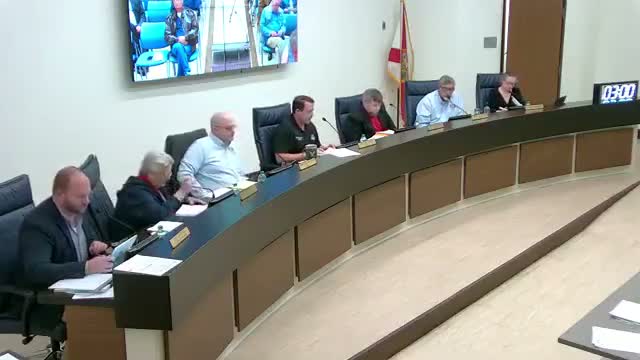
The Lynn Haven City Commission voted 5–0 to deny a development order for Bay Breeze Shores, a proposed 34‑unit manufactured/mobile home community on a roughly 2.94‑acre parcel at 1817 Bay Breeze Drive.
The proposal, presented by planning staff as meeting the city’s Unified Land Development Code and state requirements, drew more than a dozen sworn objectors at the hearing, who urged denial on compatibility, flood‑elevation and traffic‑safety grounds. Planning staff noted the project’s traffic estimate would add about 170 vehicle trips per day and about 20 vehicles per peak hour onto Highway 77.
Neighbors described the site as low‑lying (roughly 4 feet in elevation) and argued the required first‑floor elevation (about 13 feet in surrounding single‑family construction) made the plan impractical without extensive fill and tall piles. Contractor and resident witnesses repeatedly questioned whether the modular units could be built and insured at the required elevation. "You've been lied to tonight in this room," said certified building contractor Stephen Paul Sims, who told commissioners the illustrations shown were not what could be built and that the proposed units would need to be elevated on piers, producing ``towers in the sky.''
Residents also focused on safety and access. Several objectors said Grassy Point Road is narrow, includes a sharp curve, and does not accommodate the additional traffic or emergency‑vehicle turning the development would create. "It's a park, not a cul‑de‑sac," one adjacent property owner said, pointing to on‑street parking and kayak access at the street terminus. Other commenters raised concerns about the absence of nearby grocery or service amenities, arguing the site would be poorly located for households that might lack vehicle access.
The applicant's representatives defended the plan as permitted in the property’s high‑density residential land‑use category and said they had county approval for driveway access. "These are single family homes gathered together," the developer's representative said, framing the project as affordable homeownership rather than a permanent rental park.
City Attorney Amy reminded the commission it must determine compatibility based on the record presented. After deliberation, Commissioner Tender moved to deny the development order; the motion was seconded and carried on a 5–0 roll call.
Next steps: the denial concludes the hearing record for this application. The applicant may seek to revise the proposal or pursue other available options under the city's land‑use regulations.
The proposal, presented by planning staff as meeting the city’s Unified Land Development Code and state requirements, drew more than a dozen sworn objectors at the hearing, who urged denial on compatibility, flood‑elevation and traffic‑safety grounds. Planning staff noted the project’s traffic estimate would add about 170 vehicle trips per day and about 20 vehicles per peak hour onto Highway 77.
Neighbors described the site as low‑lying (roughly 4 feet in elevation) and argued the required first‑floor elevation (about 13 feet in surrounding single‑family construction) made the plan impractical without extensive fill and tall piles. Contractor and resident witnesses repeatedly questioned whether the modular units could be built and insured at the required elevation. "You've been lied to tonight in this room," said certified building contractor Stephen Paul Sims, who told commissioners the illustrations shown were not what could be built and that the proposed units would need to be elevated on piers, producing ``towers in the sky.''
Residents also focused on safety and access. Several objectors said Grassy Point Road is narrow, includes a sharp curve, and does not accommodate the additional traffic or emergency‑vehicle turning the development would create. "It's a park, not a cul‑de‑sac," one adjacent property owner said, pointing to on‑street parking and kayak access at the street terminus. Other commenters raised concerns about the absence of nearby grocery or service amenities, arguing the site would be poorly located for households that might lack vehicle access.
The applicant's representatives defended the plan as permitted in the property’s high‑density residential land‑use category and said they had county approval for driveway access. "These are single family homes gathered together," the developer's representative said, framing the project as affordable homeownership rather than a permanent rental park.
City Attorney Amy reminded the commission it must determine compatibility based on the record presented. After deliberation, Commissioner Tender moved to deny the development order; the motion was seconded and carried on a 5–0 roll call.
Next steps: the denial concludes the hearing record for this application. The applicant may seek to revise the proposal or pursue other available options under the city's land‑use regulations.
Don't Miss a Word: See the Full Meeting!
Go beyond summaries. Unlock every video, transcript, and key insight with a Founder Membership.
✓
Get instant access to full meeting videos
✓
Search and clip any phrase from complete transcripts
✓
Receive AI-powered summaries & custom alerts
✓
Enjoy lifetime, unrestricted access to government data
30-day money-back guarantee
