Committee weighs H.757 changes for manufactured-home co-ops; staff urge registry fixes, JFO flags modest fiscal effects
January 30, 2026 | General & Housing, HOUSE OF REPRESENTATIVES, Committees, Legislative , Vermont
This article was created by AI summarizing key points discussed. AI makes mistakes, so for full details and context, please refer to the video of the full meeting. Please report any errors so we can fix them. Report an error »
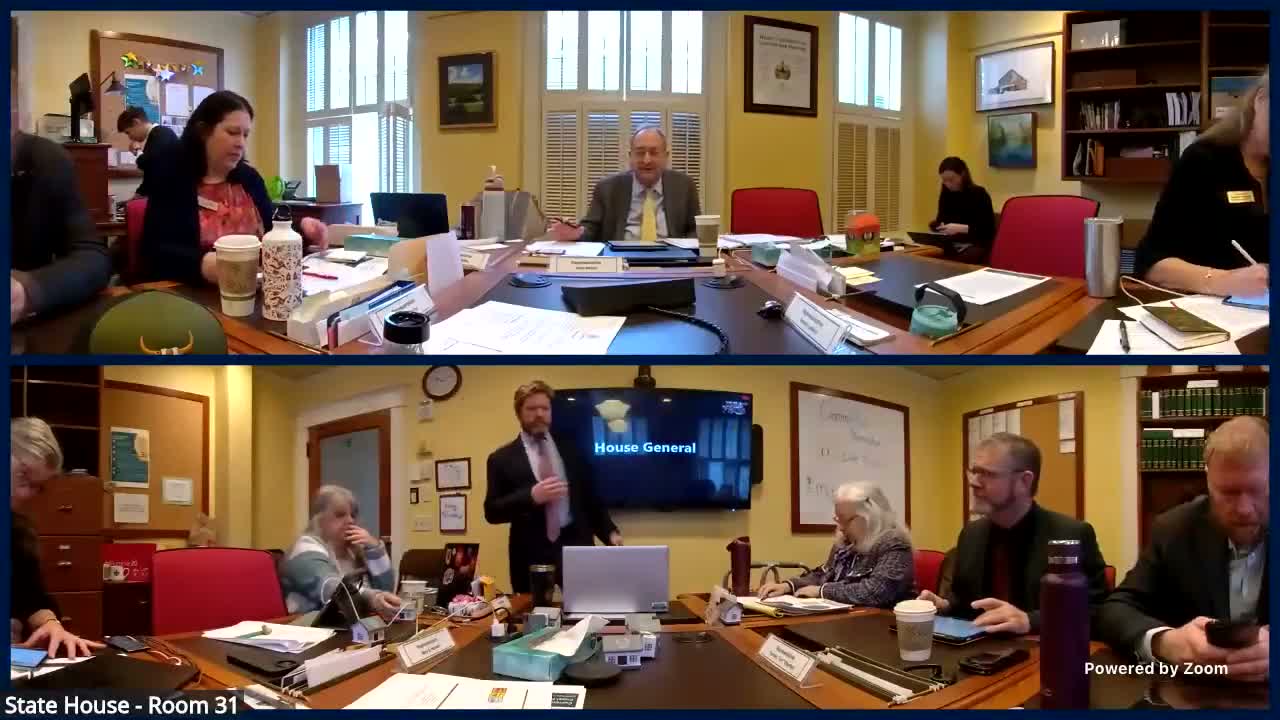
The House General & Housing Committee on Jan. 29 heard testimony on H.757, a bill aimed at manufactured-home communities organized as limited-equity cooperatives, with witnesses and staff urging narrow drafting and administrative fixes before formal markups.
David Hall, director of business services at the Secretary of State's office, told the committee the central, practical problem is terminology and registry classification: "The terminology we now use is business corporation, which reflects the title of 11a," he said, and recommended a legislative directive to allow the office to correct records so LECs are listed under the statutory business-organization categories rather than inconsistently as "profit" or "nonprofit."
Why it matters: committee members and witnesses said inconsistent registry labels can affect how grantmakers and state programs view an organization's eligibility. Hall cautioned that registry fixes would not change federal or state tax law. "I would recommend that you replace [the bill language] with ... some sort of directive that we scrub the record, make sure everything labeled according to the way the statutory construction is," Hall said, adding the office could make corrections if given authority but recommended making that authority permissive rather than mandatory.
Fiscal trade-offs: Ted Barnett of the Joint Fiscal Office gave a section-by-section fiscal walkthrough. He estimated exempting manufactured-home sales from the sales-and-use tax would reduce education-fund revenue by about $600,000 (in addition to an existing $400,000 exemption) and that extending property-transfer-tax coverage to manufactured-home transactions could raise roughly $100,000 in additional revenue; the latter would be subject to statutory allocations to housing and resilience funds and ultimately to the budget process.
On stormwater, Barnett said the proposed exemption for LECs from the 3-acre stormwater permitting threshold would have a de minimis effect on permit funds if limited to the small number of LEC-owned parcels but cautioned a broader exemption could yield larger losses. He also reported that data sources show about 238 manufactured-home parks in Vermont, of which roughly 19 are organized as limited-equity cooperatives.
Committee response and next steps: lawmakers asked legislative counsel to draft revisions narrowing the bill to manufactured-home LECs and to include language authorizing, but not requiring, the Secretary of State to correct registry entries. Members asked staff to consult Jeremiah Ward (CDI) and other program staff about wastewater/grant implications and to provide JFO with any additional data needed for a formal fiscal note. No formal votes or motions were taken; the committee plans to reconvene for markups after counsel and staff deliver updated language.
The committee recessed after the hearing; witnesses and counsel remained available for follow-up.
David Hall, director of business services at the Secretary of State's office, told the committee the central, practical problem is terminology and registry classification: "The terminology we now use is business corporation, which reflects the title of 11a," he said, and recommended a legislative directive to allow the office to correct records so LECs are listed under the statutory business-organization categories rather than inconsistently as "profit" or "nonprofit."
Why it matters: committee members and witnesses said inconsistent registry labels can affect how grantmakers and state programs view an organization's eligibility. Hall cautioned that registry fixes would not change federal or state tax law. "I would recommend that you replace [the bill language] with ... some sort of directive that we scrub the record, make sure everything labeled according to the way the statutory construction is," Hall said, adding the office could make corrections if given authority but recommended making that authority permissive rather than mandatory.
Fiscal trade-offs: Ted Barnett of the Joint Fiscal Office gave a section-by-section fiscal walkthrough. He estimated exempting manufactured-home sales from the sales-and-use tax would reduce education-fund revenue by about $600,000 (in addition to an existing $400,000 exemption) and that extending property-transfer-tax coverage to manufactured-home transactions could raise roughly $100,000 in additional revenue; the latter would be subject to statutory allocations to housing and resilience funds and ultimately to the budget process.
On stormwater, Barnett said the proposed exemption for LECs from the 3-acre stormwater permitting threshold would have a de minimis effect on permit funds if limited to the small number of LEC-owned parcels but cautioned a broader exemption could yield larger losses. He also reported that data sources show about 238 manufactured-home parks in Vermont, of which roughly 19 are organized as limited-equity cooperatives.
Committee response and next steps: lawmakers asked legislative counsel to draft revisions narrowing the bill to manufactured-home LECs and to include language authorizing, but not requiring, the Secretary of State to correct registry entries. Members asked staff to consult Jeremiah Ward (CDI) and other program staff about wastewater/grant implications and to provide JFO with any additional data needed for a formal fiscal note. No formal votes or motions were taken; the committee plans to reconvene for markups after counsel and staff deliver updated language.
The committee recessed after the hearing; witnesses and counsel remained available for follow-up.
Don't Miss a Word: See the Full Meeting!
Go beyond summaries. Unlock every video, transcript, and key insight with a Founder Membership.
✓
Get instant access to full meeting videos
✓
Search and clip any phrase from complete transcripts
✓
Receive AI-powered summaries & custom alerts
✓
Enjoy lifetime, unrestricted access to government data
30-day money-back guarantee
