Building Code Council TAG debates smaller dwelling‑unit rules but cannot act without quorum
January 30, 2026 | Building Code Council, Governor's Office - Boards & Commissions, Executive, Washington
This article was created by AI summarizing key points discussed. AI makes mistakes, so for full details and context, please refer to the video of the full meeting. Please report any errors so we can fix them. Report an error »
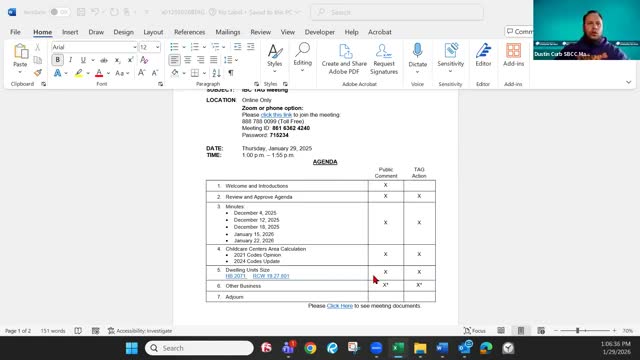
Members of the Building Code Council's International Building Code Technical Advisory Group discussed a package of proposed code changes aimed at clarifying minimum sizes and habitable‑area measurements for very small dwelling units during a Jan. 29 webinar, but the group could not make formal recommendations because it lacked a quorum.
David Neiman, who presented a joint proposal developed with Micah, said the draft would remove section 1208.3 as redundant and "retain[] all the basic size standards that require a 120 square feet as the minimum in that floor area," adding that "we're simply clarifying that 70 square feet of that area has to be habitable space that is not less than 7 feet in any dimension." The change, Neiman said, is intended to ensure a clearly furnishable area within the minimum unit size and to align the code language with the National Healthy Housing Standard's intent.
Supporters said the clarified language would reduce inconsistent interpretation by code officials. "The essence the problem we've always had in small unit design is getting code officials to reconcile the concept of the 7‑foot minimum dimension with the total area requirement," Neiman said. Several participants agreed that excluding built‑in cabinets and equipment from the required habitable area should be explicit to avoid counting counters or fixed cabinetry as usable floor area.
Other members raised usability and health concerns. Micah urged the TAG to consider workspace requirements for kitchens in single‑room units and pointed to a 36‑inch passageway provision that does not guarantee usable counter space; he suggested incorporating a minimum workspace (for example, about 30 inches) if 1208.5 were removed. Micah also noted that Seattle's code and the National Healthy Housing Standard discuss natural light for habitable rooms and argued the TAG should consider daylight requirements as units shrink.
Members debated whether to retain the "efficiency dwelling unit" definition, which currently requires a separate closet or storage. Some urged keeping a storage requirement or allowing permanently installed built‑ins as equivalent; others cautioned that prescriptive lists in code text can create enforcement headaches and preferred concise wording such as excluding "built‑in equipment" from net floor area.
The group extensively discussed what counts as a "permanent" cooking provision. Several members — including Hoyt Jeter and others — said a hard‑mounted cooktop or permanently installed appliance better distinguishes a dwelling unit from a sleeping unit, while others argued a mounted microwave or other listed appliance might meet the functional needs of residents. Participants warned that requiring a permanent cooktop can trigger mechanical and energy‑code work (hoods, venting, envelope penetrations) that may make retrofit projects more expensive or infeasible.
Because the TAG did not have the required quorum, the group could not take an official position or vote on the language. The facilitator said he will send a poll to find a time that yields better attendance, and the committee may return with a full room to vote or send the refined package on to committee review.
Next steps: TAG staff will poll members on scheduling to secure quorum at a future session; the committee did not adopt any formal motions at this meeting.
David Neiman, who presented a joint proposal developed with Micah, said the draft would remove section 1208.3 as redundant and "retain[] all the basic size standards that require a 120 square feet as the minimum in that floor area," adding that "we're simply clarifying that 70 square feet of that area has to be habitable space that is not less than 7 feet in any dimension." The change, Neiman said, is intended to ensure a clearly furnishable area within the minimum unit size and to align the code language with the National Healthy Housing Standard's intent.
Supporters said the clarified language would reduce inconsistent interpretation by code officials. "The essence the problem we've always had in small unit design is getting code officials to reconcile the concept of the 7‑foot minimum dimension with the total area requirement," Neiman said. Several participants agreed that excluding built‑in cabinets and equipment from the required habitable area should be explicit to avoid counting counters or fixed cabinetry as usable floor area.
Other members raised usability and health concerns. Micah urged the TAG to consider workspace requirements for kitchens in single‑room units and pointed to a 36‑inch passageway provision that does not guarantee usable counter space; he suggested incorporating a minimum workspace (for example, about 30 inches) if 1208.5 were removed. Micah also noted that Seattle's code and the National Healthy Housing Standard discuss natural light for habitable rooms and argued the TAG should consider daylight requirements as units shrink.
Members debated whether to retain the "efficiency dwelling unit" definition, which currently requires a separate closet or storage. Some urged keeping a storage requirement or allowing permanently installed built‑ins as equivalent; others cautioned that prescriptive lists in code text can create enforcement headaches and preferred concise wording such as excluding "built‑in equipment" from net floor area.
The group extensively discussed what counts as a "permanent" cooking provision. Several members — including Hoyt Jeter and others — said a hard‑mounted cooktop or permanently installed appliance better distinguishes a dwelling unit from a sleeping unit, while others argued a mounted microwave or other listed appliance might meet the functional needs of residents. Participants warned that requiring a permanent cooktop can trigger mechanical and energy‑code work (hoods, venting, envelope penetrations) that may make retrofit projects more expensive or infeasible.
Because the TAG did not have the required quorum, the group could not take an official position or vote on the language. The facilitator said he will send a poll to find a time that yields better attendance, and the committee may return with a full room to vote or send the refined package on to committee review.
Next steps: TAG staff will poll members on scheduling to secure quorum at a future session; the committee did not adopt any formal motions at this meeting.
Don't Miss a Word: See the Full Meeting!
Go beyond summaries. Unlock every video, transcript, and key insight with a Founder Membership.
✓
Get instant access to full meeting videos
✓
Search and clip any phrase from complete transcripts
✓
Receive AI-powered summaries & custom alerts
✓
Enjoy lifetime, unrestricted access to government data
30-day money-back guarantee
