Escondido council opens hearing on HOME‑fund reallocation to expand rental subsidies
January 30, 2026 | Escondido, San Diego County, California
This article was created by AI summarizing key points discussed. AI makes mistakes, so for full details and context, please refer to the video of the full meeting. Please report any errors so we can fix them. Report an error »
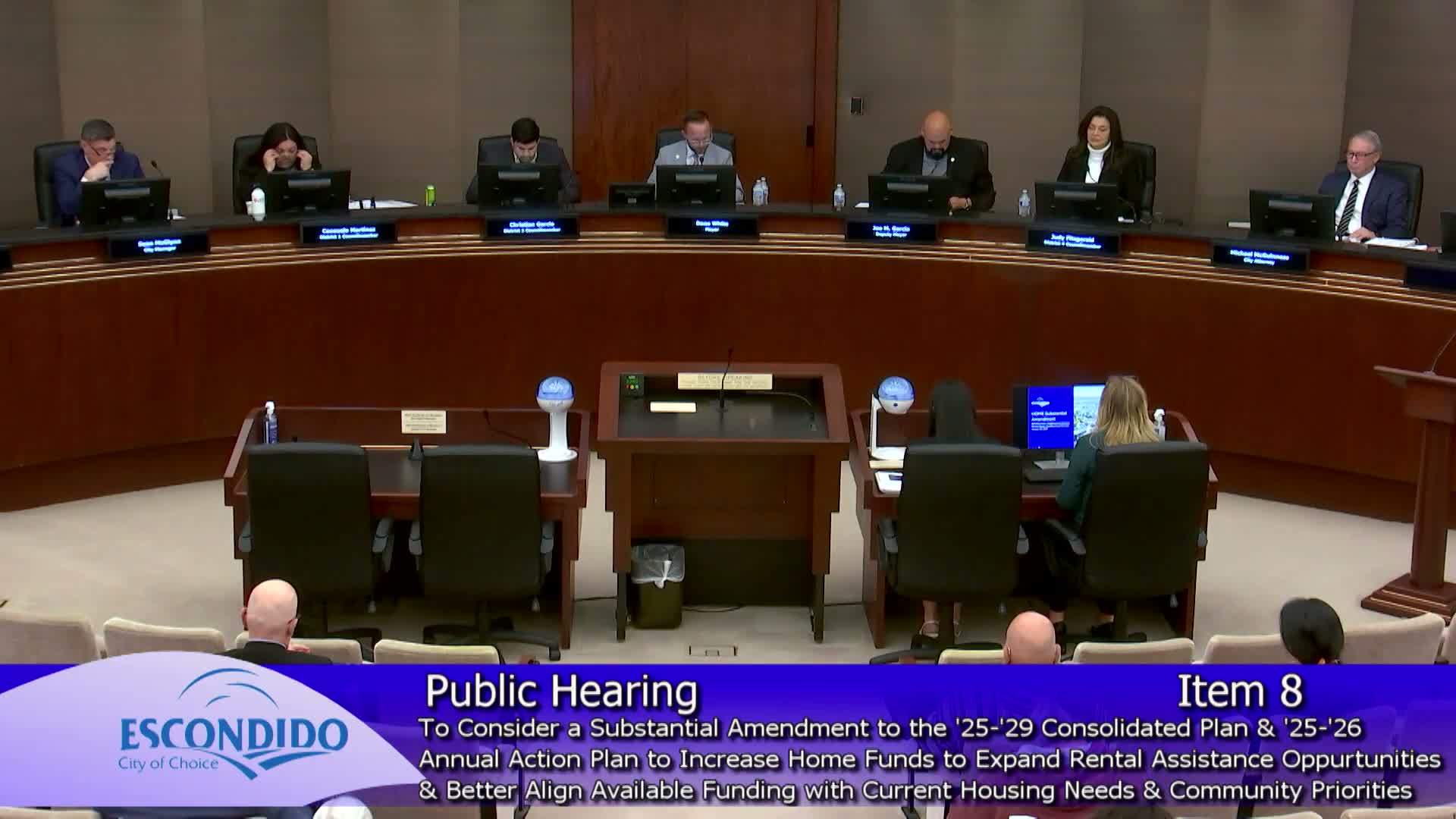
Escondido’s city council heard a staff proposal to substantially amend the city’s HOME program on Thursday, directing more grant dollars toward rental subsidies aimed at people at immediate risk of homelessness.
Danielle Lopez, housing and neighborhood services manager, told the council the HOME allocation the council adopted in June had totaled roughly $590,000, with $72,000 then budgeted for a rental subsidy that served about 30 households. Under the staff recommendation, the city would raise that line item to $388,000, increase the monthly subsidy from $200 to $400 for the lowest‑income households and expand eligibility to serve about 80 households annually. Households at or below 30% of area median income would receive the full $400; households at or below 60% AMI would receive $300, Lopez said.
The proposed change would reduce the unallocated HOME balance the city holds for first‑time homebuyer loans from about $370,000 annually to roughly $54,000, Lopez said. Staff recommended keeping the first‑time homebuyer loan program intact for now and returning to council with details on expiring‑funds proposals in a March 4 hearing.
Members of the public urged broader use of the expiring funds. “These HOME funds were awarded in 2017 … the fact that they remain largely unspent nearly nine years later is troubling,” said Victoria Nayak, who urged an income‑based approach and a preference for households experiencing homelessness. Maria Wallace and other residents urged the council to allow rental assistance for all income‑qualified residents rather than limit it to seniors on the Section 8 waiting list.
Mayor Dane White and council members questioned program rules that could exclude applicants (for example, an assets cap of $25,000). Lopez said the assets threshold was a historic program rule that staff could revisit. On loan terms, Lopez confirmed the low‑interest first‑time‑buyer loan was modeled at about 3%.
Lopez reminded the council this meeting functioned as the first of two required public hearings for a substantial amendment and that staff would conduct additional outreach and a 30‑day public review before returning with a final recommendation for possible submittal to HUD.
Council direction: members asked staff to return with options on the asset limit and loan percentage, and to outline public‑outreach dates for the follow‑up hearing. The council did not adopt the amendment on Thursday; a final action is expected at the March 4 meeting.
Danielle Lopez, housing and neighborhood services manager, told the council the HOME allocation the council adopted in June had totaled roughly $590,000, with $72,000 then budgeted for a rental subsidy that served about 30 households. Under the staff recommendation, the city would raise that line item to $388,000, increase the monthly subsidy from $200 to $400 for the lowest‑income households and expand eligibility to serve about 80 households annually. Households at or below 30% of area median income would receive the full $400; households at or below 60% AMI would receive $300, Lopez said.
The proposed change would reduce the unallocated HOME balance the city holds for first‑time homebuyer loans from about $370,000 annually to roughly $54,000, Lopez said. Staff recommended keeping the first‑time homebuyer loan program intact for now and returning to council with details on expiring‑funds proposals in a March 4 hearing.
Members of the public urged broader use of the expiring funds. “These HOME funds were awarded in 2017 … the fact that they remain largely unspent nearly nine years later is troubling,” said Victoria Nayak, who urged an income‑based approach and a preference for households experiencing homelessness. Maria Wallace and other residents urged the council to allow rental assistance for all income‑qualified residents rather than limit it to seniors on the Section 8 waiting list.
Mayor Dane White and council members questioned program rules that could exclude applicants (for example, an assets cap of $25,000). Lopez said the assets threshold was a historic program rule that staff could revisit. On loan terms, Lopez confirmed the low‑interest first‑time‑buyer loan was modeled at about 3%.
Lopez reminded the council this meeting functioned as the first of two required public hearings for a substantial amendment and that staff would conduct additional outreach and a 30‑day public review before returning with a final recommendation for possible submittal to HUD.
Council direction: members asked staff to return with options on the asset limit and loan percentage, and to outline public‑outreach dates for the follow‑up hearing. The council did not adopt the amendment on Thursday; a final action is expected at the March 4 meeting.
View the Full Meeting & All Its Details
This article offers just a summary. Unlock complete video, transcripts, and insights as a Founder Member.
✓
Watch full, unedited meeting videos
✓
Search every word spoken in unlimited transcripts
✓
AI summaries & real-time alerts (all government levels)
✓
Permanent access to expanding government content
30-day money-back guarantee
