DeKalb officials weigh expanding weekend bond hearings to reduce jail stays
January 30, 2026 | DeKalb County, Georgia
This article was created by AI summarizing key points discussed. AI makes mistakes, so for full details and context, please refer to the video of the full meeting. Please report any errors so we can fix them. Report an error »
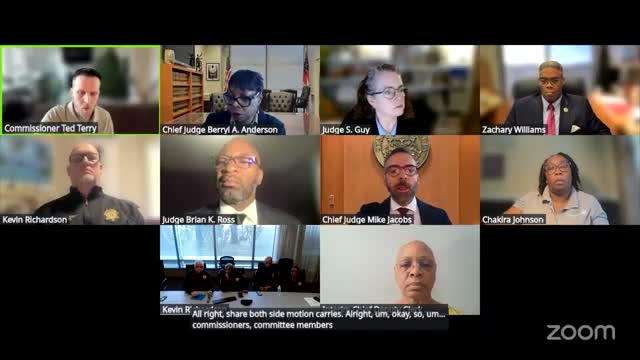
Commissioner Ted Terry, chair of the DeKalb County Finance, Administration and Budget (FAB) Committee, opened a virtual discussion about whether the county should expand weekend court calendars to reduce pretrial jail stays.
The conversation brought judges, the solicitor general, the public defender, marshals and sheriff’s office leaders to the same virtual table. Chief Magistrate Judge Beryl Anderson said DeKalb already runs misdemeanor bond hearings seven days a week and felony bond hearings six days a week but that adding more calendar days would require additional judges, space and resources. “We already have misdemeanor bond hearings 7 days a week, and we have felony bond hearings 6 days a week,” Anderson said, adding that expanding to additional weekend or late‑night slots would likely require “about 3 more part‑time judges” to cover new misdemeanor calendars.
Solicitor General Donna Colvin Stribling described how her office staffs hearings and emphasized prosecutorial workload: her office recorded roughly 30,000 appearances last year and employs 32 attorneys handling about 400 active cases per attorney at any given time. “In the state of Georgia, if you have a misdemeanor, you will receive a bond,” she said, and added that any expansion must consider rotating staffing so individual attorneys do not work every weekend.
Speakers from the sheriff’s office and marshal’s office outlined operational constraints. Marshall Richardson said courtroom security scales with the number of courtroom sites and that adding a courtroom requires additional deputies and screening resources; the sheriff’s chief of operations said the jail can host remote (Zoom) hearings every day but that in‑person sessions would have different staffing implications. County leaders also raised facility limits: the Burgess Building and other court spaces were cited as constraining where additional court calendars could be staged.
Commissioners pressed for a clearer cost‑benefit picture. Commissioner Michelle Long Spears asked for a tighter range on the memo’s cited annual estimate ($442,000–$663,000), a staffing plan, and measurable success metrics for any pilot. Staff and judges recommended a coordinated plan that ties resource requests to measurable throughput outcomes and said any expansion should be folded into FY26 budgeting discussions.
The meeting closed with direction for staff to produce more detailed, coordinated proposals—identifying exact staffing gaps in the solicitor and defender offices, facility constraints and a possible pilot design—so the board can consider funding and next steps during the budget process.
The FAB committee did not take a vote on policy at this meeting and will continue the discussion in upcoming sessions.
The conversation brought judges, the solicitor general, the public defender, marshals and sheriff’s office leaders to the same virtual table. Chief Magistrate Judge Beryl Anderson said DeKalb already runs misdemeanor bond hearings seven days a week and felony bond hearings six days a week but that adding more calendar days would require additional judges, space and resources. “We already have misdemeanor bond hearings 7 days a week, and we have felony bond hearings 6 days a week,” Anderson said, adding that expanding to additional weekend or late‑night slots would likely require “about 3 more part‑time judges” to cover new misdemeanor calendars.
Solicitor General Donna Colvin Stribling described how her office staffs hearings and emphasized prosecutorial workload: her office recorded roughly 30,000 appearances last year and employs 32 attorneys handling about 400 active cases per attorney at any given time. “In the state of Georgia, if you have a misdemeanor, you will receive a bond,” she said, and added that any expansion must consider rotating staffing so individual attorneys do not work every weekend.
Speakers from the sheriff’s office and marshal’s office outlined operational constraints. Marshall Richardson said courtroom security scales with the number of courtroom sites and that adding a courtroom requires additional deputies and screening resources; the sheriff’s chief of operations said the jail can host remote (Zoom) hearings every day but that in‑person sessions would have different staffing implications. County leaders also raised facility limits: the Burgess Building and other court spaces were cited as constraining where additional court calendars could be staged.
Commissioners pressed for a clearer cost‑benefit picture. Commissioner Michelle Long Spears asked for a tighter range on the memo’s cited annual estimate ($442,000–$663,000), a staffing plan, and measurable success metrics for any pilot. Staff and judges recommended a coordinated plan that ties resource requests to measurable throughput outcomes and said any expansion should be folded into FY26 budgeting discussions.
The meeting closed with direction for staff to produce more detailed, coordinated proposals—identifying exact staffing gaps in the solicitor and defender offices, facility constraints and a possible pilot design—so the board can consider funding and next steps during the budget process.
The FAB committee did not take a vote on policy at this meeting and will continue the discussion in upcoming sessions.
Don't Miss a Word: See the Full Meeting!
Go beyond summaries. Unlock every video, transcript, and key insight with a Founder Membership.
✓
Get instant access to full meeting videos
✓
Search and clip any phrase from complete transcripts
✓
Receive AI-powered summaries & custom alerts
✓
Enjoy lifetime, unrestricted access to government data
30-day money-back guarantee
