Centennial School District projects multimillion‑dollar shortfall, explores bringing some special‑education services in‑house
January 30, 2026 | Centennial SD, School Districts, Pennsylvania
This article was created by AI summarizing key points discussed. AI makes mistakes, so for full details and context, please refer to the video of the full meeting. Please report any errors so we can fix them. Report an error »
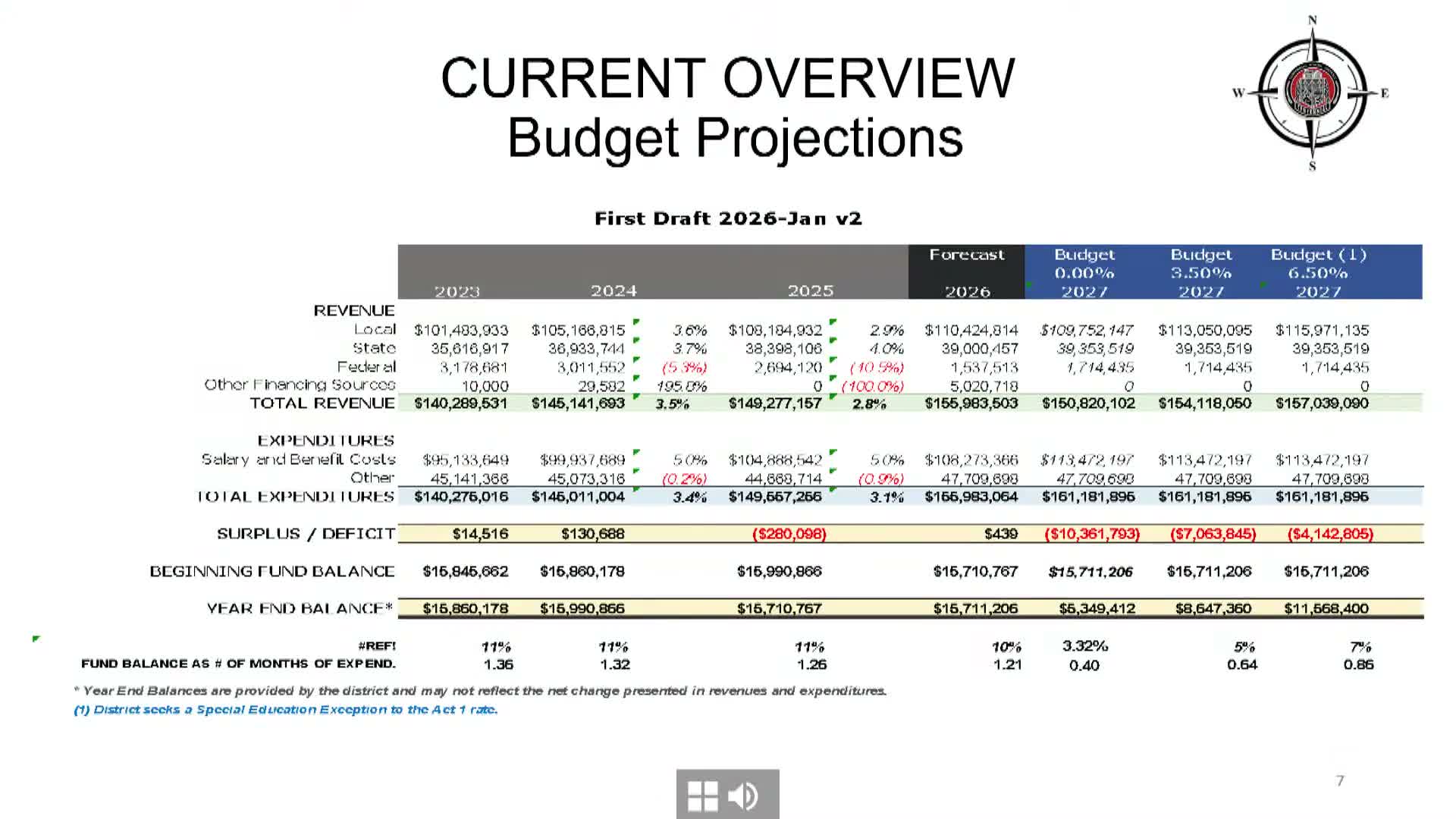
Centennial School District officials on Jan. 29 told the school board that the district faces a widening budget gap and outlined a menu of staffing, program and financial options to shrink the deficit.
Mister Greenwood, presenting the administration’s forecast, said the district’s surplus/deficit line shows scenarios ranging from roughly $4.1 million to about $10 million, depending on tax‑assessment and policy choices. Greenwood framed the session as a dialogue, not a decision night, and listed three mitigation categories: personnel and staffing; programs and services; and financial strategies.
Why it matters: Greenwood noted local property tax revenue remains the lion’s share of funding while state and federal revenue have flattened. He said the difference between the Act 1 index and board‑approved increases over prior years amounts to millions in foregone revenue — figures cited included a historical gap of about $12.7 million and a single‑year shortfall of about $3.8 million under current choices. Greenwood also flagged an expected medical and prescription benefits increase of about 14.5 percent as a significant near‑term cost pressure.
Special education and out‑of‑district placements drove much of the conversation. Greenwood said Centennial pays roughly $1.6 million to the Intermediate Unit (IU) for two Davis classrooms that serve 16 Centennial residents and estimated that bringing those classrooms into district control could save “upwards of $400,000,” with combined savings exceeding $500,000 if additional classrooms (for example at McDonald) were included. The administration also presented a total out‑of‑district tuition and placement estimate near $9 million for 2025–26 and warned that the IU contracts are tuition‑only while many related services (nursing, PCA, transportation) are billed a la carte.
Administrators emphasized parental consent and IEP team processes. Dr. Lukubaugh (district special‑education administration) said any decision to repatriate students would be selective and driven by what is best for each child: “It is critically important that we keep that student‑centered focus and that we work with families.” Greenwood added that the district would give IU staff a right of first refusal to join Centennial if programs transfer in‑house.
Other strategies presented included nonreplacement of positions through attrition (reallocating sections rather than automatic refilling), a zero‑based budgeting review to separate mandates from discretionary services, vendor consolidation and targeted grant‑seeking (including the possibility of outsourcing grant writing). Board members asked for a list of services the district performs that are not legally required and for more precise figures on recovered tuition from nonresident students; Greenwood said he would report on collections in the weekly update.
Timing and next steps: Greenwood said administrators will continue technical work with the IU, including a contracted‑cost reconciliation and a final contract submission timeline (the IU contracted‑cost presentation was described as due May 21). He reiterated the process is longer‑term and would include further board conversations over the coming months.
There were no formal budget votes at the session. The board closed the meeting after a final round of questions and a call for consensus on next steps.
Mister Greenwood, presenting the administration’s forecast, said the district’s surplus/deficit line shows scenarios ranging from roughly $4.1 million to about $10 million, depending on tax‑assessment and policy choices. Greenwood framed the session as a dialogue, not a decision night, and listed three mitigation categories: personnel and staffing; programs and services; and financial strategies.
Why it matters: Greenwood noted local property tax revenue remains the lion’s share of funding while state and federal revenue have flattened. He said the difference between the Act 1 index and board‑approved increases over prior years amounts to millions in foregone revenue — figures cited included a historical gap of about $12.7 million and a single‑year shortfall of about $3.8 million under current choices. Greenwood also flagged an expected medical and prescription benefits increase of about 14.5 percent as a significant near‑term cost pressure.
Special education and out‑of‑district placements drove much of the conversation. Greenwood said Centennial pays roughly $1.6 million to the Intermediate Unit (IU) for two Davis classrooms that serve 16 Centennial residents and estimated that bringing those classrooms into district control could save “upwards of $400,000,” with combined savings exceeding $500,000 if additional classrooms (for example at McDonald) were included. The administration also presented a total out‑of‑district tuition and placement estimate near $9 million for 2025–26 and warned that the IU contracts are tuition‑only while many related services (nursing, PCA, transportation) are billed a la carte.
Administrators emphasized parental consent and IEP team processes. Dr. Lukubaugh (district special‑education administration) said any decision to repatriate students would be selective and driven by what is best for each child: “It is critically important that we keep that student‑centered focus and that we work with families.” Greenwood added that the district would give IU staff a right of first refusal to join Centennial if programs transfer in‑house.
Other strategies presented included nonreplacement of positions through attrition (reallocating sections rather than automatic refilling), a zero‑based budgeting review to separate mandates from discretionary services, vendor consolidation and targeted grant‑seeking (including the possibility of outsourcing grant writing). Board members asked for a list of services the district performs that are not legally required and for more precise figures on recovered tuition from nonresident students; Greenwood said he would report on collections in the weekly update.
Timing and next steps: Greenwood said administrators will continue technical work with the IU, including a contracted‑cost reconciliation and a final contract submission timeline (the IU contracted‑cost presentation was described as due May 21). He reiterated the process is longer‑term and would include further board conversations over the coming months.
There were no formal budget votes at the session. The board closed the meeting after a final round of questions and a call for consensus on next steps.
View the Full Meeting & All Its Details
This article offers just a summary. Unlock complete video, transcripts, and insights as a Founder Member.
✓
Watch full, unedited meeting videos
✓
Search every word spoken in unlimited transcripts
✓
AI summaries & real-time alerts (all government levels)
✓
Permanent access to expanding government content
30-day money-back guarantee
