Residents demand cancellation of DHS/ICE range contract; council schedules discussion for Feb. 25
January 30, 2026 | Escondido, San Diego County, California
This article was created by AI summarizing key points discussed. AI makes mistakes, so for full details and context, please refer to the video of the full meeting. Please report any errors so we can fix them. Report an error »
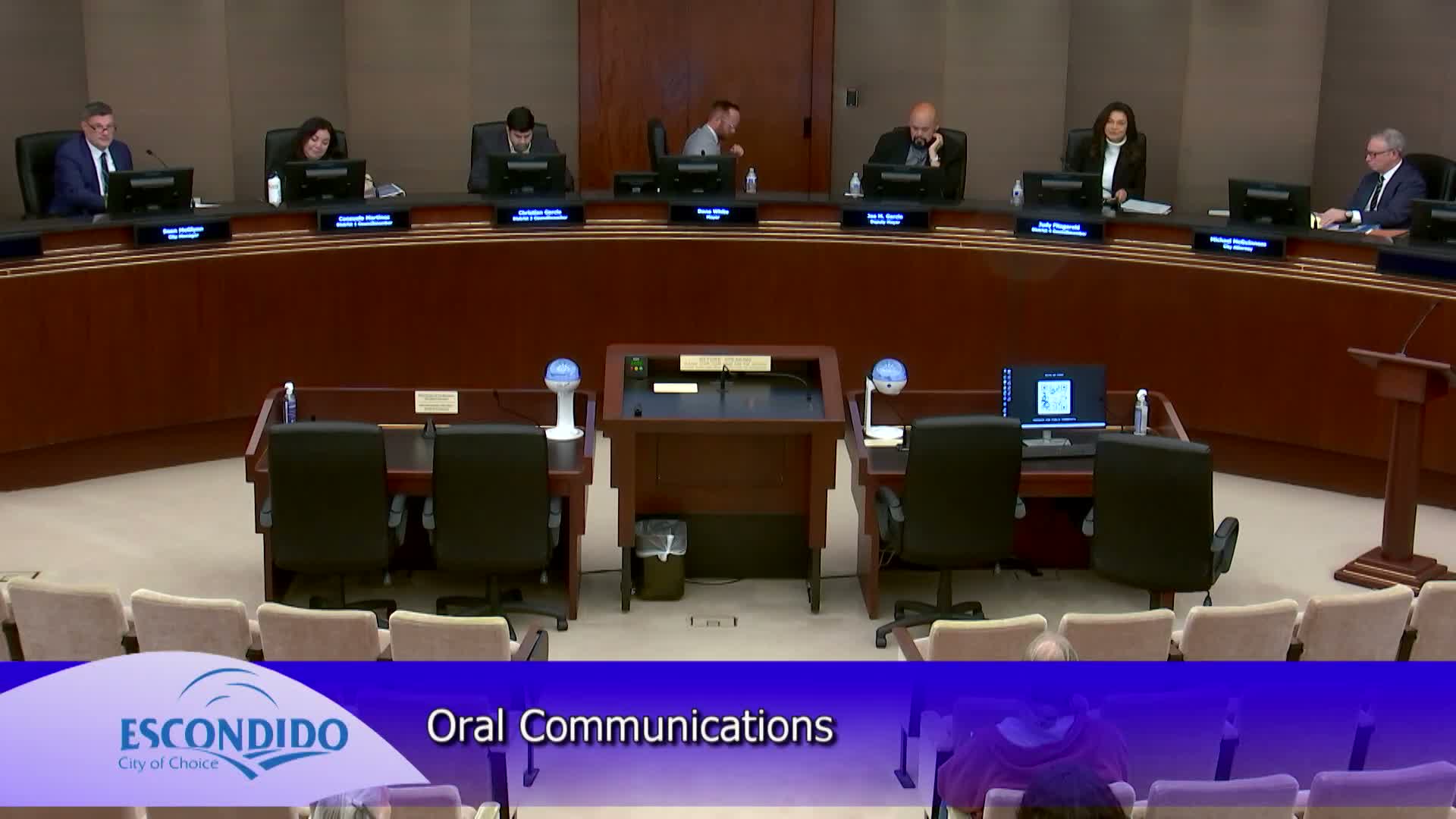
A wave of public testimony late in the meeting focused on a renewed contract that permits Department of Homeland Security/ICE personnel to use the Escondido Police Department’s training range and related facilities.
Multiple speakers — including longtime teachers, neighborhood residents and immigrant‑rights organizers — called on the council to cancel the lease and make the contract public. "We cannot allow ICE to use any facilities paid by our tax money," said Anna Marie Velasco, recounting students and families she has known in Escondido and urging immediate cancellation. Simon Guzman of Sowing Seeds of Dignity said the contract "should have never been signed" and urged the city to use all legal avenues to end the arrangement and to create ICE‑free municipal property rules.
Speakers cited recent federal enforcement actions and deaths in ICE custody and argued the contract undermines trust between immigrant communities and local law enforcement; they referenced California’s Values Act (SB 54) and asked the city to investigate whether the renewed lease is consistent with state policy and local obligations. Greg Oliver told the council the contract revenue «grosses $67,000» and said the city should not risk community trust for that amount.
Council members acknowledged the public concern and several councilmembers and staff noted an upcoming agenda item: Councilmember comments referenced a Feb. 25 public discussion on the contract (the meeting packet and staff timelines indicate that item will be publicly discussed on that date). Mayor White and staff said they would follow legal and administrative options and that staff will provide information on the contract’s renewal process; chief and contract details were the subject of repeated public requests for transparency.
No final council action to cancel the contract occurred on Thursday. Speakers said they will continue to press for administrative and legal remedies and for the council to pursue policy options such as local ICE‑free zones and emergency aid funding for families affected by enforcement.
Multiple speakers — including longtime teachers, neighborhood residents and immigrant‑rights organizers — called on the council to cancel the lease and make the contract public. "We cannot allow ICE to use any facilities paid by our tax money," said Anna Marie Velasco, recounting students and families she has known in Escondido and urging immediate cancellation. Simon Guzman of Sowing Seeds of Dignity said the contract "should have never been signed" and urged the city to use all legal avenues to end the arrangement and to create ICE‑free municipal property rules.
Speakers cited recent federal enforcement actions and deaths in ICE custody and argued the contract undermines trust between immigrant communities and local law enforcement; they referenced California’s Values Act (SB 54) and asked the city to investigate whether the renewed lease is consistent with state policy and local obligations. Greg Oliver told the council the contract revenue «grosses $67,000» and said the city should not risk community trust for that amount.
Council members acknowledged the public concern and several councilmembers and staff noted an upcoming agenda item: Councilmember comments referenced a Feb. 25 public discussion on the contract (the meeting packet and staff timelines indicate that item will be publicly discussed on that date). Mayor White and staff said they would follow legal and administrative options and that staff will provide information on the contract’s renewal process; chief and contract details were the subject of repeated public requests for transparency.
No final council action to cancel the contract occurred on Thursday. Speakers said they will continue to press for administrative and legal remedies and for the council to pursue policy options such as local ICE‑free zones and emergency aid funding for families affected by enforcement.
Don't Miss a Word: See the Full Meeting!
Go beyond summaries. Unlock every video, transcript, and key insight with a Founder Membership.
✓
Get instant access to full meeting videos
✓
Search and clip any phrase from complete transcripts
✓
Receive AI-powered summaries & custom alerts
✓
Enjoy lifetime, unrestricted access to government data
30-day money-back guarantee
