Mercer Island board finds superintendent compliant on most finance metrics but flags low reserves
January 30, 2026 | Mercer Island School District, School Districts, Washington
This article was created by AI summarizing key points discussed. AI makes mistakes, so for full details and context, please refer to the video of the full meeting. Please report any errors so we can fix them. Report an error »
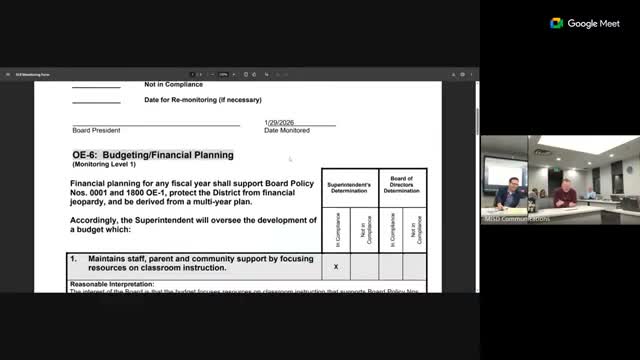
The Mercer Island School District board reviewed the superintendent’s financial monitoring report and agreed the district meets most budgeting and financial‑planning expectations, but falls short on maintaining policy reserves.
Assistant superintendents told the board that the district ended the prior fiscal year with about $3,100,000 in fund balance — around 4.1% of expenditures — well under the district’s policy floor of 8% and the 10% target cited in board policy. The district’s finance lead said the district’s Moody’s rating has fallen to AA2 and that, under Moody’s present guidance, substantially larger reserves (15%–25% depending on target rating) would be required to regain prior ratings.
Board members asked staff whether the district could reach policy targets without relying on state action. Staff said the most likely paths are a combination of legislative relief (enrollment stabilization proposals), successful levies, and gradual cost reductions tied to staffing and services; they cautioned that large, immediate cuts would risk program reductions for students. “We’re running around 4% each year,” the finance presenter said when describing the fund balance shortfall.
The board moved and seconded a compliance finding for the superintendent’s financial planning with a stated exception on the reserve requirement (item 3). Staff also presented a financial dashboard for November–December showing normal timing effects in apportionment and one‑time shifts — for example, a state accounting change moved roughly $85,000 into the CTE account and December donations increased by about $219,000, including a ~$150,000 high‑school donation.
Next steps discussed included continuing to monitor legislative proposals that would affect apportionment and reserves, planning for the upcoming levy, and modeling multi‑year strategies to avoid program‑level impacts while growing reserves over time.
Assistant superintendents told the board that the district ended the prior fiscal year with about $3,100,000 in fund balance — around 4.1% of expenditures — well under the district’s policy floor of 8% and the 10% target cited in board policy. The district’s finance lead said the district’s Moody’s rating has fallen to AA2 and that, under Moody’s present guidance, substantially larger reserves (15%–25% depending on target rating) would be required to regain prior ratings.
Board members asked staff whether the district could reach policy targets without relying on state action. Staff said the most likely paths are a combination of legislative relief (enrollment stabilization proposals), successful levies, and gradual cost reductions tied to staffing and services; they cautioned that large, immediate cuts would risk program reductions for students. “We’re running around 4% each year,” the finance presenter said when describing the fund balance shortfall.
The board moved and seconded a compliance finding for the superintendent’s financial planning with a stated exception on the reserve requirement (item 3). Staff also presented a financial dashboard for November–December showing normal timing effects in apportionment and one‑time shifts — for example, a state accounting change moved roughly $85,000 into the CTE account and December donations increased by about $219,000, including a ~$150,000 high‑school donation.
Next steps discussed included continuing to monitor legislative proposals that would affect apportionment and reserves, planning for the upcoming levy, and modeling multi‑year strategies to avoid program‑level impacts while growing reserves over time.
Don't Miss a Word: See the Full Meeting!
Go beyond summaries. Unlock every video, transcript, and key insight with a Founder Membership.
✓
Get instant access to full meeting videos
✓
Search and clip any phrase from complete transcripts
✓
Receive AI-powered summaries & custom alerts
✓
Enjoy lifetime, unrestricted access to government data
30-day money-back guarantee
