Public commenters press audit committee on contracts, staffing and utility billing
January 30, 2026 | Glendale, Los Angeles County, California
This article was created by AI summarizing key points discussed. AI makes mistakes, so for full details and context, please refer to the video of the full meeting. Please report any errors so we can fix them. Report an error »
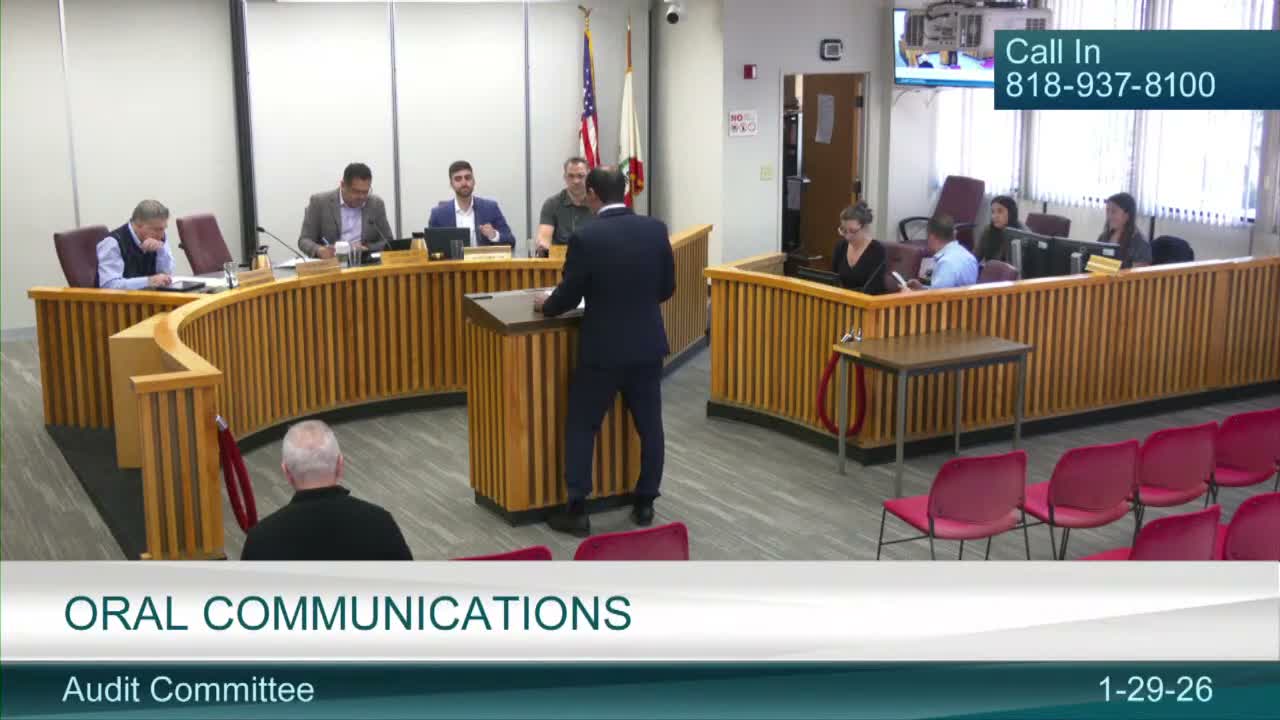
Public commenters used the oral communications period to press the audit committee for broader oversight and immediate action. Ejimin Hakobian asked the committee to adopt a 2026 audit plan, increase meeting frequency and public comment time, and to examine the CAFR and forecast assumptions, arguing the city faces multimillion-dollar deficits and large deferred‑maintenance liability. "What's short and sweet about $34,000,000 of deficit?" Hakobian asked, urging quarterly departmental reconciliations and contract audits. (Ejimin Hakobian.)
Herbert Milano asked the committee to consider transforming the audit committee into an independent audit commission with subpoena power and independent auditor selection. Milano cited a packet of contracts showing substantial contract increases (for example, an initial $500,000 contract that later totaled $5,300,000) and urged oversight of change orders and staffing to match workload.
Milano later raised a CPRA-sourced concern about residential billing: he said ZIP code 91204 has roughly 7,000 households and that the city recorded more than 13,000 shutoff notices in a single year, with average bills 53 days past due. He suggested evaluating a transition from bimonthly to monthly billing to reduce delinquencies and the incidence of shutoff notices. Committee members acknowledged the concern and suggested staff analysis; no policy change was directed at this meeting. (Herbert Milano.)
The committee approved two sets of meeting minutes by unanimous consent (Oct. 30 and Dec. 2). No new action items were taken at this meeting; committee members asked staff to consider adding staffing and CDBG audit review topics to future work plans.
Next steps: Committee asked staff to discuss how to place staffing and billing-cycle analysis on a future agenda; any change to GWP billing frequency would require staff analysis and further committee or council review.
Herbert Milano asked the committee to consider transforming the audit committee into an independent audit commission with subpoena power and independent auditor selection. Milano cited a packet of contracts showing substantial contract increases (for example, an initial $500,000 contract that later totaled $5,300,000) and urged oversight of change orders and staffing to match workload.
Milano later raised a CPRA-sourced concern about residential billing: he said ZIP code 91204 has roughly 7,000 households and that the city recorded more than 13,000 shutoff notices in a single year, with average bills 53 days past due. He suggested evaluating a transition from bimonthly to monthly billing to reduce delinquencies and the incidence of shutoff notices. Committee members acknowledged the concern and suggested staff analysis; no policy change was directed at this meeting. (Herbert Milano.)
The committee approved two sets of meeting minutes by unanimous consent (Oct. 30 and Dec. 2). No new action items were taken at this meeting; committee members asked staff to consider adding staffing and CDBG audit review topics to future work plans.
Next steps: Committee asked staff to discuss how to place staffing and billing-cycle analysis on a future agenda; any change to GWP billing frequency would require staff analysis and further committee or council review.
View the Full Meeting & All Its Details
This article offers just a summary. Unlock complete video, transcripts, and insights as a Founder Member.
✓
Watch full, unedited meeting videos
✓
Search every word spoken in unlimited transcripts
✓
AI summaries & real-time alerts (all government levels)
✓
Permanent access to expanding government content
30-day money-back guarantee
