County utilities outline capacity needs and propose updating connection fees last set in 1993
January 30, 2026 | Brevard County, Florida
This article was created by AI summarizing key points discussed. AI makes mistakes, so for full details and context, please refer to the video of the full meeting. Please report any errors so we can fix them. Report an error »
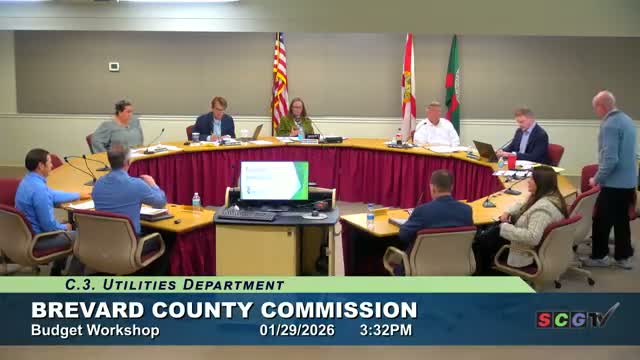
Brevard County Utilities staff briefed commissioners on service boundaries, treatment-plant capacity and a proposed update to connection fees last set in 1993.
Eddie Fontnan (Utilities) and Lucas Siegfried (Engineering Manager) said the utilities enterprise is budgeting roughly $50,000,000 annually for operations and that user rates remain the primary revenue source; staff noted balance-forward grant funds have been used and the utility has active debt service and state revolving funds for capital projects.
Staff explained connection fees are calculated as the capital investment cost per gallon divided by the level of service (gallons per equivalent residential unit). They said connection fees have not been updated since 1993 and that a consultant's draft calculations show materially higher fees would be needed to cover growth-related capital costs. Staff offered illustrative figures and phased options rather than a final proposal, noting connection fees are intended for capacity expansion and debt service, not routine operations.
“If we connect 200 homes a year, I believe that's an increase in revenue of about $4,800,000,” staff said as an example of how revising connection fees could support debt service for large treatment-plant projects. Staff also noted the Seymour (sewer) project and other major CIP items are being scoped and that consumptive‑use and permitting timelines (often 18 months or more) will factor into implementation schedules.
Commissioners asked technical questions about treatment-plant permitted capacity, peak flows, and how connection-fee calculations account for average versus peak demand; staff said the fee methodology uses average daily flow and peaking factors are part of design but that connection fees are intended to fund long-term capacity and therefore can be phased.
Staff said next steps would include agenda items to advertise proposed fee changes, public hearings and options for phased adoption; the board made no immediate changes at the workshop.
Eddie Fontnan (Utilities) and Lucas Siegfried (Engineering Manager) said the utilities enterprise is budgeting roughly $50,000,000 annually for operations and that user rates remain the primary revenue source; staff noted balance-forward grant funds have been used and the utility has active debt service and state revolving funds for capital projects.
Staff explained connection fees are calculated as the capital investment cost per gallon divided by the level of service (gallons per equivalent residential unit). They said connection fees have not been updated since 1993 and that a consultant's draft calculations show materially higher fees would be needed to cover growth-related capital costs. Staff offered illustrative figures and phased options rather than a final proposal, noting connection fees are intended for capacity expansion and debt service, not routine operations.
“If we connect 200 homes a year, I believe that's an increase in revenue of about $4,800,000,” staff said as an example of how revising connection fees could support debt service for large treatment-plant projects. Staff also noted the Seymour (sewer) project and other major CIP items are being scoped and that consumptive‑use and permitting timelines (often 18 months or more) will factor into implementation schedules.
Commissioners asked technical questions about treatment-plant permitted capacity, peak flows, and how connection-fee calculations account for average versus peak demand; staff said the fee methodology uses average daily flow and peaking factors are part of design but that connection fees are intended to fund long-term capacity and therefore can be phased.
Staff said next steps would include agenda items to advertise proposed fee changes, public hearings and options for phased adoption; the board made no immediate changes at the workshop.
Don't Miss a Word: See the Full Meeting!
Go beyond summaries. Unlock every video, transcript, and key insight with a Founder Membership.
✓
Get instant access to full meeting videos
✓
Search and clip any phrase from complete transcripts
✓
Receive AI-powered summaries & custom alerts
✓
Enjoy lifetime, unrestricted access to government data
30-day money-back guarantee
