Laguna Beach doubles down on wildfire prevention, debates $1M‑$3M emergency operations center and drone patrols
January 30, 2026 | Laguna Beach, Orange County, California
This article was created by AI summarizing key points discussed. AI makes mistakes, so for full details and context, please refer to the video of the full meeting. Please report any errors so we can fix them. Report an error »
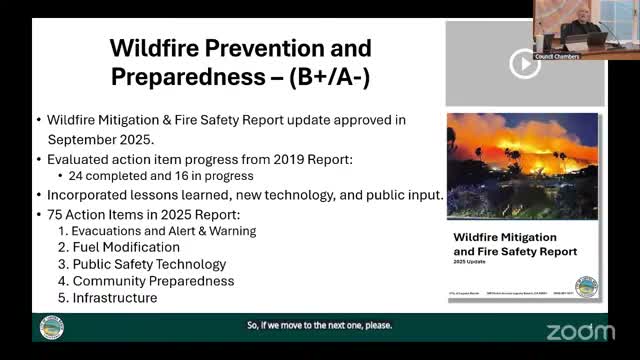
Laguna Beach officials on Jan. 28 highlighted progress on wildfire mitigation and weighed new investments in emergency preparedness and technology.
Emergency operations coordinator Sarah Lemonis said the city completed a 75‑item update to its wildfire action plan and delivered “20 of the short‑term action items” in 2025, including evacuation exercises, expanded red‑flag parking rules and a gap analysis of the outdoor warning system. Police and fire chiefs emphasized the need for improved situational awareness and faster, redundant alerting as fires move more quickly.
Finance and facilities tradeoffs framed the debate over where to place a fully equipped emergency operations center (EOC). Staff presented three options: a roughly $1.0–$1.4 million ready‑to‑roll EOC at the Community Resource Center (CRC); a modest $250,000 upgrade to the City Hall break room to shorten setup time; or a $3 million‑plus permanent addition to City Hall to house a larger, seismically compliant EOC. Council members raised seismic‑safety concerns: staff said City Hall does not meet essential‑facility seismic standards and that a full EOC should accommodate about 44 staff seats versus the current ~20.
Police described expanding Laguna’s decade‑old drone program toward a DFR (drones‑as‑first‑responders) model that can rapidly launch from distributed “pods.” Chief representatives said DFR could give officers near‑instant situational awareness on beaches and in canyons, and partially replace privately contracted beach security (about $400,000 per year today). They cautioned DFR requires capital, ongoing operational funding and procedural coordination with firefighting aircraft and regional partners to avoid airspace conflicts.
Councilmembers asked staff to further refine cost estimates and timelines and to consider EOC choices alongside Fire Station 1 and CRC long‑term planning. Staff said fuel‑mod Zone 19 work (about 27 acres) could be funded locally if grant timing requires it, and asked council for prioritization so staff can prepare a February action report.
The council did not take a formal vote. Staff said next steps include refined cost breakdowns, a recommendation on EOC phasing, and a schedule for bringing fuel‑mod and DFR feasibility options back for direction.
Emergency operations coordinator Sarah Lemonis said the city completed a 75‑item update to its wildfire action plan and delivered “20 of the short‑term action items” in 2025, including evacuation exercises, expanded red‑flag parking rules and a gap analysis of the outdoor warning system. Police and fire chiefs emphasized the need for improved situational awareness and faster, redundant alerting as fires move more quickly.
Finance and facilities tradeoffs framed the debate over where to place a fully equipped emergency operations center (EOC). Staff presented three options: a roughly $1.0–$1.4 million ready‑to‑roll EOC at the Community Resource Center (CRC); a modest $250,000 upgrade to the City Hall break room to shorten setup time; or a $3 million‑plus permanent addition to City Hall to house a larger, seismically compliant EOC. Council members raised seismic‑safety concerns: staff said City Hall does not meet essential‑facility seismic standards and that a full EOC should accommodate about 44 staff seats versus the current ~20.
Police described expanding Laguna’s decade‑old drone program toward a DFR (drones‑as‑first‑responders) model that can rapidly launch from distributed “pods.” Chief representatives said DFR could give officers near‑instant situational awareness on beaches and in canyons, and partially replace privately contracted beach security (about $400,000 per year today). They cautioned DFR requires capital, ongoing operational funding and procedural coordination with firefighting aircraft and regional partners to avoid airspace conflicts.
Councilmembers asked staff to further refine cost estimates and timelines and to consider EOC choices alongside Fire Station 1 and CRC long‑term planning. Staff said fuel‑mod Zone 19 work (about 27 acres) could be funded locally if grant timing requires it, and asked council for prioritization so staff can prepare a February action report.
The council did not take a formal vote. Staff said next steps include refined cost breakdowns, a recommendation on EOC phasing, and a schedule for bringing fuel‑mod and DFR feasibility options back for direction.
Don't Miss a Word: See the Full Meeting!
Go beyond summaries. Unlock every video, transcript, and key insight with a Founder Membership.
✓
Get instant access to full meeting videos
✓
Search and clip any phrase from complete transcripts
✓
Receive AI-powered summaries & custom alerts
✓
Enjoy lifetime, unrestricted access to government data
30-day money-back guarantee
